

Are Vaginal Douches Safe? A Doctor’s Guide to Why You Should Ditch the Douche in 2026
Douching is essentially a biological reset button that deletes your defensive bacteria, leaving your internal environment vulnerable to the very infections you're trying to avoid. As a doctor, I'm frequently asked by patients: are vaginal douches safe for maintaining daily freshness? The clinical reality in 2026 is clear. While the market for these products continues to grow, major medical institutions like the Mayo Clinic and Cleveland Clinic have issued firm warnings that douching disrupts your delicate pH and increases the risk of pelvic inflammatory disease. You're effectively washing away the specialized microorganisms that keep you healthy.
I know how frustrating it is to struggle with persistent odor or the cycle of recurrent BV. It makes sense to want a quick fix for cleanliness, but true freshness comes from cultivation, not eradication. This guide will help you understand the complex mechanics of your vaginal microbiome and why traditional douches do more harm than good. You'll learn the clinical truth about these disruptors and discover doctor-approved alternatives that solve the root cause of odor without compromising your biological balance. Let's look at how you can stay fresh while supporting your body's natural defenses.
Key Takeaways
- Understand why your body functions as a "self-cleaning oven" and how internal washing actually halts your natural biological maintenance.
- Get the clinical answer to the question "are vaginal douches safe" and why modern medical experts link the practice to recurrent infections like BV.
- Learn to identify the "freshness fallacy" where douching traps you in a vicious cycle of odor by evicting your defensive Lactobacilli.
- Discover the doctor-approved protocol for external care that maintains hygiene without disrupting your internal microbiome.
- Follow a 30-day "douche detox" to rebuild your flora and repopulate your system with the specific probiotic strains needed for lasting health.
The Science of the "Self-Cleaning Oven": Why Douching Is a Biological Mismatch
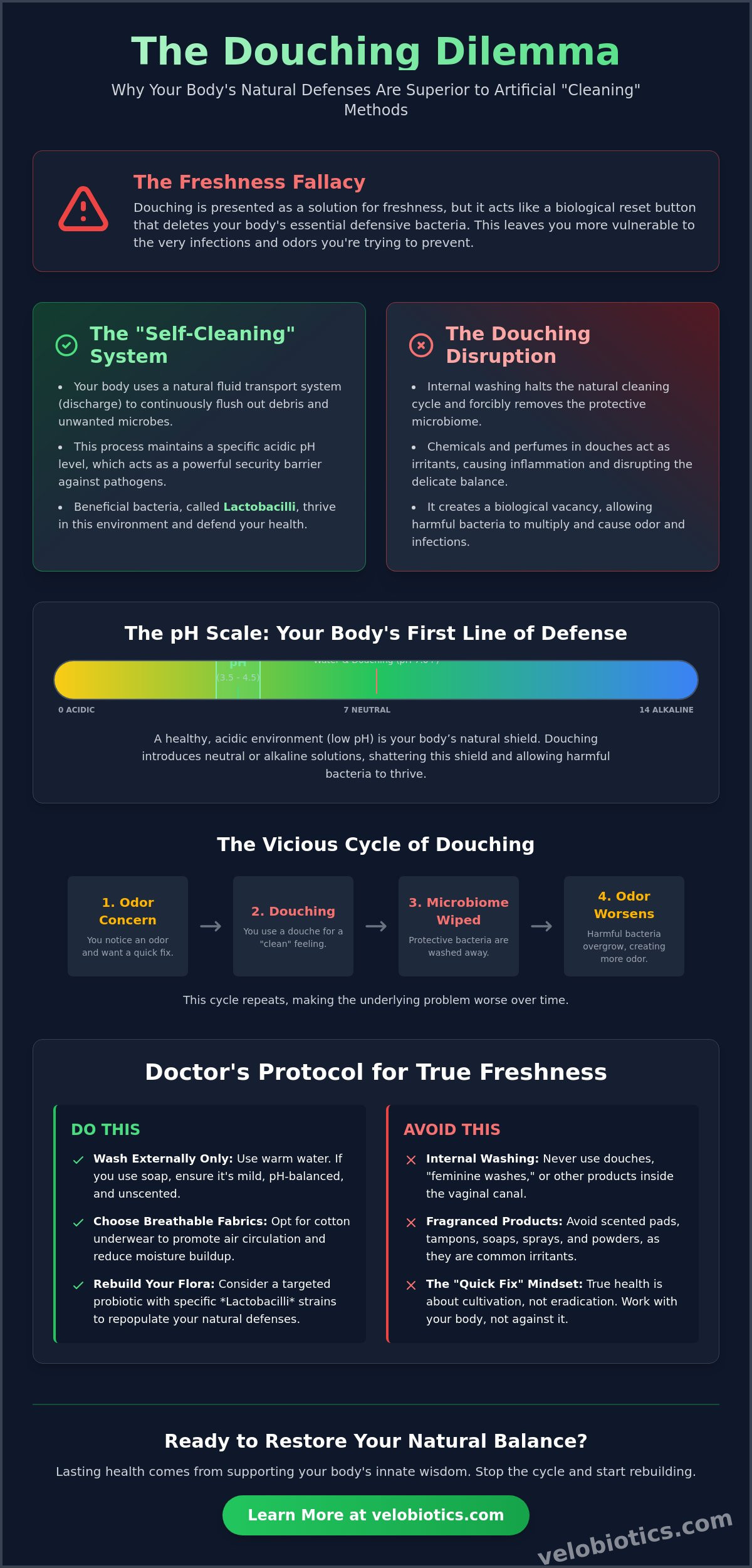
Douching is an intrusive disruption of the vaginal ecosystem that ignores the body's innate ability to regulate itself. When patients ask me, "are vaginal douches safe for a quick refresh?", I point them toward the biological reality of how their bodies actually work. Unlike your skin, which requires external soap to remove environmental grime, the vagina is an internal organ designed to manage its own hygiene. It doesn't need a shower; it needs to be left alone to perform its natural functions.
Think of it as The Science of the "Self-Cleaning Oven". Just as a modern oven uses heat to incinerate spills and keep the interior functional, your body uses a sophisticated fluid-based transport system to flush out debris. Commercial douches marketed with "fresh scents" are a major red flag. Those perfumes are often chemical irritants that signal a fundamental mismatch with your biology, as they prioritize artificial fragrance over functional health.
To better understand why this internal "washing" is so problematic, watch this helpful breakdown:
The Role of Vaginal Discharge
Discharge isn't a problem to be solved; it's your body's primary transport system. It's a healthy mixture of cervical mucus, vaginal fluid, and shed cells that moves from the cervix downward, effectively carrying away unwanted microbes and dead tissue. Healthy "cleaning" discharge is typically clear or white and mostly odorless. If you try to achieve "dryness" through douching, you're essentially stalling this vital conveyor belt. When you remove this moisture, you leave the vaginal walls brittle and prone to micro-tears, which makes it much easier for infections to take root. You can learn more about my commitment to these biological truths in the Velobiotics story.
The pH Scale: Your Vagina’s Security System
The most critical part of your internal defense is your acidity level. A healthy vagina maintains a pH between 3.5 and 4.5. This acidic barrier is your best defense against pathogens. From my perspective as a doctor and researcher, I've seen how easily this security system is breached. Water has a neutral pH of 7.0, and most vinegar-based douches are still far too harsh for the delicate mucosal lining. It's a common misconception that "neutral" products are vaginal douches safe for daily use; in reality, anything that shifts you toward a pH of 7 is a threat. While "neutral" sounds balanced in a marketing brochure, in the context of vaginal health, it's a clinical failure that invites disaster.
The Ripple Effect: How Douching Disarms Your Natural Defenses
When you use a douche, you aren't just rinsing away fluid; you're performing a mass eviction of your most loyal biological defenders. This practice fundamentally disrupts your natural defenses by stripping away the Lactobacilli that keep your environment stable. If you've been wondering are vaginal douches safe for long-term hygiene, the clinical data suggests the opposite. By removing the good bacteria, you create a biological vacancy that harmful pathogens are all too happy to fill. It's a classic case of a short-term "clean" feeling leading to a long-term medical challenge.
Beyond the bacterial loss, there's a mechanical danger known as the vacuum effect. The pressure of the douching liquid can actually push existing bacteria or subclinical infections higher into the reproductive tract. This moves microbes from the vagina into the uterus and fallopian tubes, which significantly increases the risk of Pelvic Inflammatory Disease (PID). Douching increases susceptibility to STIs by stripping away protective mucus and creating microscopic tears in the vaginal epithelium that serve as entry points for viral and bacterial pathogens. These micro-lesions are often invisible, but they provide a direct highway for infection.
Lactobacilli vs. Pathogens
Lactobacilli are your internal antibiotic factory. They produce hydrogen peroxide and lactic acid to kill off invaders and maintain that protective acidic pH we discussed earlier. When douching kills these guards, "squatters" like Gardnerella vaginalis move in, leading to the fishy odor and irritation associated with Bacterial Vaginosis (BV). To break this cycle, I often recommend patients focus on repopulating their system using targeted probiotics for BV to help the good guys regain their territory. Supporting your flora from within is always more effective than trying to "wash" away the symptoms.
Long-term Fertility and Pregnancy Risks
The risks extend deeply into reproductive health and future family planning. Research has consistently linked regular douching to a higher incidence of ectopic pregnancy, where the fertilized egg implants outside the uterus. This is a life-threatening emergency that can permanently damage your fertility. As a doctor, my warning is clear: douching during pregnancy is strictly prohibited. It can lead to preterm birth by weakening the amniotic sac or causing ascending infections that trigger early labor. If you want to support your microbiome safely during this time, consider a high-quality supplement like Femina Probiotic Capsules to maintain balance without the mechanical risks of douching.
The "Freshness" Fallacy: Addressing the Real Reasons You Feel the Need to Wash
We live in a culture that markets "spring rain" and "summer breeze" scents for an organ that is supposed to smell like a healthy, functioning part of the human body. This societal pressure creates a deep sense of "freshness anxiety," leading many to wonder are vaginal douches safe for managing daily scent. The clinical truth is that your vagina should have a natural, slightly musky or tangy aroma. When you attempt to replace this biological signature with artificial fragrances, you aren't just masking a scent; you're actively destabilizing your internal chemistry.
According to the 2026 "State of the Vagina Report," 60% of women surveyed expressed confusion about what a healthy vagina should actually smell like. This confusion is exactly what marketing departments capitalize on. However, doctors recommend you do not douche because the pursuit of an artificial "clean" usually results in a clinical "mess." Reclaiming the definition of clean means moving away from floral scents and toward a balanced, asymptomatic state where your microbiome does the heavy lifting.
The Vicious Cycle of Odor
Douching to stop odor is one of the most counterproductive habits I see in my practice. When you flush the canal, you kill off the aerobic Lactobacilli that keep things fresh. This leaves a vacuum where anaerobic bacteria, which produce foul-smelling compounds as metabolic byproducts, can flourish. This creates a vicious cycle: you douche because you notice an odor, the douche causes an overgrowth of odor-producing bacteria, and the smell returns even stronger 48 hours later. If a scent is fishy or reminds you of something rotting, it's a medical signal of an infection, not a hygiene failure. Masking these signals with fragrance often leads to a secondary yeast infection, as the sugars and chemicals in douches provide the perfect fuel for fungal overgrowth.
Safer Post-Intercourse Hygiene
Many patients feel the urge for a "post-sex flush" to remove semen or lubricants. You don't need to enter the canal to stay hygienic. Follow the "External Only" rule: use warm water and a mild, fragrance-free cleanser on the vulva only. Your internal system will naturally move any remaining fluids out through discharge within a few hours. A far more effective health habit than douching is simply peeing after sex, which helps flush the urethra and prevent UTIs. To maintain your internal equilibrium during times of high activity, I recommend supporting your system from the inside out with Femina Probiotic Capsules. This approach reinforces your natural guards rather than washing them away.
The same logic applies to post-period anxiety. Blood is naturally alkaline, which can slightly shift your pH at the end of your cycle. You don't need to "wash away" the end of your period. Your body's transport system is already on the job. Trust the process, keep the soap on the outside, and let your biology handle the rest.
Beyond the Douche: Safer Alternatives for Intimate Wellness
In 2026, we're finally moving past the era of aggressive internal "cleaning" and entering the age of biological balancing. When patients ask me are vaginal douches safe, they're usually looking for a way to reset their system after their period or intimacy. The mindset shift required is simple: you don't need to scrub your internal tissues. Instead, you need to support the chemical environment that allows your defensive bacteria to thrive. True wellness isn't about being "sterile"; it's about being stable.
The most important rule for 2026 is to keep your cleaning efforts strictly external. Your vulva can handle a gentle wash with warm water, but the moment you introduce liquids into the vaginal canal, you risk the "vacuum effect" we discussed earlier. For a targeted reset that actually respects your biology, I recommend using Femina Probiotic COOKIE FRESH with Boric Acid. This approach manages your pH through biochemical buffering rather than physical flushing.
The Boric Acid Advantage
Boric acid is the clinical gold standard for pH management because it doesn't act as a wash. It's a mild mineral that serves as a pH buffer, gently nudging your environment back into that protective 3.5 to 4.5 acidic range. Unlike liquid douches that are gone in seconds (taking your good bacteria with them), suppositories dissolve slowly. This allows the active ingredients to maintain a sustained presence, creating a hospitable "garden" for your Lactobacilli to return. It's particularly effective after your period, when alkaline blood can leave you feeling less than fresh, or after sex when semen shifts your balance. It provides the reset people want from a douche without any of the clinical risks.
Intimate Hygiene Best Practices
Your vagina loves simplicity. Beyond using targeted pH buffers when needed, your daily routine should focus on external maintenance and environmental factors. I tell my patients that cotton is the "probiotic" of the underwear drawer. Breathable fabrics prevent the trapped moisture that anaerobic, odor-producing bacteria love. You should also avoid the "fragrance trap" found in many modern pads and tampons. Under the Modernization of Cosmetics Regulation Act of 2022 (MoCRA), there's more oversight on these products, but "fragrance" remains a catch-all term for chemicals that can irritate your mucosal lining. Stick to unscented, high-quality materials to keep your security system intact.
Ready to ditch the disruptors and start supporting your natural defenses? You can explore our clinical-grade pH balancing solutions to find a safer way to stay fresh every day.
The Doctor’s Protocol: How to Rebuild Your Flora After Douching
If you have been a serial doucher, your internal garden probably looks more like a desert right now. Recovery is entirely possible, but it requires a structured approach to transition from a state of constant disruption to one of biological stability. When patients realize that the answer to "are vaginal douches safe" is a resounding no, their first question is usually: "How do I fix what I've damaged?" The answer is a 30-day Douche Detox. During this time, you must stop all internal washing to allow your mucosal lining to repair and your natural transport system to restart. You might notice a temporary change in discharge as your body clears out old debris, but this is a sign that your "self-cleaning oven" is back online.
To accelerate this process, you need to focus on probiotic loading. Specific probiotic strains, particularly Lactobacillus crispatus, are essential for recovery because they produce the highest levels of lactic acid and hydrogen peroxide needed to lock out pathogens. You can also support this transition through your diet. Eating high-fiber foods and fermented items like kimchi or unsweetened yogurt provides the prebiotics that feed your good bacteria. Think of it as fertilizing the soil so your defensive guards can take root and stay there.
Re-populating the Microbiome
There is often a debate about oral versus vaginal probiotics for recovery. While suppositories provide a localized pH reset, high-quality oral supplements are incredibly effective for long-term colonization. These beneficial bacteria actually migrate from the gut to the vaginal tract, creating a reservoir of health. The key is selecting high-viability supplements that can survive the journey through your digestive system. I recommend using Femina™ Probiotic Capsules with Cranberry Extract because they are engineered to ensure the bacteria remain active until they reach their destination. Consistency matters here; you are trying to win a numbers game against the "squatter" bacteria that moved in while you were douching.
Lifestyle Adjustments for Lasting Freshness
Beyond supplements, your daily habits dictate the volume and quality of your healthy discharge. Hydration is non-negotiable. If you are dehydrated, your cervical mucus becomes thick and less effective at flushing out dead cells. You should also be mindful of stress management. High cortisol levels can deplete the glycogen stores in your vaginal walls, which is the primary food source for your Lactobacilli. When you starve your good bacteria, your pH fluctuates, and odor returns.
My final piece of doctor's advice is simple: trust your body. It has spent thousands of years evolving a perfect system for staying clean and protected. Once you stop the cycle of douching and start supporting your flora, your biology will find its own balance. You don't need a bottle of "summer breeze" to be healthy; you just need to give your microbiome the tools it needs to defend itself.
Empowering Your Natural Defenses
Understanding the clinical reality of your microbiome is the first step toward lasting freshness. We've established that douching acts as a biological reset button that deletes your defensive bacteria, often leading to a cycle of recurrent infections. When you ask are vaginal douches safe, remember that true health comes from supporting your body's pH rather than physically flushing it. It's time to move from a mindset of internal washing to one of biological cultivation.
As a doctor, I've designed our protocols to target odor and pH at the source without harming your beneficial Lactobacilli. Our products utilize advanced micro-encapsulation for maximum viability, ensuring that the active ingredients actually reach the internal environment where they're needed most. This scientific approach solves the root cause of imbalance while protecting your system. You can restore your balance the right way with Femina Cookie Fresh Probiotic & Boric Acid Suppositories and finally break the douching cycle.
Trust your body's innate ability to maintain its own hygiene. With the right clinical support and a focus on biological stability, you'll achieve the lasting comfort and confidence you deserve.
Frequently Asked Questions
Is it safe to douche with just water?
No, douching with plain water is still clinically disruptive because water has a neutral pH of 7.0. Your internal environment must remain acidic, typically between 3.5 and 4.5, to keep pathogens at bay. When you use water, you dilute the natural lactic acid and flush out the protective Lactobacilli that act as your primary defense system.
Can douching cause bacterial vaginosis (BV)?
Yes, douching is a major risk factor for developing BV because it creates a biological vacancy. When the defensive bacteria are washed away, harmful anaerobic bacteria "squat" in the empty space and overgrow. This leads to the characteristic fishy odor and gray discharge that many people mistakenly try to wash away with even more douching.
How should I clean my vagina if I can’t douche?
You should focus exclusively on the external vulva using warm water and your hand. The internal canal is a self-cleaning organ that uses discharge as a transport system to move dead cells and microbes out naturally. There's no clinical reason to reach inside; your body is already performing its own maintenance around the clock.
What happens if I douche during my period?
Douching during your period can push menstrual blood and bacteria back up into your uterus and fallopian tubes. This increases the risk of pelvic inflammatory disease and other ascending infections. Your period is already a natural flushing process, so interfering with it only destabilizes your chemistry when it's most vulnerable.
Can douching prevent pregnancy after sex?
No, douching is not a form of birth control and is completely ineffective at preventing pregnancy. In many cases, the pressure from the liquid can actually push sperm further toward the cervix, making pregnancy more likely. It's a dangerous myth that provides a false sense of security while increasing your risk of infection.
Will douching help get rid of a yeast infection?
No, douching usually worsens a yeast infection by removing the bacteria that naturally keep yeast populations in check. While you might feel a few minutes of relief from the cooling liquid, the disruption allows the fungus to grow even more aggressively. Clinical treatments or pH buffers are much more effective than mechanical rinsing.
What are the signs that douching has damaged my flora?
Common signs include a persistent odor that returns shortly after washing, unusual discharge, or chronic itching and irritation. If you're wondering are vaginal douches safe because you're trapped in a cycle of recurrent infections, your flora is likely compromised. You might also notice that you've become more sensitive to soaps or lubricants than you used to be.
Are "natural" douches with vinegar and water safer than store-bought ones?
No, "natural" DIY mixtures are still fundamentally incompatible with your internal biology. Vinegar is highly acidic, but it doesn't provide the sophisticated pH buffering your body requires to stay healthy. These home remedies still cause the same mechanical "vacuum effect" that pushes pathogens into your upper reproductive tract, regardless of the ingredients used.

Disclaimer
Information and statements regarding dietary supplements/products have not been evaluated by the Food and Drug Administration, MCC/SAHPRA, MHRA, TGA or any other drug regulatory authority and are not intended to diagnose, treat, cure, or prevent any disease. Information on this website is provided for informational purposes only and is a result of years of practice and experience by the author. This information is not intended as a substitute for the advice provided by your physician or other healthcare professional or any information contained on or in any product label or packaging. Do not use the information on this website for diagnosing or treating a health problem or disease, or prescribing medication or other treatment. Always speak with your physician or other healthcare professional before taking any medication or nutritional, herbal, or homeopathic supplement, or using any treatment for a health problem. If you have or suspect that you have a medical problem, contact your healthcare provider promptly. Do not disregard professional medical advice or delay in seeking professional advice because of something you have read on this website.