

Best Time to Take Collagen Peptides: Doctor's Guide
Could your morning coffee be sabotaging your expensive skin routine? Many people assume that simply swallowing a capsule is enough, but the physiological reality is far more complex. Determining the best time of day to take collagen peptides isn't just about convenience; it's about aligning with your body's natural circadian rhythms and metabolic windows. With your body's natural collagen production slowing by roughly 1% every year starting in early adulthood, you can't afford to ignore the science of biological viability.
I understand the frustration of seeing conflicting advice online that leaves you wondering if you're wasting your investment. A 2026 umbrella review of 113 randomized controlled trials confirms that collagen provides measurable benefits for skin and joints, but these results depend on consistent, strategic delivery. In this guide, I'll show you how to identify the scientifically optimal window for your specific health goals, whether you're targeting gut repair or skin elasticity. We'll explore the mechanisms behind peptide absorption and provide a practical, evidence-based schedule to ensure your supplement actually reaches the tissues that need it most. By the end, you'll have a clear, clinical roadmap to maximize every gram of protein you consume.
Key Takeaways
- Understand why daily consistency is the non-negotiable foundation for results, while specific timing acts as a clinical "tuning knob" to align with your body's natural repair cycles.
- Discover why the best time of day to take collagen peptides for joint support is actually 30 to 60 minutes before movement to maximize nutrient delivery to your connective tissues.
- Learn how to choose between a morning dose for antioxidant skin protection and an evening dose to support the intensive cellular regeneration that occurs while you sleep.
- Identify the critical co-factors, like Vitamin C and a balanced gut microbiome, that determine whether your collagen is successfully absorbed or simply wasted by your digestive system.
- Master the "habit stacking" method to seamlessly integrate collagen into your existing routine, ensuring you maintain the 90-day window required for visible physiological changes.
Does Timing Really Matter? The Truth About Collagen Absorption
One of the most frequent questions I get in the clinic is whether taking your supplement at 8:00 AM versus 8:00 PM actually changes the biological outcome. It's a valid concern. You're investing in your health, and you don't want your peptides to end up as expensive waste. To understand the best time of day to take collagen peptides, we first have to look at what collagen is on a molecular level. It's a complex structural protein that provides the framework for your skin, bones, and connective tissues.
The short answer is that consistency beats timing every single time. While specific windows can "tune" your results for skin or joints, the most important factor is ensuring your body has a steady supply of amino acids to draw from. Your body processes these peptides by breaking them down into individual amino acids and small chains called dipeptides and tripeptides. These then travel through your bloodstream to the "construction sites" that need them most, like a sagging dermis or a worn-down knee joint.
To better understand the physiological impact of timing and how it relates to your goals, watch this helpful breakdown:
The Myth of Stomach Acid Destruction
Some "wellness gurus" claim that taking collagen with food is a mistake because stomach acid will destroy the peptides. This is a fundamental misunderstanding of human physiology. Your stomach is a highly efficient processing plant, not a graveyard for nutrients. In fact, hydrolyzed collagen peptides are already "pre-digested" into smaller chains through enzymatic hydrolysis. The acid in your gut doesn't "kill" the collagen; it simply prepares these peptides for the small intestine, where the real magic of absorption happens. This concept, known as bioavailability, refers to the proportion of the nutrient that actually enters your systemic circulation. Whether your stomach is empty or full, those peptides are remarkably resilient.
Consistency: The Unsung Hero of Collagen
Your body didn't lose its structural integrity overnight, and it won't rebuild it in a week. Current scientific data suggests that collagen levels typically take 4 to 12 weeks of daily use to show measurable changes in skin elasticity or joint comfort. It's a cumulative process. Think of it like filling a leaky bucket; you need a constant drip of high-quality protein to keep the levels high. If you miss days, you're essentially letting the bucket drain.
When patients ask about the best time of day to take collagen peptides, I always remind them that the clock matters far less than the calendar. My best doctor's tip for never missing a dose? Tie it to an existing habit, like your first glass of water or your evening tea. When you remove the friction of remembering, you secure the long-term benefits that only daily repetition can provide.
Morning vs. Night: Choosing Your Collagen Window
While the previous section established that consistency is the non-negotiable foundation of any supplement routine, the specific hour you choose can act as a physiological catalyst. Determining the best time of day to take collagen peptides often comes down to your personal lifestyle and primary health objectives. In my clinical experience, patients usually fall into two camps: those who need a metabolic boost to start their day and those who prioritize structural repair while they sleep. Both approaches are scientifically valid, but they offer distinct biological advantages.
The Morning Ritual: Energy and Satiety
Starting your day with collagen is an excellent strategy for metabolic health. Adding a high-quality protein source to your breakfast helps stabilize blood sugar levels, preventing the mid-morning insulin spike and subsequent crash that leads to "brain fog." Many of my patients enjoy stirring their peptides into oatmeal or a morning smoothie for an effortless protein hit. A common concern is whether the heat from a morning latte will destroy the protein. You can rest easy; collagen peptides are thermally stable up to approximately 300°C, which is far hotter than your standard brew. Research on collagen supplements suggests that as long as the peptides are hydrolyzed, your body can utilize them effectively regardless of the carrier liquid's temperature.
The Nighttime Repair: Skin and Joint Recovery
While the morning is about energy, the evening is about restoration. Your body enters a state of intensive cellular repair during REM sleep, making the hours before bed a prime window for structural protein synthesis. Collagen is uniquely high in glycine, an amino acid that serves two vital functions at night. First, it provides the building blocks for skin and joint recovery. Second, glycine acts as an inhibitory neurotransmitter that can help lower your core body temperature, signaling to your brain that it's time to rest. This is why athletes often prefer an evening routine; it supports the best time of day to take collagen peptides for muscle and connective tissue recovery after a day of physical stress.
If you're still undecided on which window fits your life, remember that your gut health plays a massive role in how well these proteins are actually utilized. To ensure your body is primed for maximum absorption, you might consider how a scientifically formulated probiotic can support your digestive landscape and enhance peptide delivery.
Goal-Based Timing: When to Take Collagen for Specific Results
The generic advice you often find online suggests that timing doesn't matter as long as you're consistent. While consistency is your foundation, ignoring the specific biological goals you have is a missed opportunity for optimization. The best time of day to take collagen peptides actually shifts depending on whether you're trying to fix a "leaky" gut, soothe creaky knees, or maintain a youthful glow. By treating timing as a tactical tool, you can align your supplement intake with the specific physiological processes you want to support.
For those focused on the mirror, the morning is your primary window. UV radiation from the sun triggers oxidative stress that breaks down your skin's structural integrity throughout the day. By taking Type I collagen in the morning, you provide your body with a fresh pool of amino acids to help mitigate this daily environmental damage. Current collagen for joint and skin health research highlights how these peptides support the dermal matrix when utilized correctly. It's not just about vanity; it's about providing the raw materials for cellular defense.
Conversely, if you're managing digestive issues, an evening dose is superior. Your intestinal lining undergoes significant repair while you're in a fasted, sleeping state. Providing the specific amino acids required for this "patchwork" during your evening wind-down supports the integrity of your gut barrier. If you find yourself reaching for snacks at 3:00 PM, collagen can also serve as a functional bridge. Because it's a pure protein, it triggers satiety hormones that tell your brain you're full. For those specifically targeting metabolic health, products like the GutSlim Probiotics Tummy Toner can further enhance this satiety effect through gut-brain axis support.
The Beauty Window: Protecting Your Glow
Think of your morning collagen as the internal companion to your topical Vitamin C serum. While the serum protects from the outside, the ingested peptides build from the inside. This dual-action approach ensures that the best time of day to take collagen peptides for aesthetics is right alongside your breakfast. It's about creating a sustained supply of building blocks that your skin cells can tap into during peak daylight hours when environmental stress is at its highest.
The Athlete's Window: Pre-Workout vs. Post-Workout
Joint health requires a different tactical approach. You should aim to consume your collagen roughly 30 to 60 minutes before physical activity. This isn't about muscle growth; it's about mechanical "loading." When you exercise, blood flow to your connective tissues increases, helping to drive those peptides directly into the cartilage and tendons that need them most. It's a perfect complement to your existing whey protein, which you likely save for post-workout recovery to repair muscle fibers rather than connective tissue.
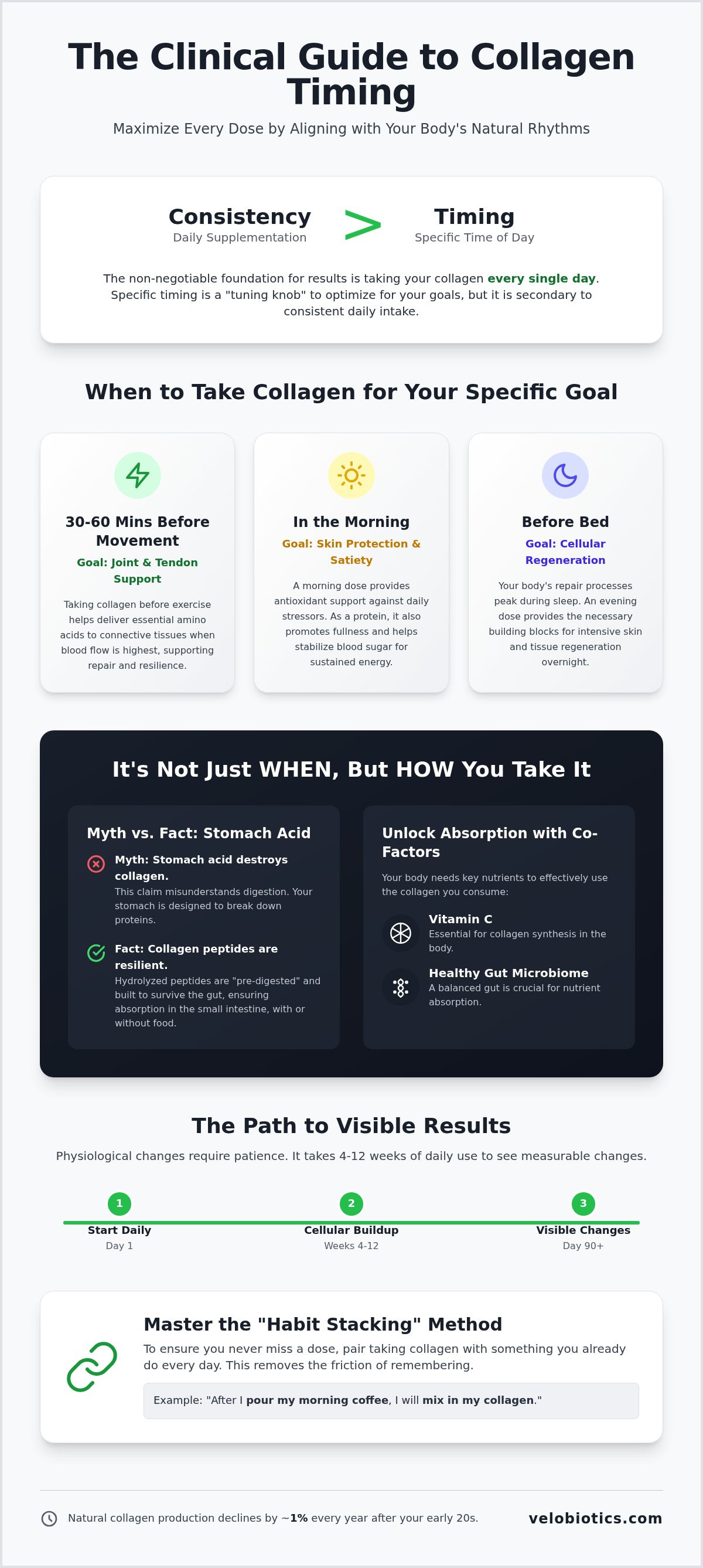
Maximizing Bioavailability: It’s Not Just When, But How
Even if you pinpoint the absolute best time of day to take collagen peptides, your effort is wasted if your body's delivery system is offline. Bioavailability is the percentage of a nutrient that actually enters the bloodstream. To maximize this, you need to look beyond the clock and focus on the internal environment where absorption happens. I often tell my patients that collagen doesn't work in a vacuum; it requires specific biological partners to transform from a swallowed capsule into a glowing complexion or a resilient joint.
One of these partners is Vitamin C. Think of it as the clinical "glue" that allows your body to cross-link amino acids into sturdy collagen fibers. Without it, your body struggles to synthesize the protein, regardless of how many peptides you ingest. You should also be mindful of "collagen competition." If you take your supplement alongside a massive 30-gram protein shake, the specific receptors in your small intestine can become overcrowded, slowing down the uptake of those specialized collagen sequences.
The Gut-Skin Axis Explained
Your gut is the gatekeeper of your beauty and structural health. If your microbiome is out of balance, inflammation can block the absorption of vital nutrients, a phenomenon often visible as dullness or irritation on your face. My doctor's secret for optimizing this process is a 16-strain probiotic approach. Using velo16-probiotic-digestive-capsules helps stabilize the intestinal environment, ensuring your peptides aren't just passing through but are actually being utilized. When your gut is healthy, your body can direct those amino acids to the "construction sites" that need them most, from your dermis to your gut lining itself.
Optimal Pairings for Your Daily Dose
To boost your daily results, pair your collagen with nutrient-dense foods like citrus fruits, berries, and leafy greens. These provide the natural cofactors your cells crave for structural repair. However, avoid mixing your peptides into high-sugar drinks or processed snacks. Sugar triggers glycation, a process where sugar molecules bind to proteins and effectively "caramelize" them, making your collagen fibers stiff and prone to breaking. If you want to ensure your supplements are actually reaching their destination, you should choose a delivery system engineered for maximum viability.
- Citrus and Berries: High in Vitamin C to support fiber cross-linking.
- Leafy Greens: Provide chlorophyll and antioxidants to protect existing collagen.
- Avoid High Sugar: Prevents glycation from damaging your protein structure.
Creating a Collagen Habit That Sticks
Knowing the best time of day to take collagen peptides is a clinical advantage, but that knowledge is useless without a sustainable routine. Most of my patients start with great intentions but lose momentum by day ten. To prevent this, I recommend the "Habit Stacking" method. This involves anchoring your supplement to a behavior you already perform automatically, like checking your morning emails or setting your alarm at night. By piggybacking on an existing neural pathway, you bypass the need for willpower and ensure your body receives the steady supply of amino acids it needs for structural repair.
Travel is another common hurdle for maintaining structural protein levels. When you're on the go, your gut microbiome often takes a hit from different foods and environmental stress, which in turn affects your skin's vitality. I always suggest keeping a travel-sized stash in your carry-on. If you're flying, take your dose before boarding to help manage the oxidative stress of travel and cabin air. To see if your routine is working, keep a simple 30-day diary. Track your morning joint stiffness on a scale of 1 to 10 and note any changes in skin hydration or hair texture. This quantifiable data provides the motivation to keep going when the initial excitement of the routine wears off.
Practical Tips for the Busy Professional
If you spend ten hours a day at a desk, the kitchen counter isn't the most effective place for your supplements. Keep a bottle at your workstation so it's visible during your most productive hours. For those with zero time for mixing powders, capsules are the logical choice for maximum efficiency. They provide the same biological viability without the mess of a shaker bottle. Shop our Probiotic Collagen Peptides at Velobiotics to find a format that fits your pace. Our approach simplifies your life by combining 16 strains of probiotics with Type I and II collagen, addressing both structural integrity and digestive health in one step.
What to Expect: The Timeline of Transformation
Transformation doesn't happen in a single dose; it's a biological progression that requires patience. Around week two, you'll likely notice improved digestion and a better sense of satiety after meals. By week four, many of my patients report that their nails feel less brittle and their hair looks more hydrated. However, the real results emerge at the three-month mark. This is the clinical gold standard for seeing significant improvements in joint comfort and skin elasticity. Stick with your chosen best time of day to take collagen peptides for at least 90 days to allow your cellular turnover to reflect your hard work.
Take Control of Your Structural Health Today
Understanding the best time of day to take collagen peptides is more than just a scheduling choice; it's a clinical strategy to align with your body's natural repair cycles. We've established that while consistency provides the foundation, tactical timing for morning skin protection or nighttime joint recovery can amplify your results. However, remember that even the perfect schedule fails if your gut isn't primed for absorption. By focusing on biological viability and the synergy between probiotics and proteins, you ensure every dose counts toward your long-term wellness.
If you're ready to move past the confusion of conflicting advice, choose a solution that prioritizes science over trends. You can optimize your gut and skin health with Velobiotics Collagen Peptides. Our doctor-formulated system utilizes a unique 16-strain probiotic delivery system to ensure maximum viability of our Non-GMO, clinically backed ingredients. You now have the tools and the timeline to see real transformation. Start your 90-day journey today and watch your body respond with the resilience and glow you deserve.
Frequently Asked Questions
Can I take collagen peptides on an empty stomach?
Yes, taking collagen on an empty stomach is perfectly safe and won't diminish its effectiveness. Some people find this is the best time of day to take collagen peptides because it ensures there's no competition with other proteins for absorption in the small intestine. While stomach acid is highly acidic, it acts to prepare the hydrolyzed peptides for uptake rather than destroying them. If you have a sensitive digestive system, taking it with a small snack is equally effective.
Does taking collagen at night help you sleep better?
Taking collagen in the evening can support better sleep quality due to its high glycine content. Glycine is an amino acid that acts as an inhibitory neurotransmitter, helping to calm the central nervous system and lower your core body temperature. This physiological shift signals to your brain that it's time for deep, restorative rest. It's a practical way to support both your structural repair and your circadian rhythm simultaneously without using heavy sedatives.
How many scoops of collagen peptides should I take daily?
Most clinical studies show benefits at a dosage of 10 to 20 grams per day. If you're using a product like our Almasi Probiotics Collagen Powder, this typically equates to one or two scoops depending on the specific serving size. For those using capsules, such as our 16-strain probiotic collagen blend, following the label's recommended serving ensures you receive a precise dose of both Type I and II collagen alongside beneficial bacteria for optimal gut health.
Is it okay to put collagen powder in hot tea or coffee?
Yes, you can absolutely add collagen to your hot beverages without losing any nutritional value. Collagen peptides are thermally stable and don't denature until temperatures reach approximately 300°C, which is significantly higher than a standard cup of coffee or tea. This makes it a very versatile supplement for busy professionals who want to stack their health habits with their morning caffeine ritual without worrying about protein degradation or clumping in cold liquids.
Can I take collagen while intermittent fasting?
Technically, collagen will break a strict fast because it contains calories and protein, which can trigger an insulin response. However, if your goal for intermittent fasting is weight management rather than strict autophagy, a "dirty fast" including collagen might be acceptable. The protein helps maintain satiety and protects muscle mass during your fasting window. If you're doing a strict water fast for medical reasons, it's better to save your collagen for your first meal.
Does collagen help with bloating or gut issues?
Collagen is highly effective for gut health because it contains amino acids like glutamine and glycine that help "seal" the intestinal lining. When combined with a 16-strain probiotic blend, it addresses the root causes of bloating by balancing the microbiome and strengthening the gut barrier. This dual-action approach prevents undigested food particles from leaking into the bloodstream, which is a common trigger for systemic inflammation and the digestive discomfort often associated with "leaky gut."
What is the difference between Type I and Type II collagen for timing?
The main difference lies in your target tissue. Type I collagen is the primary building block for skin, hair, and nails, making it a great addition to your morning routine for all-day protection. Type II collagen is specific to cartilage and joint health. For the best results with Type II, the best time of day to take collagen peptides for your joints is roughly 30 to 60 minutes before physical activity to ensure nutrients reach your cartilage.
Should I take collagen and probiotics at the same time?
Taking collagen and probiotics together is actually the preferred clinical method for maximum results. Probiotics improve the health of your intestinal villi, which are the tiny structures responsible for nutrient absorption. By taking them together, you're essentially fixing the "gatekeeper" of your gut while simultaneously providing the raw materials for repair. This synergy is why our 16 Strains Probiotics Collagen Peptides are designed as a single, high-viability delivery system for your daily routine.

Disclaimer
Information and statements regarding dietary supplements/products have not been evaluated by the Food and Drug Administration, MCC/SAHPRA, MHRA, TGA or any other drug regulatory authority and are not intended to diagnose, treat, cure, or prevent any disease. Information on this website is provided for informational purposes only and is a result of years of practice and experience by the author. This information is not intended as a substitute for the advice provided by your physician or other healthcare professional or any information contained on or in any product label or packaging. Do not use the information on this website for diagnosing or treating a health problem or disease, or prescribing medication or other treatment. Always speak with your physician or other healthcare professional before taking any medication or nutritional, herbal, or homeopathic supplement, or using any treatment for a health problem. If you have or suspect that you have a medical problem, contact your healthcare provider promptly. Do not disregard professional medical advice or delay in seeking professional advice because of something you have read on this website.