
Boric Acid for Yeast Infection: A Doctor's Guide (2026)
Your doctor prescribed the antifungal cream. You tried it. Then you tried it again. And somehow, that relentless itch is still there, mocking every over-the-counter solution you've thrown at it. If standard treatments have failed you, you're not imagining things, and you're definitely not alone. Some yeast strains, particularly Candida glabrata, are simply resistant to conventional antifungals, and no amount of Monistat will change that biological reality.
Here's what you already suspect: there has to be something better. You're right. Boric acid suppositories have decades of clinical evidence behind them, and understanding exactly how to use boric acid for yeast infection treatment, safely and strategically, is the knowledge that separates a one-time fix from a genuine, lasting recovery.
In this guide, I'll walk you through the precise protocols I recommend to my own patients: the correct dosage, the safety boundaries you must respect, and why clearing the infection is only half the battle. Restoring your vaginal flora is the other half, and it's the part most guides completely ignore.
Key Takeaways
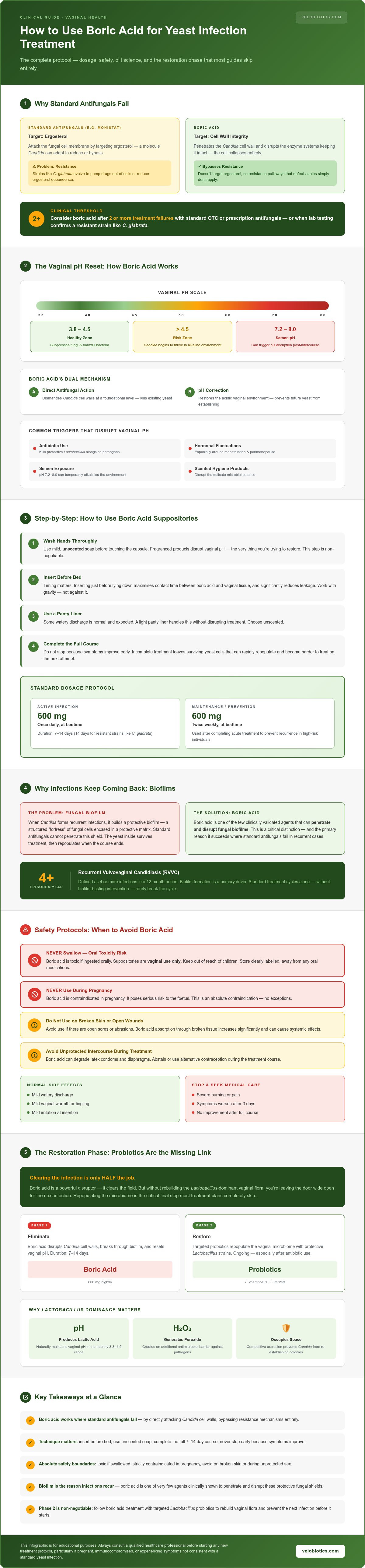
- Boric acid works where standard antifungals fail by directly attacking Candida cell walls — making it a clinically validated option for resistant strains like Candida glabrata.
- Knowing exactly how to use boric acid for yeast infection treatment — including timing, dosage, and hygiene protocols — is the difference between a temporary fix and a complete recovery.
- Boric acid is powerful but carries serious safety boundaries: it is toxic if swallowed and must never be used during pregnancy.
- Recurrent infections are often driven by fungal biofilms, and boric acid is one of the few agents clinically shown to break through these protective shields.
- Clearing the infection is only half the job — rebuilding your Lactobacillus-dominant vaginal flora through targeted probiotics is the critical final step most treatment plans skip entirely.
What is Boric Acid and Why Does it Work for Yeast?
Boric acid is a white, crystalline compound derived from boron, a naturally occurring element found in soil, water, and certain foods. It's been used in medicine for well over a century, but its application in vaginal health is where it genuinely earns its reputation. At its core, boric acid is a weak acid with potent antifungal and antiviral properties, and understanding why it works is the key to using it with confidence.
Here's the mechanism that matters: boric acid disrupts the integrity of the Candida cell wall. Fungal cells depend on a structurally stable outer membrane to survive, grow, and replicate. Boric acid interferes with that stability by penetrating the cell wall and disrupting the fungal enzyme systems that keep it intact. The result? The yeast cell can no longer maintain its structure and dies. It doesn't negotiate with the fungus. It dismantles it at a foundational level.
Boric Acid vs. Standard Antifungals
Standard antifungals like clotrimazole (the active ingredient in Monistat) work by targeting a molecule called ergosterol, which is essential to fungal cell membrane function. For years, this approach worked well. The problem is that Candida is adaptive. Strains like Candida glabrata have evolved mechanisms to reduce their dependence on ergosterol or to pump antifungal drugs out of their cells before they can cause damage. This is antifungal resistance, and it's a clinically documented, growing reality.
Boric acid bypasses this resistance entirely. Because it doesn't target ergosterol, the resistance pathways that render azole antifungals ineffective simply don't apply. This is exactly why clinicians typically recommend exploring boric acid when a patient has experienced two or more treatment failures with standard OTC or prescription antifungals, or when lab testing identifies a resistant strain like C. glabrata.
The Role of Vaginal pH in Yeast Overgrowth
Think of your vaginal environment as a finely tuned ecosystem with a very specific operating range. A healthy vaginal pH sits between 3.8 and 4.5, a mildly acidic zone that actively suppresses the growth of harmful bacteria and fungi. When that pH climbs above 4.5, becoming more alkaline, the environment shifts in favour of opportunistic organisms. Candida thrives in this alkaline window.
This is where boric acid functions as a genuine pH reset. When introduced vaginally, it lowers the local pH back into that protective acidic range, creating a hostile environment for fungal overgrowth. It's not just killing yeast that's already there; it's reconfiguring the environment so yeast can't establish itself in the first place. Understanding this dual mechanism, direct antifungal action combined with pH correction, is fundamental to understanding how to use boric acid for yeast infection treatment strategically rather than reactively.
Common triggers that push vaginal pH out of its healthy range include:
- Antibiotic use: kills protective Lactobacillus bacteria alongside harmful pathogens
- Hormonal fluctuations: particularly around menstruation and perimenopause
- Semen exposure: which has a naturally alkaline pH of around 7.2 to 8.0
- Scented hygiene products: which disrupt the delicate microbial balance
Addressing pH isn't a side benefit of boric acid treatment. It's a central part of why it works when nothing else does.
Step-by-Step: How to Use Boric Acid Suppositories Safely
Knowing that boric acid works is one thing. Knowing exactly how to use it is another. The clinical evidence is compelling, but technique matters more than most people realise, and small errors in application can undermine an otherwise effective treatment course.
Start with the basics: wash your hands thoroughly with a mild, unscented soap before you even touch the capsule. This isn't optional hygiene theatre. Introducing external bacteria into the vaginal canal during treatment actively works against what you're trying to achieve. Unscented soap is the non-negotiable detail here, because fragranced products can disrupt the very pH environment you're trying to restore.
Timing is straightforward but worth being deliberate about. Insert the suppository just before bed. Lying down for several hours maximises the contact time between the boric acid and the vaginal tissue, and it significantly reduces the leakage that can occur when you're upright and active. Think of it as working with gravity rather than against it.
For an active infection, the standard clinical protocol is one 600mg suppository once daily for 7 to 14 days. Seven days is typically sufficient for straightforward cases; 14 days is the recommended course for resistant strains like Candida glabrata. Completing the full course is non-negotiable. Stopping early because symptoms improve is the most common reason infections return.
Preparation and Application Tips
You don't need a dedicated applicator, though one can make the process easier if you're uncomfortable with finger insertion. Using a clean index finger works perfectly well for most people. Insert the capsule to roughly the depth of your finger, similar to inserting a tampon without an applicator. Position matters too: squatting slightly or lying on your back with knees bent both work well. Try both and use whichever feels most comfortable and controlled for you. Consistency across the full treatment window is what drives results, not any single perfect application.
Managing Leakage and Discharge
Expect watery discharge. This is normal, not a sign that something's wrong. It's simply the gelatin capsule dissolving and the boric acid dispersing. Wear a panty liner for the first 12 hours after each application to manage this comfortably. Avoid sexual intercourse for the entire treatment period; the local tissue is already under stress, and penetration can cause irritation and potentially disrupt the treatment environment you're carefully maintaining.
Understanding how to use boric acid for yeast infection treatment correctly, from hand hygiene through to completing the full course, is genuinely half the clinical battle. If you're looking for a formulation that pairs the standardised 600mg boric acid dose with targeted probiotic support, the Femina Probiotic COOKIE FRESH suppositories are worth examining as a combined-approach option.
Safety Protocols: When to Avoid Boric Acid
Boric acid is clinically effective precisely because it's chemically potent. That potency demands respect. Understanding how to use boric acid for yeast infection treatment safely isn't a footnote in the process — it's the foundation of the entire protocol. Get the application right and you have a powerful therapeutic tool. Ignore the safety boundaries and you have a genuinely dangerous substance.
The single most critical rule: boric acid is for vaginal use only, never oral ingestion. This cannot be overstated. Swallowing even a small amount can cause serious systemic toxicity. Symptoms of oral ingestion include nausea, vomiting, abdominal pain, and in severe cases, circulatory collapse. If accidental ingestion occurs, contact Poison Control immediately. Store suppositories in a clearly labelled container, away from children and pets, and treat them with the same caution you'd apply to any prescription medication.
Pregnancy is an absolute contraindication. Boric acid carries documented risks of fetal harm, and no infection severity justifies that risk. If you're pregnant, or if there's any possibility you could be, stop and speak with your OB-GYN before considering this treatment.
Contraindications and Risks
Open wounds, sores, or ulcerations on vaginal tissue change the safety calculation entirely. Intact tissue provides a protective barrier that limits systemic absorption of boric acid. Broken tissue removes that barrier, creating a pathway for the compound to enter the bloodstream at concentrations that can cause harm. If you have any visible lesions, active herpes outbreaks, or significant tissue damage from scratching, hold off on treatment and get a clinical assessment first.
Avoid combining boric acid suppositories with tampons or vaginal douches during treatment. Tampons physically absorb the compound before it can work, reducing efficacy. Douching disrupts the pH environment you're actively trying to restore. These aren't minor inconveniences to work around — they undermine the mechanism you're relying on.
Mild, transient burning or watery discharge during the first few days of treatment is normal, particularly if vaginal tissue is already inflamed. What's not normal is escalating pain, significant swelling, or a rash spreading beyond the vaginal area. That pattern suggests an allergic reaction, not routine irritation, and it warrants stopping treatment immediately.
When to Call Your Doctor
Knowing when to escalate is as important as knowing how to use boric acid for yeast infection treatment in the first place. Call your doctor if:
- Symptoms persist after a full 14-day course: this may indicate a mixed infection, a bacterial component, or a strain requiring a different treatment approach entirely.
- You develop fever, pelvic pain, or pain during urination: these symptoms can indicate Pelvic Inflammatory Disease (PID), a serious upper reproductive tract infection that boric acid won't touch and that requires prompt antibiotic treatment.
- Discharge changes colour or develops a strong odour mid-treatment: this suggests a bacterial infection may be present alongside the fungal one.
- You experience hives, significant swelling, or difficulty breathing: these are signs of a systemic allergic reaction requiring immediate medical attention.
The distinction between a persistent yeast infection and PID matters enormously. PID originates higher in the reproductive tract, involving the uterus, fallopian tubes, or ovaries, and it shares some surface-level symptoms with a stubborn vaginal infection. Pelvic pressure, fever, and pain during intercourse that doesn't resolve with antifungal treatment are the clinical red flags that should send you to a doctor, not a pharmacy.
Addressing Recurrent Infections: The Long-Term Plan
Clearing an active infection is one problem. Stopping it from coming back every six weeks is a completely different one. If you've experienced three or more yeast infections in a single year, the issue almost certainly isn't that you're not treating correctly. It's that you're not treating the right target.
The hidden culprit in recurrent infections is the biofilm. Candida is extraordinarily adaptive, and under the right conditions, it shifts from free-floating yeast cells into a structured, multi-layered colony encased in a self-produced protective matrix. Think of it as the fungal equivalent of a fortified bunker. Standard antifungals struggle to penetrate this matrix at all, which is why some patients find themselves in an exhausting cycle of temporary relief followed by inevitable relapse. Boric acid disrupts biofilm architecture directly, breaking down the structural integrity of that protective shield and exposing the colony to elimination. It's one of the few agents with documented biofilm-disrupting activity, which is precisely why understanding how to use boric acid for yeast infection treatment as a long-term strategy, not just an acute fix, changes the clinical picture entirely.
The Maintenance Protocol
Once you've completed a full acute treatment course, the transition to maintenance dosing is the step most people skip entirely. For chronic or recurrent cases, the clinically supported approach is two suppositories per week for up to six months. This isn't about keeping the infection suppressed indefinitely; it's about maintaining a consistently acidic vaginal pH during the window when your flora is still re-establishing itself.
Timing those twice-weekly doses strategically matters. Inserting a suppository at the end of your menstrual period is particularly effective. Menstrual blood has a naturally alkaline pH, and this temporary shift is one of the most reliable triggers for post-period flares. Correcting pH in that specific window closes a recurring vulnerability. Stopping maintenance too early, even when you feel completely symptom-free, is the primary driver of what clinicians call rebound infection: the biofilm remnants that survived treatment repopulate rapidly when the inhibitory environment is removed.
Key triggers worth tracking across your cycle and lifestyle:
- Antibiotic courses: use a suppository during and for one week after any antibiotic prescription
- Hormonal shifts: perimenopause and the luteal phase of your cycle both elevate infection risk
- High-sugar dietary periods: Candida metabolises glucose directly, and sustained dietary sugar elevates its growth rate
- Post-menstrual pH spike: address this proactively rather than reactively
Lifestyle Adjustments for a Healthy Microbiome
No suppository protocol works in isolation. The vaginal environment is shaped daily by the choices you make, and some of the most impactful ones cost nothing. Breathable, natural-fibre underwear reduces the warm, moist conditions that favour fungal overgrowth. Avoiding douching is non-negotiable; it strips the Lactobacillus-dominant flora you're actively trying to rebuild and raises pH in the process.
Diet is underestimated in this context. Candida directly metabolises simple sugars, and a sustained high-sugar diet provides a continuous growth substrate that undermines even a well-executed treatment plan. Reducing refined carbohydrates and alcohol during treatment and maintenance phases isn't a wellness trend; it's a logical extension of the same biology that makes boric acid effective.
If you're interested in the science-first philosophy behind building genuinely effective vaginal health solutions, read our story on why we focus on evidence-backed formulations rather than wellness marketing. For a treatment approach that combines the 600mg standardised boric acid dose with active probiotic support to accelerate flora restoration, explore the Femina Probiotic Capsules with Cranberry
The Restoration Phase: Why Probiotics are the Missing Link
Here's the part of the treatment story that almost no one tells you. Boric acid is, by design, a scorched-earth intervention. It doesn't discriminate between the harmful Candida colonising your vaginal tissue and the beneficial Lactobacillus bacteria that were keeping it in check. It clears the infection effectively, but it leaves the environment empty. And an empty environment doesn't stay empty for long.
Think of Lactobacillus as the resident police force of your vaginal ecosystem. These bacteria produce lactic acid continuously, maintaining that protective acidic pH we discussed earlier, and they compete directly with Candida for the physical space and nutrients needed to colonise. When Lactobacillus populations are robust, yeast simply can't gain a foothold. When they're depleted, whether by antibiotics, hormonal shifts, or an aggressive treatment course, the vacancy is an open invitation for fungal regrowth. This is the biological reason why so many people experience a recurrence within weeks of a seemingly successful treatment. The infection was cleared. The conditions that allowed it were not.
Understanding how to use boric acid for yeast infection treatment strategically means accepting that clearing the pathogen is step one, not the finish line. The restoration phase is what determines whether you stay clear.
Choosing the Right Probiotic
Not all probiotics are built for this job. Standard gut-focused probiotic supplements are formulated to survive stomach acid and colonise the intestinal tract. The vaginal environment has entirely different requirements, a different pH, different dominant strains, and a different colonisation mechanism. Taking a generic gut probiotic and expecting meaningful vaginal flora restoration is like sending the wrong team to the wrong location.
What you need are strains clinically associated with vaginal Lactobacillus dominance, delivered in a form that actually reaches the target tissue alive. This is where delivery technology matters enormously. Micro-encapsulation protects probiotic bacteria from environmental degradation during storage and from the conditions they encounter during transit through the body. Without it, a significant proportion of viable bacteria in a standard capsule never reach the site where they're needed. The label might list an impressive colony count; what's actually delivered to vaginal tissue can be a fraction of that.
The Femina Probiotic COOKIE FRESH suppositories are formulated to address this gap directly, combining the standardised 600mg boric acid dose with targeted probiotic support in a single suppository. The logic is sound: clear and seed simultaneously, rather than treating them as separate sequential steps that most patients never complete in full.
A Doctor's Final Advice for Intimate Wellness
The science here is solid. But clinical experience teaches you something that no study captures cleanly: your body will tell you things the protocol doesn't account for. Mild initial irritation is expected. Escalating symptoms are not. Trust the evidence, follow the full course, and stay honest with yourself about what's improving and what isn't.
The framework I recommend to my own patients is what I call the "Clear and Seed" strategy:
- Clear: complete a full 7 to 14-day boric acid course to eliminate the active infection and disrupt any biofilm architecture
- Seed: introduce targeted vaginal-specific probiotics immediately after, or concurrently, to re-establish Lactobacillus dominance before Candida can reclaim the territory
- Sustain: maintain the restored environment through the lifestyle adjustments, dietary awareness, and strategic maintenance dosing covered in the previous section
Knowing how to use boric acid for yeast infection treatment is genuinely powerful knowledge. But it's the restoration phase that transforms a one-time intervention into a durable outcome. For ongoing flora support beyond the suppository course, the Femina Probiotic Capsules with Cranberry offer a practical daily option designed specifically for women's microbiome maintenance. Clear the infection. Rebuild the defence. Then protect what you've rebuilt.
Your Recovery Starts With the Right Protocol
Persistent yeast infections aren't a personal failure. They're a biology problem, and biology responds to the right intervention. Knowing how to use boric acid for yeast infection treatment correctly means understanding three things: clearing the active infection with a complete course, respecting the safety boundaries that make treatment safe rather than harmful, and rebuilding the Lactobacillus-dominant environment that keeps Candida from returning.
That third step is the one most treatment plans quietly skip. Don't skip it.
If you want a formulation that handles both sides of the equation simultaneously, the Femina Probiotic COOKIE FRESH suppositories deliver 600mg clinical-strength boric acid alongside targeted probiotic support, trusted by over 100,000 women who were done with the cycle of temporary relief and inevitable relapse.
The science is on your side. The protocol is clear. Shop the doctor-formulated boric acid and probiotic solution and take the step that actually moves the needle.
Frequently Asked Questions
Can I use boric acid during my period?
It's technically possible, but not ideal. Menstrual blood has a naturally alkaline pH, which partially neutralises the acidic environment boric acid is working to establish. This reduces its efficacy during active flow. The more practical approach is to pause treatment during heavy flow days and resume immediately after your period ends, which is also one of the most strategically valuable moments to insert a suppository given the post-menstrual pH spike.
How long does it take for boric acid to work for a yeast infection?
Most people notice meaningful symptom relief within 24 to 72 hours of starting treatment. That said, symptom improvement is not the same as infection clearance. The standard protocol for how to use boric acid for yeast infection treatment runs 7 days for straightforward cases and 14 days for resistant strains like Candida glabrata. Stopping early because you feel better is the most reliable way to ensure the infection returns within weeks.
Is it normal to have watery discharge after using boric acid?
Yes, completely normal. The watery discharge you're seeing is simply the gelatin capsule dissolving and the boric acid dispersing through vaginal tissue. It's not a sign of treatment failure or an adverse reaction. Wearing a panty liner for the first 12 hours after each application handles this comfortably. If the discharge develops a strong odour or changes colour to yellow or grey mid-treatment, that's a different signal worth investigating with your doctor.
Can I have sex while using boric acid suppositories?
No, and there are two distinct reasons for this. First, penetration during an active infection irritates already-inflamed tissue and can disrupt the treatment environment you're carefully maintaining. Second, boric acid can degrade latex condoms, removing a layer of protection you'd want in place. Abstain for the full treatment course. Once you've completed treatment and completed the restoration phase with targeted probiotics, you can resume sexual activity safely.
What happens if I accidentally swallow a boric acid capsule?
Contact Poison Control immediately. Don't wait for symptoms to appear. Boric acid is toxic when ingested, and even a single 600mg suppository can cause nausea, vomiting, abdominal pain, and in serious cases, systemic toxicity affecting the kidneys and circulation. This is not a situation for a wait-and-see approach. Store suppositories in a clearly labelled container, separate from any oral medications, and keep them completely out of reach of children and pets.
Can boric acid treat BV (Bacterial Vaginosis) as well?
Yes, though the mechanism is different from its antifungal action. Boric acid's pH-lowering effect creates an environment that's hostile to the anaerobic bacteria responsible for BV, particularly Gardnerella vaginalis. Clinical evidence supports its use as an adjunct treatment for BV, especially in recurrent cases. It's worth knowing that BV and yeast infections can coexist, which is one reason why symptoms that don't fully resolve with antifungal treatment alone deserve a proper lab assessment rather than another round of the same approach.
How many days in a row should I use boric acid?
For an active infection, the answer is 7 consecutive days for a standard case, or 14 consecutive days if you're dealing with a resistant strain. Daily, uninterrupted use during the acute phase is what drives complete clearance. Understanding how to use boric acid for yeast infection treatment correctly means committing to the full course without gaps. After the acute phase, the maintenance protocol shifts to twice weekly rather than daily, which is a very different dosing rhythm designed for long-term flora protection rather than active infection elimination.
Is boric acid safe for long-term use?
At the twice-weekly maintenance dose, boric acid has a well-established safety profile for up to six months of ongoing use in non-pregnant adults with intact vaginal tissue. The key variables are dose, frequency, and the absence of open lesions or wounds. Long-term daily use at the full 600mg acute dose is not the goal and isn't supported by clinical evidence. If you find yourself needing daily suppositories beyond a 14-day course to control symptoms, that's a signal to revisit your diagnosis with a clinician rather than simply extending treatment independently.

Disclaimer
Information and statements regarding dietary supplements/products have not been evaluated by the Food and Drug Administration, MCC/SAHPRA, MHRA, TGA or any other drug regulatory authority and are not intended to diagnose, treat, cure, or prevent any disease. Information on this website is provided for informational purposes only and is a result of years of practice and experience by the author. This information is not intended as a substitute for the advice provided by your physician or other healthcare professional or any information contained on or in any product label or packaging. Do not use the information on this website for diagnosing or treating a health problem or disease, or prescribing medication or other treatment. Always speak with your physician or other healthcare professional before taking any medication or nutritional, herbal, or homeopathic supplement, or using any treatment for a health problem. If you have or suspect that you have a medical problem, contact your healthcare provider promptly. Do not disregard professional medical advice or delay in seeking professional advice because of something you have read on this website.