

Boric Acid vs Probiotics for BV: A Doctor's Guide
What if the reason your bacterial vaginosis keeps returning isn't that your treatment failed, but that it only did half the job? As a doctor, I see patients daily who are caught in a frustrating loop of temporary fixes and recurring symptoms. When weighing the benefits of boric acid vs probiotics for bv, many women feel they must choose one or the other. However, clinical data suggests that up to 60% of women experience a recurrence within six months of standard treatment because the underlying biological environment remains unstable.
I understand the exhaustion of dealing with that returning fishy odor or the confusion of whether to treat your pH or your bacteria first. You deserve more than a revolving door of antibiotics. In this guide, I'll explain why the secret to long term relief lies in a dual action approach. We'll explore how boric acid acts as a necessary reset for your vaginal pH while specialized probiotics, like Lactobacillus rhamnosus, serve as the essential builders for your internal microbiome. You'll walk away with a clear, science backed protocol to restore balance and finally regain your confidence.
Key Takeaways
- Learn how boric acid acts as a biological "scrubber" to reset your vaginal pH to its healthy, acidic state between 3.8 and 4.5.
- Discover why introducing live probiotics is the essential second step to repopulate your "biological fortress" and prevent bad bacteria from returning.
- Understand the synergy of boric acid vs probiotics for bv and why using them together is more effective than cycling through endless rounds of antibiotics.
- Find out why delivery technology is the secret to ensuring your probiotics actually reach the target area alive and viable.
- Get a clear, actionable 7-day intensive protocol designed to break the cycle of recurring odor and discomfort for good.
The BV Merry-Go-Round: Why Boric Acid and Probiotics Are Your Best Defense
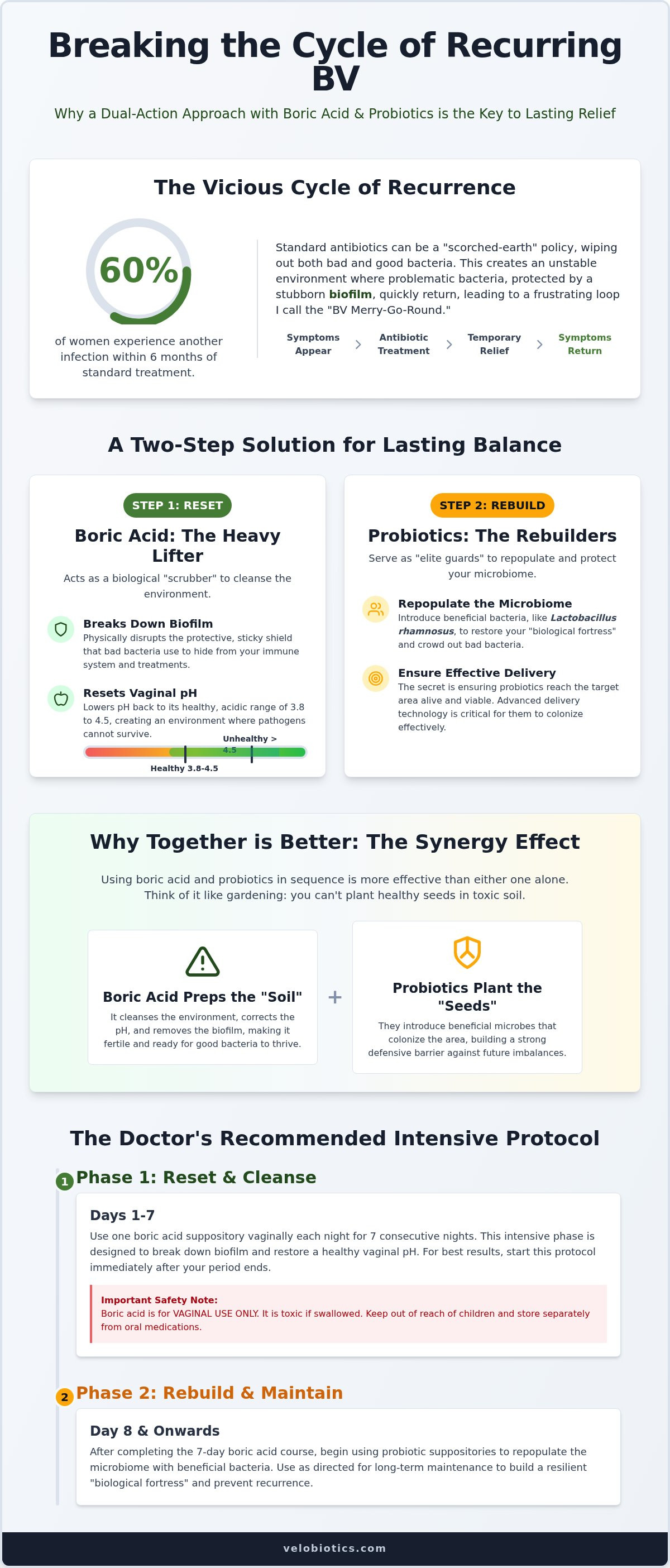
Many women spend years on what I call the "BV Merry-Go-Round." You take a course of antibiotics, the symptoms vanish for a week, and then, like clockwork, the fishy odor returns after your next period. This happens because antibiotics are like a scorched-earth policy; they kill the bad bacteria but also wipe out the beneficial ones that act as your "biological fortress." Bacterial vaginosis is fundamentally an ecological imbalance within the vaginal ecosystem rather than a simple, one-off infection. To break this cycle, we need a two-pronged strategy. When comparing boric acid vs probiotics for bv, it's helpful to view boric acid as the deep-cleanser that resets the environment and probiotics as the elite guards that keep the peace.
Understanding the Vaginal Biofilm
The main reason standard treatments fail is the development of a biofilm. Think of this as a sophisticated, sticky protective shield that bad bacteria build to hide from your immune system and medications. It's incredibly stubborn. While you might feel better temporarily, those bacteria are just "sleeping" behind their shield, waiting for the right moment to strike again. This constant recurrence isn't just a physical nuisance; it's an emotional drain that affects your confidence and intimacy. According to research, up to 60% of women experience another infection within six months of treatment. Breaking that shield is the first step toward long-term freedom.
The Doctor’s Perspective on pH Balance
In my clinical practice, I've found that the secret to a healthy microbiome is a strictly maintained pH level. A vaginal pH above 4.5 is essentially an open invitation for Gardnerella vaginalis to take over. Most traditional oral pills don't address this environmental factor directly. I've always believed that treating the symptoms while ignoring the pH is like trying to put out a fire while someone else is pouring gasoline on the floor. It doesn't work long term.
Actionable Doctor’s Tip: Don't guess; test. Pick up a pack of vaginal pH strips at your local pharmacy. If your reading is consistently high, it’s a clear signal that your internal environment is ready for a reset. Combining targeted products like Femina Probiotic Cookie Fresh can help address both the pH and the bacterial balance simultaneously. Understanding the synergy of boric acid vs probiotics for bv allows you to move from temporary fixes to a sustainable health protocol.
Boric Acid: The Heavy Lifter That Resets Your Vaginal pH
Boric acid acts as a biological reset button. When your vaginal pH climbs above 4.5, it becomes a playground for unwanted bacteria. Boric acid intervenes through a process called pH acidification, physically lowering the environment back to its natural, protective range of 3.8 to 4.5. This shift is critical because most pathogens simply cannot survive in such an acidic state. While it's a powerful tool, safety is non-negotiable. Boric acid is strictly for vaginal use; it is toxic if swallowed. I always tell my patients to store it in a completely separate area from their oral vitamins to prevent any dangerous mix-ups.
Breaking Down the Biofilm Fortress
Bad bacteria don't just float around; they build a protective, sticky shield known as a biofilm. This shield is the reason why a standard round of antibiotics might only provide temporary relief. Boric acid physically disrupts this biofilm, essentially stripping away the armor that protects the infection. By breaking this layer, you make the environment much more hospitable for recovery. For the best results, I recommend starting a boric acid protocol immediately after your period ends, as the presence of menstrual blood naturally raises your pH and creates a window for bad bacteria to bloom.
Who Should Use Boric Acid?
If you find yourself stuck in a cycle of chronic recurrence or dealing with a stubborn odor that persists despite your best efforts, boric acid is your primary ally. Think of it as the "spring cleaning" phase of your health journey. It’s not about long-term maintenance yet; it’s about clearing out the clutter so your body can breathe again.
The real magic happens when you realize the synergy of boric acid vs probiotics for bv. The acid preps the "soil," making it fertile and ready for the beneficial bacteria to take root. It ensures that the good guys aren't just thrown into a hostile environment where they'll immediately perish. If you need a straightforward way to start this reset, Femina Cookie Fresh Boric Acid Only Suppositories offer a clean, medical-grade option for effective acidification without unnecessary fillers.
Probiotics for BV: Maintenance for Your Microbiome
If boric acid is the deep-clean that resets your environment, probiotics are the elite settlers that rebuild your biological fortress. The "good guys" in your vaginal ecosystem are primarily species of Lactobacillus. These bacteria act as tiny chemical factories, producing lactic acid and hydrogen peroxide to keep the environment acidic and inhospitable to pathogens. In the ongoing discussion of boric acid vs probiotics for bv, probiotics represent the essential maintenance phase. They function through a mechanism called "competitive exclusion." This is a clinical term for a simple concept: the good bacteria occupy all the available real estate and consume the nutrients, leaving no room for bad bacteria to take root. For more on this process, you can read my detailed guide on Probiotics for BV.
The Viability Challenge: Why Most Probiotics Die
The biggest hurdle in probiotic therapy is survival. When you take an oral supplement, those delicate bacteria must survive a "stomach acid gauntlet" that kills off the majority of the colony before it ever reaches its destination. This is why I focus so heavily on biological viability. We use a specialized micro-encapsulation technology that acts like a "protective seal" around each bacterium, ensuring they stay alive until they reach the target area. While oral capsules are great for systemic health, vaginal delivery via suppositories provides a direct shortcut. It places the active guards exactly where they are needed most, bypassing the digestive system entirely and ensuring a higher concentration of live cultures.
Strains Matter: Looking for the Lactobacillus Family
Not all probiotics are created equal, and generic "gut health" strains won't cut it for vaginal balance. You need the "pH police" of the vagina. Clinical research points to three specific heavy hitters: L. crispatus, L. jensenii, and L. gasseri. These strains are uniquely adapted to thrive in the vaginal environment and are the most effective at maintaining that crucial 3.8 to 4.5 pH range. When you're shopping for supplements, don't settle for vague labels. Look for these specific names on the bottle. If a product doesn't list the exact strains, you can't be sure you're getting the targeted support required to break the cycle of recurrence.
Boric Acid vs. Probiotics: When to Use Which (and Why the Answer is Both)
When deciding between boric acid vs probiotics for bv, the most important thing to realize is that they aren't competitors; they're teammates. I often tell my patients that using only boric acid is like scrubbing the walls of a house but leaving the door wide open for squatters to move back in. You’ve cleared the "vacuum," but you haven’t filled it with anything protective. Conversely, trying to use probiotics in a high-pH environment is like planting expensive seeds in a scorching desert. Without the right "soil" conditions—specifically a pH between 3.8 and 4.5—those beneficial bacteria won't survive long enough to do their job.
- Boric Acid: Provides rapid relief of acute symptoms, often within 24 hours, by resetting the pH and disrupting biofilms, but it doesn't provide the "guards" needed to prevent the next infection.
- Probiotics: Works more gradually over several days to weeks to rebuild the microbiome fortress, focusing on long-term prevention and sustainable balance.
The Sequential Strategy: The 1-2 Punch
To break the recurrence cycle, you need a sequential approach. Phase 1 involves using boric acid to eliminate the overgrowth and tear down the biofilm shields we discussed earlier. Once the environment is acidic and the "bad guys" are cleared out, you move to Phase 2: colonization. This is when you introduce high-quality probiotics to move the "furniture" back in. By following this order, you ensure the probiotics have a hospitable home where they can thrive, multiply, and eventually take over the defense of your biological fortress. This dual approach is why many women finally see an end to the "revolving door" of infections.
Common Mistakes in BV Self-Treatment
I see many women accidentally sabotage their own recovery. Douching is the most frequent culprit. It acts like a biological tsunami, wiping out every living thing in its path, including the few good bacteria you have left. Scented soaps and "feminine wipes" are another trap; they might mask the odor for an hour, but their chemicals often fuel the inflammatory fire and disrupt your pH further. During the rebuild phase, keep it simple. Wear breathable cotton underwear to reduce moisture buildup and give your microbiome the stable environment it needs to recover.
If you're ready to stop the guesswork and start a professional-grade regimen, I recommend the Femina Probiotic Cookie Fresh, which simplifies this entire process into one effective system.
The Doctor’s Protocol: How to Use Femina Cookie Fresh for Long-Term Balance
I developed the "Cookie Fresh" concept because I saw too many patients struggling to manage a complex, multi-step regimen. The traditional approach to boric acid vs probiotics for bv usually involves using one for a week and then switching to the other. This delay can allow bad bacteria to regain their footing. By combining both into a single delivery system, Femina Probiotic Cookie Fresh with Boric Acid allows for a simultaneous pH reset and microbiome reconstruction. Our proprietary micro-encapsulation technology acts as a protective seal around the live probiotic strains, ensuring they remain viable and ready to colonize even as the boric acid works to acidify the environment.
For an active flare-up or a noticeable odor, I recommend a 7-day intensive protocol. If you have a history of chronic recurrence, extending this to a 14-day protocol provides the deep-seated reconstruction your biological fortress needs. This isn't just about masking a scent; it's about systematically replacing a dysfunctional ecosystem with a healthy one.
Step-by-Step: Your First Week to Freshness
Pro-tip: bedtime is the absolute best time for administration. Gravity is not your friend during the day; using the suppository right before you sleep ensures the ingredients stay in place to dissolve and absorb properly. You should expect some watery discharge the next morning. This is a normal part of the acidification process as your body flushes out the unwanted elements and resets its internal metrics. I suggest using a light panty liner during the first few days to stay comfortable and dry while your system recalibrates.
Long-Term Maintenance: Keeping the Fortress Strong
Once you've completed your initial week, the goal shifts to maintenance. Your vaginal pH is most vulnerable after intimacy or during the final days of your period, as both semen and blood are alkaline. Using a single suppository during these "high-risk" windows can prevent a pH spike before it leads to a full-blown imbalance. For comprehensive support, many of my patients pair their suppositories with Femina Probiotic Capsules. This provides a steady supply of beneficial bacteria from the inside out, reinforcing your defenses on multiple levels.
While this protocol is highly effective for most, you should see a healthcare provider if you experience pelvic pain, a fever, or symptoms that don't improve after 14 days. These can be signs of a different type of infection that requires a specific prescription. Understanding the synergy of boric acid vs probiotics for bv is your best tool for daily health, but professional clinical oversight remains a vital part of your long-term wellness strategy.
Take Control of Your Biological Fortress
Breaking the cycle of bacterial vaginosis requires moving beyond temporary fixes. We've explored how the debate of boric acid vs probiotics for bv shouldn't be about choosing one, but about mastering their sequence. Boric acid provides the essential pH reset and biofilm disruption your body needs to clear the path, while specialized probiotics move in to reconstruct your natural defenses. This two-pronged approach addresses both the immediate symptoms and the underlying ecological imbalance that leads to frustrating recurrence.
As a doctor, I'm committed to formulas that prioritize biological viability. Our dual-action system is micro-encapsulated to ensure that every beneficial bacterium reaches its destination alive and ready to work. It’s time to stop the "merry-go-round" of infections and start a protocol that respects your body’s complex science. Ready to break the BV cycle? Shop Femina Cookie Fresh Dual-Action Suppositories and experience the difference of a doctor-founded formula designed for long-term balance. You have the tools to stay fresh, confident, and in control of your health.
Vaginal Health: Frequently Asked Questions
Can I use boric acid and probiotics at the same time?
Yes, and using them together is actually the most effective strategy for long term balance. While many people treat these as separate steps, our dual action formula allows you to reset your pH and rebuild your microbiome simultaneously. The key is using micro-encapsulated probiotics that stay protected from the acidic environment. This combined approach is a major evolution in the management of boric acid vs probiotics for bv.
How long does it take for boric acid to work for BV?
Most women notice a significant reduction in odor and discharge within 24 to 48 hours of the first application. Boric acid works rapidly to acidify the environment and disrupt stubborn biofilms. However, for long term stability, I recommend completing a full 7-day intensive protocol. Stopping too early might leave your "biological fortress" empty, which allows bad bacteria to move back in and restart the cycle.
Will probiotics make my BV smell worse before it gets better?
No, probiotics don't increase odor. If you notice a temporary change in discharge, it's usually just the suppository carrier or the boric acid flushing out unwanted elements. Beneficial bacteria like Lactobacillus produce lactic acid and hydrogen peroxide, which naturally neutralize odors over time. If a fishy smell intensifies, it's likely a sign that the bacterial overgrowth hasn't been fully cleared by the initial pH reset.
Is it safe to have sex while using boric acid suppositories?
I recommend waiting until the suppository has fully dissolved and any discharge has cleared, which usually takes about 12 to 24 hours. Boric acid has a gritty texture that can be irritating to a partner's sensitive tissues. Additionally, it's toxic if ingested, so oral contact must be strictly avoided. It's also important to note that boric acid can weaken latex condoms, significantly increasing the risk of breakage.
Can I use these treatments during my period?
You can certainly use these treatments during your cycle. In fact, your period is a high-risk time for recurrence because menstrual blood is alkaline, which naturally raises your vaginal pH. Using a reset protocol during the final days of your period can help prevent a pH spike. Just remember to avoid using tampons while using a suppository, as they will absorb the active ingredients before they can work.
Why does my BV keep coming back even after using boric acid?
Boric acid is a powerful "reset button," but it isn't a permanent guard. If your symptoms return, it’s often because beneficial bacteria didn't take root after the cleanse. This highlights the importance of boric acid vs probiotics for bv; you need both. Without repopulating the area with live, viable probiotics, your vaginal environment remains a vacuum that bad bacteria are all too happy to fill again.
Do I need a prescription for boric acid or vaginal probiotics?
No, these are available over-the-counter as wellness supplements. You don't need a doctor's script to purchase our Femina Cookie Fresh products. However, I always advise patients to consult a professional if they're pregnant or if symptoms don't improve after a 14-day protocol. It's vital to rule out other underlying infections that might require specific prescription antibiotics or antifungals to ensure your long term health.
What is the difference between Cookie Fresh with Boric Acid and Boric Acid Only?
The "Boric Acid Only" version is designed for a pure pH reset, which is ideal for those who already have a separate, strong probiotic regimen. Our flagship "Probiotic Cookie Fresh" is a dual-action formula. It combines 600mg of medical-grade boric acid with micro-encapsulated probiotics. This allows you to scrub the walls and move the furniture back in at the same time, providing a more comprehensive and convenient solution.

Disclaimer
Information and statements regarding dietary supplements/products have not been evaluated by the Food and Drug Administration, MCC/SAHPRA, MHRA, TGA or any other drug regulatory authority and are not intended to diagnose, treat, cure, or prevent any disease. Information on this website is provided for informational purposes only and is a result of years of practice and experience by the author. This information is not intended as a substitute for the advice provided by your physician or other healthcare professional or any information contained on or in any product label or packaging. Do not use the information on this website for diagnosing or treating a health problem or disease, or prescribing medication or other treatment. Always speak with your physician or other healthcare professional before taking any medication or nutritional, herbal, or homeopathic supplement, or using any treatment for a health problem. If you have or suspect that you have a medical problem, contact your healthcare provider promptly. Do not disregard professional medical advice or delay in seeking professional advice because of something you have read on this website.