

Probiotic Multivitamin Benefits: How to Choose the Right Formula
A longer supplement label doesn’t automatically mean a better formula. Potential probiotic multivitamin benefits depend on what’s included, whether the probiotic ingredients suit your needs, and how the product is designed to protect them through storage and use.
It makes sense to wonder whether combining probiotics and vitamins offers more than convenience. A multivitamin may help supplement dietary intake, while probiotics are studied for their role in the gut microbiome. But combining them isn’t a guaranteed shortcut to better health. Your existing supplements matter, too: overlapping ingredients can change what you take each day.
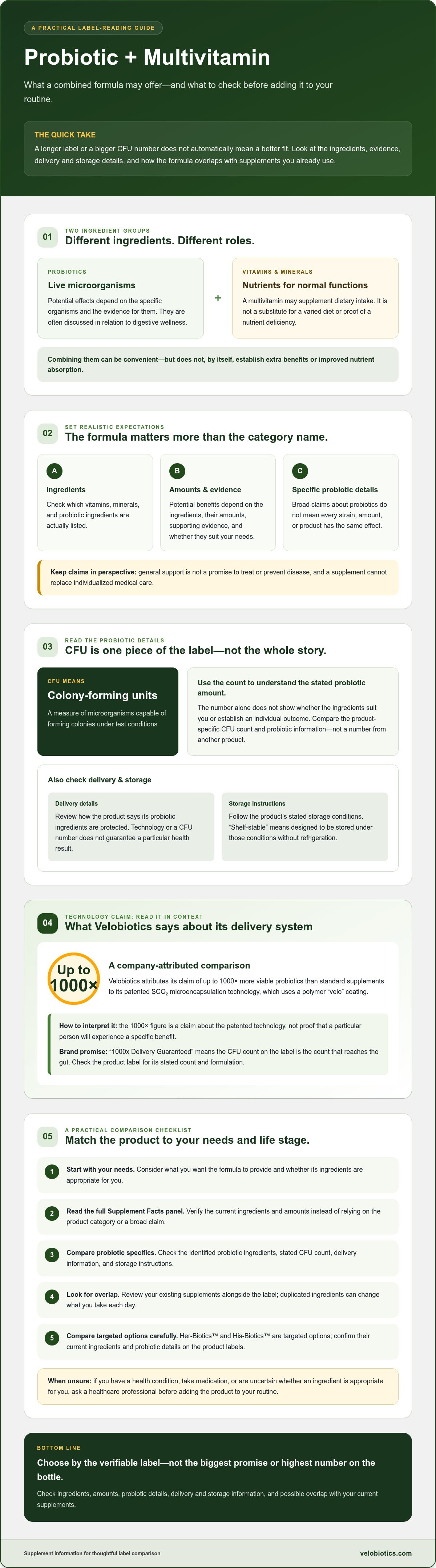
This guide explains what combined formulas may and may not offer, then shows you how to compare options according to your needs and life stage. You’ll learn how to assess probiotic details and CFU claims, check delivery and storage information, and spot ingredients that may duplicate supplements you already use. The goal is a practical choice based on a clear, verifiable label, not the biggest promise or highest number on the bottle.
Key Takeaways
- Understand what probiotic multivitamin benefits may involve, and how probiotics differ from vitamins and minerals.
- Compare Her-Biotics™ and His-Biotics™ as targeted options, then confirm their current ingredients and probiotic details on the product labels.
- Use a practical checklist to match a formula to your needs and life stage before adding it to your routine.
- Check CFU, probiotic information, delivery, and shelf-stability details without treating them as promises of individual results.
- Review your existing supplements alongside the Supplement Facts panel to spot overlapping ingredients.
What Benefits Can a Probiotic Multivitamin Offer?
A probiotic multivitamin combines live microorganisms, called probiotics, with vitamins and minerals in one supplement. Potential probiotic multivitamin benefits come from two different ingredient groups, not automatically from a special effect created by putting them together. What a formula may offer depends on its ingredients, amounts, supporting evidence, and whether those ingredients suit your needs.
Vitamins and minerals are nutrients the body needs for normal functions. A multivitamin may supplement dietary intake, but it isn’t a substitute for a varied diet or proof that you have a nutrient deficiency. Probiotics have a different role: they’re live microorganisms, and their potential effects depend on the specific organisms and the evidence for them. For a foundational overview, see Probiotics.
For an expert perspective on choosing supplements, watch this video:
How probiotics and multivitamins serve different roles
Probiotics are often discussed in relation to digestive wellness, but that doesn’t mean every strain has the same effect or that every product supports the same claim. CFU, or colony-forming units, is a measurement of microorganisms capable of forming colonies under test conditions. It can help describe the probiotic amount, but the number alone doesn’t show whether a formula is right for you.
Vitamins and minerals are nutrients, not probiotics. Combining them in one capsule may be convenient, but that fact alone doesn’t establish extra benefits or improved nutrient absorption. Formulas differ, so check the Supplement Facts panel for ingredients and amounts rather than relying on the category name.
What benefits should shoppers realistically expect?
A probiotic formula may support digestive wellness when its specific ingredients and evidence substantiate that use. Broad statements about probiotics don’t prove that every strain, amount, or combined formula delivers the same result. Look for clearly identified probiotic ingredients and match any benefit claims to the product’s own formulation and evidence.
General support is not a promise to treat or prevent disease. A supplement also can’t replace individualized medical care. If you have a health condition, take medication, or are unsure whether an ingredient is appropriate for you, ask a healthcare professional before adding the product to your routine.
How Probiotic Delivery and Multivitamin Formulas Work
A probiotic multivitamin brings together live microorganisms and nutrients such as vitamins and minerals. The label tells you what the product is designed to provide; delivery and storage details explain how its probiotic ingredients are protected. Neither formulation technology nor a CFU number, by itself, guarantees a particular health result.
For general background on multivitamins and minerals, the NIH Office of Dietary Supplements explains their role in Multivitamin/mineral Supplements, including how they may help fill nutrient gaps. In a combined product, check each nutrient’s form and amount on the specific label instead of assuming every formula contains the same ingredients.
What CFU and probiotic delivery claims mean
CFU means colony-forming units, a measure used to describe microorganisms capable of forming colonies. It can help you understand the probiotic quantity listed for a formula, but it doesn’t tell you whether the probiotic ingredients suit your needs or establish an individual outcome. Compare the product-specific label, including the listed probiotic details and stated CFU count, rather than relying on a number from another product.
Velobiotics attributes its claim of up to 1000× more viable probiotics than standard supplements to its patented SCO₂ microencapsulation technology. The process uses a polymer “velo” coating. The 1000× figure is a claim about this patented technology, not proof that a particular person will experience a specific benefit.
Velobiotics’ 1000x Delivery Guaranteed brand promise is that the CFU count on the label is the count that reaches the gut. Check the product label for the stated count and formulation.
Why storage instructions and product labels matter
Shelf-stable means a product is designed to be stored under its stated conditions without refrigeration. Velobiotics states that its products are shelf-stable and don’t require refrigeration. This describes storage, not a guarantee of a particular health outcome. Shelf-stable also doesn’t mean a product should be exposed to any conditions: follow the storage directions printed on the product you choose.
Before adding a formula to your routine, check the Supplement Facts panel, serving directions, ingredients, and storage instructions. This helps you identify nutrient amounts that may overlap with other supplements and understand how the product is intended to be stored. Potential probiotic multivitamin benefits depend on the actual formula and your needs, not just the delivery method.
Comparing Probiotic Multivitamin Benefits Across Targeted Formulas
Targeted formulas are intended for different audiences, but a product name alone can’t tell you whether the formula matches your needs. Use it as a starting point, then compare the current Supplement Facts panel and product directions. The table distinguishes the stated audience from the details to verify before choosing.
| Formula | Audience or stated use | What to check on the current label |
|---|---|---|
| Her-Biotics Probiotics Original Multivitamin 60 Capsules for Women | A probiotic multivitamin targeted to women. | Vitamin and mineral amounts, probiotic information and CFU count, serving directions, and storage instructions. |
| His-Biotics Probiotics Original Multivitamin 60 Capsules for Men | A probiotic multivitamin targeted to men. | Review the same details, then compare ingredient forms and amounts with your needs and other supplements. |
How targeted options differ
Her-Biotics™ and His-Biotics™ are positioned for women and men, respectively. That audience focus doesn’t establish that one is right for every person in that group; the actual nutrient amounts and probiotic details matter. Use the product’s current description and label, not assumptions based on its name.
A product’s intended audience can help narrow your search, but it can’t determine whether its ingredients suit your circumstances. If you’re planning a pregnancy, pregnant, breastfeeding, taking medication, or managing a health condition, discuss supplement choices with a healthcare professional.
Check the formula, not just the front label
Ingredient details shouldn’t be transferred from one product to another. Before making a claim about a vitamin or comparing nutrient forms, verify the form and amount on the current product label. Do the same for probiotic details and CFU counts; information can differ between formulas and may change with product updates.
These checks help put probiotic multivitamin benefits in context: a targeted label can help you narrow your options, but it can’t promise a particular outcome. Compare the nutrients with what you already take, confirm the intended audience, and choose based on the specific formula rather than a shared brand name.
How to Choose a Probiotic Multivitamin for Your Needs
Start with your goal and life stage, not the biggest CFU number or the most crowded label. Potential probiotic multivitamin benefits depend on the formula and your circumstances, so use this checklist to compare what’s actually inside before adding another supplement to your routine.
A practical label checklist
- Define what you need. Decide whether you’re looking to supplement nutrients in your diet, interested in a probiotic formula, or comparing a product intended for a particular audience. Be specific about your goal so you can judge whether the formula is relevant.
- Read the Supplement Facts panel. Check each vitamin and mineral, its form, and its amount per serving. When comparing a nutrient, verify its form and amount on the current product label rather than assuming formulas match.
- Inspect the probiotic details. Look for the listed organisms or strains and the product-specific CFU statement. Don’t assume every product has the same probiotic details or count, and don’t treat a higher CFU number as proof that a formula is a better fit.
- Check the full ingredient list. Review other ingredients and serving directions. If you have a relevant allergy or sensitivity, check the label carefully and contact the manufacturer if an ingredient or its source isn’t clear.
- Compare against your current routine. Put the new Supplement Facts panel beside the labels for your existing multivitamin and supplements. Look for repeated nutrients and ask a healthcare professional or pharmacist if you’re unsure whether combining them is appropriate.
- Follow product directions. Confirm how to take and store the specific product. Storage instructions can differ, so follow the chosen product’s label rather than relying on assumptions about the category.
Avoid common selection mistakes
The words “probiotic” and “multivitamin” describe broad product categories, not a guaranteed effect or a one-size-fits-all ingredient profile. Choose based on the actual label, not a broad wellness promise. Don’t stack products simply because they address different goals: duplicated nutrients, allergies, and serving directions deserve a careful check first.
Pregnancy, medication use, and health conditions call for individualized advice. Before starting a supplement in these circumstances, ask a healthcare professional who can consider your needs and current routine. To compare options, explore targeted multivitamin formulas and review each product’s current label.
Explore Velobiotics’ Probiotic Multivitamin Collection
A targeted formula can make the search more manageable, but it isn’t a universal recommendation. Velobiotics offers probiotic multivitamins for women and men. Use those audience labels to narrow your search, then confirm the formula’s current ingredients, serving directions, and probiotic details before deciding whether it suits your routine.
Standout formulas for different shopping needs
Her-Biotics Probiotics Original Multivitamin 60 Capsules for Women and His-Biotics Probiotics Original Multivitamin 60 Capsules for Men are separate options directed toward women and men, respectively. Their audience positioning can help you start comparing, but it doesn’t tell you which nutrients, amounts, or probiotic ingredients are included. Check each product’s current label rather than assuming the formulas are identical or that one is automatically right for you.
Compare the labels side by side if you’re choosing between the two. Check nutrient forms and amounts, probiotic information, serving directions, and storage details. If you already take a multivitamin or other supplements, look for overlapping ingredients before adding another product.
What to do before choosing a product
Velobiotics’ patented SCO₂ microencapsulation process uses a polymer “velo” coating to support probiotic delivery and shelf stability. The company states that this patented microencapsulation technology delivers up to 1000× more viable probiotics than standard supplements. This is a company claim about its technology, not a promise of a particular personal health outcome. Velobiotics also states that the CFU count on the label is the count that reaches the gut. Check the product-specific label for the stated count and formulation.
Before selecting either option, match its stated audience to your needs and verify the current label. Review the full ingredient list, nutrient forms and amounts, probiotic information, serving directions, and storage instructions. If you already take supplements or medicines, compare ingredients for overlap and ask a healthcare professional or pharmacist about potential concerns.
For a closer look at the available selection, browse the Vitamin B1 collection. Product details can change, so confirm the current label before choosing.
Choose Your Formula With Confidence
The right choice isn’t simply the product with the most ingredients or the biggest probiotic number. Potential probiotic multivitamin benefits depend on whether the nutrients, probiotic details, and stated audience fit your needs. Check the current label, compare it with supplements you already take, and seek professional advice if pregnancy, medication, or a health condition affects your decision.
Velobiotics offers targeted formulas for women and men. The company’s probiotic delivery claim is based on its patented SCO₂ microencapsulation technology, and it states that its products are shelf-stable and don’t require refrigeration. These features explain aspects of formulation and storage, not guaranteed individual outcomes.
Ready to compare? Browse Velobiotics’ targeted probiotic multivitamin options, then verify each product’s current ingredients and directions. A careful label check is a practical first step toward choosing a formula that fits your routine.
Frequently Asked Questions
What are the benefits of a probiotic multivitamin?
A probiotic multivitamin combines vitamins and minerals with live microorganisms called probiotics. The nutrients may supplement dietary intake, while particular probiotics may support digestive wellness when the formula’s ingredients and evidence support that use. Potential probiotic multivitamin benefits depend on the specific nutrients, probiotic details, amounts, and your needs. Combining ingredients in one product doesn’t automatically create an added benefit or guarantee a health outcome.
Can a probiotic multivitamin replace my other supplements?
Not necessarily. A combined formula may not contain the same nutrients, forms, or amounts as the supplements you currently take, and it may not suit the reason you take them. Compare the new product’s Supplement Facts panel with your existing labels before making a change. If a supplement was recommended for a specific health need, check with your healthcare professional before stopping or replacing it.
How do I choose the right probiotic multivitamin?
Start with your goal and life stage, then check the product’s actual label. Review vitamin and mineral forms and amounts, probiotic details and product-specific CFU count, serving directions, ingredients, and storage instructions. Consider allergies and compare the formula with supplements you already use. Don’t choose by a high CFU number or broad product name alone. Ask a healthcare professional if you have a health condition or take medication.
Do probiotic multivitamins need to be refrigerated?
Follow the storage directions on the specific product label. Velobiotics states that its products are shelf-stable and don’t require refrigeration, but check the storage guidance for the formula you choose. Shelf-stable describes how a product is stored under its stated conditions; it doesn’t guarantee an individual health result. Store the package as directed to help maintain the product as intended.
Does a higher CFU count mean a probiotic multivitamin is better?
No. CFU, or colony-forming units, describes microorganisms capable of forming colonies under test conditions, but a higher count alone doesn’t show that a product is more suitable for you. Check the specific probiotic details, stated count, formulation, and evidence for the intended use. Compare the product label and don’t assume CFU counts or probiotic information are the same across formulas.
Can I take a probiotic multivitamin while pregnant?
Ask your obstetrician, midwife, or another qualified healthcare professional before starting a probiotic multivitamin during pregnancy. Formulas can differ in their nutrients, amounts, and other ingredients, so suitability depends on the specific product and your circumstances. Bring the product label and a list of your current supplements and medicines to the conversation. Don’t rely on an audience label alone to determine whether a formula is appropriate.
What happens if my probiotic multivitamin contains ingredients I already take?
You may be doubling up on a nutrient or other ingredient. Compare serving amounts across the Supplement Facts panels for your multivitamin and existing supplements, and include medicines in the review if relevant. Don’t add or combine products without understanding the overlap. If you’re unsure whether the total amount is appropriate, ask a healthcare professional or pharmacist to review your full supplement routine.

Disclaimer
Information and statements regarding dietary supplements/products have not been evaluated by the Food and Drug Administration, MCC/SAHPRA, MHRA, TGA or any other drug regulatory authority and are not intended to diagnose, treat, cure, or prevent any disease. Information on this website is provided for informational purposes only and is a result of years of practice and experience by the author. This information is not intended as a substitute for the advice provided by your physician or other healthcare professional or any information contained on or in any product label or packaging. Do not use the information on this website for diagnosing or treating a health problem or disease, or prescribing medication or other treatment. Always speak with your physician or other healthcare professional before taking any medication or nutritional, herbal, or homeopathic supplement, or using any treatment for a health problem. If you have or suspect that you have a medical problem, contact your healthcare provider promptly. Do not disregard professional medical advice or delay in seeking professional advice because of something you have read on this website.