

Shelf-Stable vs. Refrigerated Probiotics: A Doctor’s Guide to What Actually Works in 2026
Most people assume the "cold" section of the health store holds the most potent supplements, but that refrigerator might just be a high-priced graveyard for bacteria. If you are wondering about shelf-stable vs refrigerated probiotics which is better, you've likely stood in the supplement aisle staring at a bottle that costs as much as a nice dinner, worried you're buying expensive waste. It's frustrating to juggle cold packs while traveling or worry if your supplements died the moment they hit your kitchen counter. I've seen countless patients struggle with this confusion, and it's time we cleared the air.
In this guide, we're finally settling the debate by looking at the only metric that actually matters: biological viability. You'll discover why a probiotic's "shield" is far more important than its storage temperature. We will break down the science of gastric survival, explain why up to 99% of standard cultures never make it past your stomach acid, and provide a doctor-approved checklist for choosing a supplement that actually reaches your gut. By the end, you'll have the confidence to stop paying for "sleeping" bacteria and start investing in technology that works.
Key Takeaways
- Understand why refrigeration is simply a way to keep bacteria dormant and doesn't actually help them survive the acidic journey through your digestive tract.
- Evaluate shelf-stable vs refrigerated probiotics which is better by looking for proprietary micro-encapsulation technology that ensures live cultures reach your colon.
- Learn to identify the "Survival Gap" to avoid wasting money on supplements where 90% of the active ingredients die before they can do any good.
- Use a professional 5-point checklist to verify strain diversity and ensure your probiotic is guaranteed to be viable at the date of expiration, not just when it was made.
- Discover how to maintain a consistent gut health routine while traveling by choosing high-tech, shelf-stable options that don't require a constant cold chain.
The Cold Truth: Why Your Probiotic Doesn't Always Need a Winter Coat
For years, patients have asked me if they should only buy the probiotics kept in the refrigerator. It's a logical assumption. We keep fresh food in the fridge to prevent spoilage, so why wouldn't we do the same for beneficial live microorganisms? However, the truth is that refrigeration is often just a storage detail, not a badge of quality. In the debate over shelf-stable vs refrigerated probiotics which is better, you have to understand that cold storage was historically a necessity for fragile, unprotected bacteria. It doesn't mean those bacteria are more potent. It just means they are on life support.
To better understand this concept, watch this helpful video:
The History of the Probiotic Fridge
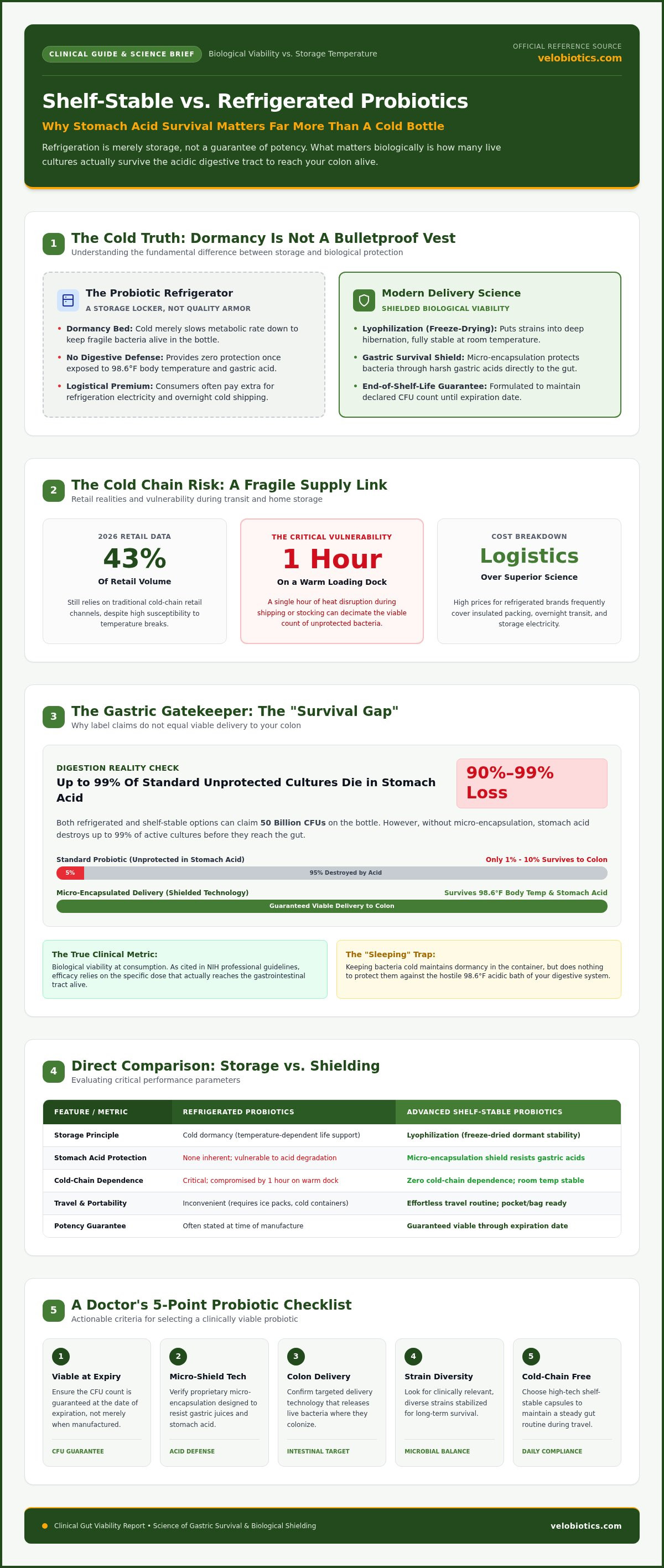
In the early days of supplement manufacturing, the strains we used were incredibly sensitive to heat and moisture. Keeping them chilled was the only way to slow down their metabolic activity and prevent them from dying on the shelf. This created the "cold chain" requirement, a logistical system where products must stay at specific temperatures from the factory to your home. In reality, this system often fails. Retail data from 2026 shows that traditional cold-chain channels still account for 43% of retail volume, yet a single hour on a warm loading dock can decimate the viable count of unprotected bacteria. Despite these risks, the "fridge factor" stuck in the consumer's mind as a proxy for freshness.
Modern Stability: Science Catches Up
The landscape has shifted decisively. We now use a process called lyophilization, or freeze-drying, which essentially puts the bacteria into a state of deep hibernation. When these microbes are properly dried and sealed in moisture-controlled packaging, they remain dormant and stable at room temperature. A high-quality shelf-stable probiotic is formulated to maintain its stated CFU count until the very last day of its shelf life.
As a physician, I prioritize biological viability over a cold bottle. Keeping bacteria cold might keep them "asleep" in the box, but it does nothing to help them survive the 98.6 degree acidic bath of your stomach. We need to move past the storage temperature and look at the actual delivery technology. The fridge doesn't provide a bulletproof vest; it just provides a bed. If the bacteria die the moment they hit your body temperature, the storage method was irrelevant.
Shelf-Stable vs. Refrigerated: A Side-by-Side Comparison
When patients ask me shelf-stable vs refrigerated probiotics which is better, I tell them that the fridge is just a storage locker, not a quality filter. Both categories can boast 50 billion CFUs on the label. The critical difference lies in whether those bacteria are still alive when you actually swallow the capsule. While some consumers believe the cold temperature signifies a more active product, the reality is that you're often paying for the logistical overhead of climate-controlled shipping rather than superior microbial science. From a clinical perspective, potency at the time of consumption is the only metric that truly matters for your gut health.
The NIH Probiotics Health Professional Fact Sheet highlights that efficacy depends on the specific strain and the dose that actually reaches the gastrointestinal tract. Refrigerated brands often charge a premium because they have to maintain a strict cold chain from the factory to the retail shelf. You aren't necessarily paying for a better strain; you're paying for the electricity, specialized packaging, and overnight shipping required to keep the product chilled. If that cold chain breaks for even a few hours during transit, the "high potency" you paid for can vanish before the bottle even reaches your door.
When Refrigeration Makes Sense
There are still specific scenarios where the fridge is your friend. Some very delicate, older-generation strains haven't been successfully stabilized through modern drying techniques yet. Additionally, bulk liquid probiotics often lack the protective coatings found in capsules, making them highly susceptible to heat degradation. If you live in a tropical environment where your home consistently exceeds 30°C (86°F), even your shelf-stable supplements will benefit from the cooler environment of a refrigerator to prevent the natural decline of the bacterial count over several months.
The Case for Shelf-Stable Probiotics
Convenience drives compliance, and compliance drives results. If your probiotic is tucked away in the back of a refrigerator, you're statistically less likely to remember it during a hectic morning. Shelf-stable options can sit on your nightstand or office desk, ensuring you never miss a dose. This consistency is vital for maintaining a balanced microbiome. Furthermore, shelf-stable products eliminate the "death by delivery" risk. You don't have to worry if an ice pack melted on a delivery truck. For a robust, multi-strain option that offers high biological viability without the refrigeration headache, you might consider our Velo16 Probiotic Digestive Capsules. Choosing a stable format means your bacteria stay in hibernation until they reach the environment where they're meant to work.
The Survival Science: Why Stomach Acid is the Real Gatekeeper
When we discuss shelf-stable vs refrigerated probiotics which is better, we often ignore the most violent part of the journey. Your stomach is a literal acid pit designed to kill bacteria. That is its job. While we spend so much time worrying about whether a capsule stayed at 4 degrees Celsius on a retail shelf, we forget it's about to be dropped into a 37 degree Celsius bath of hydrochloric acid with a pH between 1.5 and 3.0. For most unprotected bacteria, this is a death sentence. A "cold" probiotic is completely useless if it dissolves in 30 seconds and dies in your stomach before reaching its destination.
Research confirms a staggering "Survival Gap" where between 95% and 99% of standard, unprotected probiotic strains are destroyed within 60 minutes of ingestion. If those microbial soldiers die in the stomach, they can't provide any benefit to your microbiome. This is why I focus on biological viability. Biological viability is the true measure of probiotic efficacy.
The Journey Through the Gastrointestinal Tract
The transition from the stomach to the small intestine is a gauntlet of biological barriers. Standard gelatin or veggie capsules often dissolve almost instantly once they hit gastric juices. This premature release exposes delicate microbes to a harsh environment long before they reach the colon. According to Harvard Health's review on probiotic supplementation, the clinical value of these products hinges on their ability to survive this transit. If you want real results, you must prioritize probiotics that survive stomach acid through advanced delivery systems rather than just focusing on the temperature of your fridge.
CFUs vs. Viability: Don't Get Fooled by the Numbers
Marketing teams love to brag about "100 Billion CFUs," but this is often a vanity metric. If you start with 100 billion and 99% die in your stomach, you're only getting 1 billion to your gut. I've seen patients spend a fortune on high-CFU refrigerated brands that lack any acid-resistant shielding. It's like sending an army into a fire without protective gear. The number on the bottle doesn't matter if the bacteria aren't alive when they reach their target.
Always look for labels that guarantee potency at the time of expiration, not at the time of manufacture. Many brands use the "at manufacture" claim to hide the fact that their bacteria are dying every day they sit on the shelf. True clinical efficacy requires a delivery system that acts as a molecular submarine, keeping the cargo sealed until it senses the neutral pH of the intestines. Without this protection, you're just buying expensive, dead bacteria.
A Doctor’s 5-Point Checklist for Choosing Your Probiotic
Standing in the supplement aisle can feel like a test you didn't study for. While the debate over shelf-stable vs refrigerated probiotics which is better often dominates the conversation, the storage method is only a tiny piece of the puzzle. I've spent years analyzing clinical data and developing delivery systems, and I've found that the most expensive bottle in the fridge is often the least effective if it lacks a scientific foundation. Use this 5-point checklist to ensure you're investing in your health, not just buying fancy marketing.
- Check for Strain Diversity: Your gut is a complex ecosystem. Look for a formula that provides 10 to 15 different strains to support a balanced microbiome. A single-strain product rarely provides the broad-spectrum support most people need.
- Verify the Delivery System: This is the most critical factor. Does the label mention micro-encapsulation or acid-resistance? If the bacteria aren't shielded, they won't survive the journey to your colon.
- Look for Targeted Benefits: Probiotics aren't one-size-fits-all. Choose formulas designed for your specific needs, whether that's gender-specific multivitamins or support for intimate wellness.
- Inspect the Packaging: Light, heat, and moisture are the enemies of shelf-stable bacteria. Look for opaque bottles with moisture-seals or desiccant-lined packaging to ensure the microbes stay in hibernation.
- Research the Clinical Roots: Check if the brand is backed by actual research and proprietary technology. Avoid "white-label" products that just slap a new name on a generic, unprotected culture.
Decoding the Probiotic Label
When you read a label, look for three names: the genus, the species, and the specific strain designation. For example, Lactobacillus acidophilus velo2 tells you exactly which "breed" of bacteria you're getting. If a brand only lists the genus and species, they're hiding the fact that they haven't used a clinically studied strain. You should also watch out for excessive fillers like maltodextrin or artificial colors. For the younger members of your family, I recommend checking our BioKid Chewable Probiotics, which provide the same clinical precision in a kid-friendly format.
Tailoring to Your Specific Health Goals
Your health goals should dictate your choice. Women often require specific strains that support vaginal pH balance and urinary tract health. In my practice, I've seen how much of a difference the right combination can make. You can explore our Femina Probiotic Capsules with Cranberry for a formula specifically engineered for these needs. If you're focused on metabolic health, look for "tummy toners" or GLP-1 boosters that use targeted strains to support weight management and digestive efficiency. When you understand shelf-stable vs refrigerated probiotics which is better for your specific lifestyle, you can finally stop guessing and start seeing results.
Ready to experience the difference that high-viability technology makes? View our clinically-backed formulations and find the right fit for your gut health journey.
The Velobiotics Edge: Protecting Potency with Micro-encapsulation
When I founded Velobiotics, I wanted to solve the fundamental biological problem that the supplement industry was largely ignoring. We've spent this guide dissecting the shelf-stable vs refrigerated probiotics which is better debate, but the truth is that neither storage method matters if the bacteria are dead by the time they reach your colon. Our proprietary micro-encapsulation technology isn't just a marketing buzzword; it's a patented delivery system that acts as a microscopic molecular submarine for your gut health. By shielding delicate strains from the environment, we've rendered the "refrigeration headache" obsolete.
The clinical reality is that unprotected bacteria are fragile. Our technology delivers over 1,000x more live, viable probiotic bacteria directly into the lower GI tract compared to conventional, unprotected cultures. We achieve this by forming an inter-polymer complex that creates a physical barrier around the active microflora. This shield is impervious to the heat on your shelf and the acid in your stomach, ensuring that the 50 billion CFUs promised on our label are actually the 50 billion CFUs utilized by your body.
How Micro-encapsulation Works
The secret lies in the way we handle moisture and pH levels. Our process creates a technological seal that keeps moisture and heat out while the product sits in your cabinet, preventing the bacteria from waking up and dying prematurely. This seal is engineered to remain closed in the acidic environment of the stomach (pH 1.5 to 3.0). It only triggers a release when it senses the neutral pH of the lower intestine. This "timed release" mechanism ensures that the bacteria are delivered to the safe zone where they can actually colonize and thrive. This level of precision makes the old debate over shelf-stable vs refrigerated probiotics which is better irrelevant because the technology handles the protection, not the temperature.
Real Science for Real Life
In my medical practice, I prioritize solutions that fit into a patient's actual routine. You shouldn't have to worry about your probiotics losing potency because you left them in a hot car or forgot them at home during a business trip. With our advanced delivery system, you can take your gut health anywhere. This isn't just about convenience; it's about the peace of mind that comes from using a doctor-founded, research-backed supplement designed to bridge the gap between laboratory breakthroughs and your daily life. You're no longer dependent on a "cold chain" that might have broken before the bottle even reached the store shelf.
If you're ready to stop wasting money on ineffective supplements and start using technology that actually delivers on its promises, I invite you to discover the Velobiotics range of technologically advanced probiotics. It's time to choose a delivery system that works as hard as you do.
Take Control of Your Biological Viability
Choosing the right supplement shouldn't feel like a guessing game in the dairy aisle. We've established that while refrigeration can slow down bacterial death on the shelf, it does nothing to protect those microbes once they enter your body. When you evaluate shelf-stable vs refrigerated probiotics which is better, the answer lies in the delivery technology. You need a solution that survives the stomach's acid bath and reaches your colon alive.
As a doctor, I've seen the difference that proprietary micro-encapsulation makes for my patients. It's the difference between wasting money on dormant bacteria and investing in a research-backed shield that ensures potency until the date of expiration. By focusing on biological viability rather than storage temperature, you're giving your microbiome the diverse, 16-strain support it needs to thrive. We are proud to offer doctor-founded wellness solutions with global shipping to ensure everyone has access to high-tech gut health.
Shop Velobiotics: Scientifically Protected Probiotics for Gut & Intimate Health
You're now equipped with the clinical checklist to make a confident purchase. Start prioritizing survival science today and feel the impact of a probiotic that actually arrives where it's needed most.
Frequently Asked Questions
Do probiotics lose their effectiveness if they aren't refrigerated?
Not necessarily. Effectiveness depends on the delivery technology and formulation stability rather than just the thermometer. Modern freeze-drying and micro-encapsulation allow probiotics to remain dormant and viable at room temperature. The real question of shelf-stable vs refrigerated probiotics which is better comes down to whether the manufacturer guarantees the CFU count at the date of expiration. If they only guarantee it at the time of manufacture, the bacteria are likely dying on the shelf.
Can I travel with a probiotic that usually requires refrigeration?
It's incredibly risky. Most refrigerated probiotics are "naked" and begin to degrade quickly once they leave their cold environment. Traveling exposes them to fluctuating heat and moisture, which can kill the live cultures before you even reach your destination. If you lead a busy lifestyle or travel often, switching to a high-quality shelf-stable option with protective shielding ensures you aren't carrying around a bottle of dead bacteria that provides zero clinical benefit.
How can I tell if my shelf-stable probiotic is still alive?
You can't tell by looking at the capsule, so you must check the label for specific quality markers. Look for a "guaranteed at expiration" CFU count and evidence of acid-resistant technology. A reliable brand will use moisture-sealed, opaque packaging to prevent environmental degradation. If the product uses advanced micro-encapsulation, the bacteria stay in a state of hibernation until they reach the neutral pH of your intestines. This is the only way to ensure biological viability.
Is it better to take probiotics on an empty stomach or with food?
Generally, it's best to take them about 30 minutes before a meal or with a light snack. This timing helps the bacteria move through the stomach more quickly while acid levels are naturally lower. However, if your supplement uses a proprietary technological seal to survive gastric acid, the timing becomes much less critical. The most important factor for success is consistency, so pick a time you'll remember every single day to maintain your microbiome balance.
What happens if a refrigerated probiotic sits at room temperature for a few hours?
A few hours might not kill the entire batch, but it definitely starts the clock on the natural death of the bacteria. Unprotected strains are highly sensitive to thermal stress. If the cold chain is broken, the viable count begins to drop immediately. This is why many clinicians prefer shelf-stable formulations that use micro-encapsulation. These advanced delivery systems handle ambient temperatures without losing any potency, giving you much more flexibility in your daily routine.
Are liquid probiotics more effective than shelf-stable capsules?
Liquid probiotics often lack the protective barriers needed to survive the stomach's harsh acid. While they might seem "fresh" or more natural, they are highly susceptible to heat and gastric juices. Shelf-stable capsules using advanced delivery systems are typically more effective because they act like a molecular submarine. They keep the active microflora safe until they reach the colon. This is a key factor when deciding shelf-stable vs refrigerated probiotics which is better for your long-term health.
How long does it take to see results from a new probiotic supplement?
Most patients notice digestive improvements within two to three weeks of consistent use. Rebalancing your microbiome is a gradual process that depends on strain diversity and the delivery system's efficiency. For more complex health goals, such as metabolic support or intimate wellness, it may take up to two months of daily supplementation to achieve the full clinical benefit. You're looking for measurable physiological changes, not just a quick fix that doesn't last.
Can children take the same shelf-stable probiotics as adults?
While the strains are often similar, children usually require different dosages and delivery formats tailored to their smaller systems. It's best to choose a product specifically formulated for their developing microbiomes. Look for chewable options designed with the same high-viability technology found in adult capsules. This ensures the beneficial bacteria survive the child's digestive process. It provides the intended support for their immune and gut health without the need for adult-sized capsules.

Disclaimer
Information and statements regarding dietary supplements/products have not been evaluated by the Food and Drug Administration, MCC/SAHPRA, MHRA, TGA or any other drug regulatory authority and are not intended to diagnose, treat, cure, or prevent any disease. Information on this website is provided for informational purposes only and is a result of years of practice and experience by the author. This information is not intended as a substitute for the advice provided by your physician or other healthcare professional or any information contained on or in any product label or packaging. Do not use the information on this website for diagnosing or treating a health problem or disease, or prescribing medication or other treatment. Always speak with your physician or other healthcare professional before taking any medication or nutritional, herbal, or homeopathic supplement, or using any treatment for a health problem. If you have or suspect that you have a medical problem, contact your healthcare provider promptly. Do not disregard professional medical advice or delay in seeking professional advice because of something you have read on this website.