

Vaginal Probiotics: A Doctor’s Practical Guide to Intimate Microbiome Health in 2026
Most vaginal probiotics on the market today are essentially expensive placebos because the beneficial bacteria die in your stomach acid long before they can reach their destination. It’s a harsh reality, but when up to 90% of unprotected probiotics perish in the gut, your intimate health remains at risk. You’re likely exhausted by the frustrating cycle of antibiotics and the embarrassment of recurring odors that seem to return every 30 days like clockwork. It’s common to feel like you're fighting a losing battle against your own biology.
As a doctor and the founder of Velobiotics, I'm here to bridge the gap between complex clinical research and your daily wellness routine. I'll show you how to identify a supplement that uses patented micro-encapsulation to ensure 1,000x more delivery of live cultures to where they're needed most. You'll learn how to stabilize your vaginal pH and finally break free from the antibiotic loop using evidence-based strategies. This guide provides a clear, three-step framework for picking a probiotic that actually survives to do its job, ensuring you gain the protection and vitality you deserve.
Key Takeaways
- Learn why your microbiome gets "grumpy" and how specific good bacteria use lactic acid to restore peace and balance to your intimate ecosystem.
- Solve the great delivery debate by understanding the "migration theory" that allows oral supplements to successfully reach their destination.
- Use my professional checklist to find vaginal probiotics that are engineered for survival, ensuring they reach your system alive and ready to work.
- Discover how to break through stubborn bacterial biofilms and adopt simple daily habits for a flourishing, low-maintenance microbiome.
What Are Vaginal Probiotics and Why Is Your Microbiome So Grumpy?
As a physician and the founder of Velobiotics, I often tell my patients that their intimate health isn't a mystery; it's a matter of microbiology. When we talk about vaginal probiotics, we're referring to specific live microorganisms formulated to restore the delicate bacterial balance "down there." It's a mistake to view the vaginal microbiome as a static environment. Instead, it's a thriving, complex ecosystem that requires the right inputs to stay stable. To understand the mechanics of these "good bugs," it's helpful to look at What Are Probiotics? and how they serve as the primary defense against opportunistic pathogens.
Think of your microbiome as a high-stakes garden. In this clinical analogy, the probiotics are the high-quality seeds you plant, while the vaginal pH represents the soil. If the soil is too alkaline, your beneficial flowers won't bloom, and weeds will take over. To keep the garden lush, you need the right seeds and the right environment. Our goal is to ensure those seeds survive the journey and actually take root where they're needed most.
To better understand this concept, watch this helpful video:
In a healthy 2026 clinical profile, we expect to see Lactobacillus as the undisputed queen of the vagina. This "Hero Strain" should ideally make up over 90% of your total microbial count. These bacteria are biological powerhouses that actively crowd out harmful invaders. When their numbers drop, the entire ecosystem becomes vulnerable to irritation and infection.
The pH Connection: Why Acidity Is Your Best Friend
The primary job of Lactobacillus is to produce lactic acid. This process keeps your vaginal pH in a tightly controlled range of 3.8 to 4.5. This acidic environment is your best friend because it's naturally hostile to "bad guys" like Gardnerella vaginalis. When your Lactobacillus population dips, the pH rises above 4.5, and those pathogens begin to multiply. You don't need a laboratory to spot a shift. If you notice a sudden change in scent, often described as "fishy," or a change in discharge consistency, your "soil" has likely become too alkaline. Monitoring these signals is a practical way to manage your health before a full-blown issue develops.
Common Disruptors: What’s Killing Your Good Bacteria?
Even with the best intentions, your internal garden can face significant threats. We frequently see the "Antibiotic Paradox" in clinical practice. You take a prescription to clear up a sinus or urinary tract infection, but those drugs don't discriminate; they wipe out your beneficial Lactobacillus along with the bad bacteria. This leaves a vacuum that pathogens are happy to fill. Other disruptors include:
- Lifestyle Factors: Harsh soaps and "feminine washes" can strip away your natural protection instantly.
- Biological Stress: High cortisol levels can alter glycogen levels in the vaginal lining, starving your good bacteria.
- Hormonal Shifts: Your period can temporarily raise your pH, as blood has a neutral pH of about 7.4.
These disruptions often lead to common issues like What Is Bacterial Vaginosis (BV)? Causes & Symptoms. To counteract these daily stressors, many women utilize targeted support like Femina Probiotic Capsules with Cranberry to ensure their vaginal probiotics are consistently replenished and ready to defend the ecosystem.
How Vaginal Probiotics Work: The Science of "Good" Bacteria
Let's clear the air: using vaginal probiotics isn't about "wellness" trends or "woo-woo" magic. It's a matter of rigorous competitive biology. When I talk to patients about their intimate health, I describe the vaginal environment as a high-stakes real estate market. There's limited space on the vaginal walls, specifically the epithelial cells, for bacteria to settle. If the "good" guys don't claim that space, the "bad" guys certainly will. This isn't just theory; The Science of the Vaginal Microbiome shows that a healthy ecosystem depends on three specific biological mechanisms.
First, we have competitive exclusion. This is the physical act of beneficial bacteria occupying the "parking spots" on your cellular lining, leaving no room for pathogens like yeast or BV-causing bacteria to attach. Second, these friendly bacteria produce lactic acid, which keeps your vaginal pH in the ideal acidic range of 3.8 to 4.5. This acidity is a chemical barrier that most pathogens can't survive. Finally, they produce biosurfactants. Think of these as biological detergents that prevent "bad" bacteria from sticking to your tissues in the first place.
One of the biggest hurdles we face in clinical practice is the "Biofilm" problem. Pathogens like Gardnerella vaginalis are incredibly clever. They don't just float around; they build a sticky, protective fortress called a biofilm. This shield makes them up to 1,000 times more resistant to standard treatments and even your own immune system. High-quality probiotics help break these defenses down by secreting hydrogen peroxide and other antimicrobial substances that dissolve the biofilm's integrity from the outside in.
The Role of Lactobacillus Acidophilus
In the world of intimate health, Lactobacillus Acidophilus is the undisputed gold standard. I focus on this strain because of its superior "stickiness." It has a unique ability to adhere to vaginal epithelial cells, creating a robust living shield. This strain is particularly effective at churning out the lactic acid needed to crash the party for unwanted bacteria. For a deeper look at how this works during an active infection, you can read my Lactobacillus Acidophilus Probiotic for BV Guide.
Beyond Just One Strain: Why Diversity Matters
While L. Acidophilus is the star, a resilient microbiome requires a supporting cast. A single-strain supplement is a "lone soldier" that can be easily overwhelmed by a sudden shift in your body's chemistry. We prefer a multi-strain approach because different strains thrive in different conditions, ensuring your protection doesn't vanish if your hormone levels or stress levels fluctuate. We also include prebiotics, which act as the "fuel" for these bacteria, ensuring they have the energy to colonize effectively once they arrive.
"A diverse microbiome is a stable microbiome; we want an army, not a lone soldier."
If you're looking for a scientifically formulated way to build this internal army, you might consider starting with Femina Probiotic Capsules, which are designed to survive the journey and deliver these exact benefits where they matter most.
Oral vs. Suppository: The Great Probiotic Delivery Debate
The question I hear most often in my clinical practice is simple: "Doc, how does a pill I swallow actually help my vaginal health?" It sounds like a geographical impossibility. You're putting a capsule in one end and hoping the benefits show up at the other. However, the human body is more connected than you might think. This biological journey relies on the "migration theory." Essentially, bacteria travel from the rectum across the perineum to colonize the vaginal tract. This recto-vaginal route is a natural pathway that your body uses to maintain its internal balance.
The problem isn't the pathway; it's the survival of the travelers. When you swallow standard vaginal probiotics, they enter a literal death trap of gastric acid. Your stomach pH sits around 2.0, which is acidic enough to dissolve metal. This environment is designed to kill bacteria. If your probiotic isn't protected, the "migration" never even begins because the cargo is destroyed before it reaches the small intestine. This is why I focus so heavily on our Velobiotics™ technology. We ensure the bacteria reach your gut alive, providing 1000x more delivery than unprotected brands.
This biological migration is a well-documented phenomenon. A recent scientific expert opinion on probiotics confirms that specific strains, when delivered effectively, can successfully colonize the vaginal tract to manage conditions like bacterial vaginosis and yeast overgrowth. Whether you choose oral or suppository delivery depends entirely on your immediate health goals.
The Problem with Standard Oral Probiotics
Most people buy probiotics based on the Colony Forming Unit (CFU) count on the label. If you see 50 billion CFUs, you think you're getting a powerful dose. In reality, CFU count is a vanity metric if the delivery system is flawed. Data shows that 99% of unprotected probiotics are obliterated by stomach acid within 30 minutes. If only 1% survives, that 50 billion count effectively becomes 500 million. To bridge this "probiotic gap," you need micro-encapsulation that shields the bacteria until they reach the alkaline environment of the intestines.
The Suppository Advantage for "Cookie" Health
When you need immediate, localized relief, a suppository like Femina Cookie Fresh is the superior choice. While oral capsules are great for long-term maintenance, suppositories work directly at the source. These often include Boric Acid, which acts as a gentle "cleaner" to reset the vaginal pH and break down biofilms. Once the "bad" bacteria are cleared, the probiotics in the suppository can "re-seed" the area effectively. My top doctor's tip: always use suppositories right before bed. Gravity is your enemy during the day, but lying flat at night ensures maximum absorption and prevents the product from leaking out before it can work its magic.
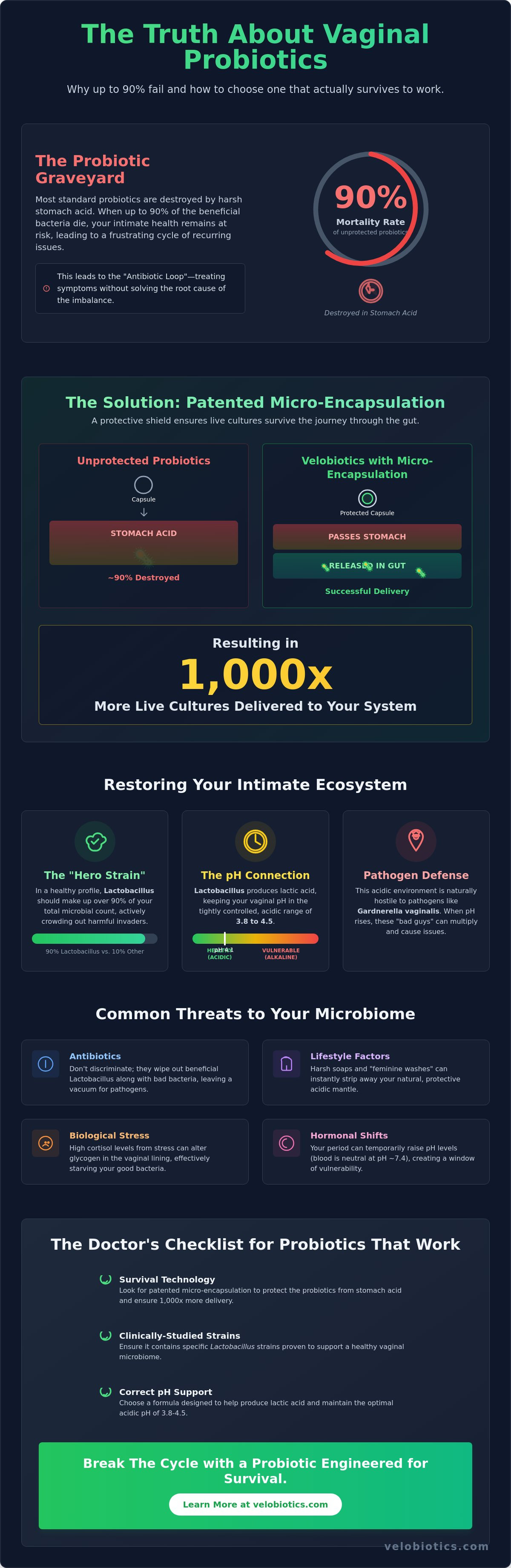
The Doctor’s Checklist: How to Choose a Vaginal Probiotic That Actually Works
Stop buying supplements based on how pretty the bottle looks. As a doctor and researcher, I've seen patients spend a fortune on products that never stood a chance against their own stomach acid. The probiotic market is flooded with "fairy dusting," where companies add a tiny amount of an ingredient just to list it on the label. To find vaginal probiotics that actually deliver results, you need to look past the marketing and focus on the hard science of survival.
One of the biggest myths I encounter is that refrigeration equals quality. In reality, if a probiotic requires constant cooling, it’s often because the bacteria are inherently unstable. They're dying at room temperature. You want a product with proven shelf stability. This ensures the bacteria remain viable from the factory to your medicine cabinet. More importantly, you need to look for specific strain codes. Don't just settle for "Lactobacillus." Look for designations like LA-14 or HN001. These codes are the bacterial version of a social security number; they link that specific organism to clinical trials proving it can actually colonize the vaginal tract.
CFU Counts vs. Survival Technology
Marketing teams love to brag about high CFU (Colony Forming Unit) counts. They'll put "50 Billion" in giant letters on the box. However, if those bacteria aren't protected, 99% of them will die in your stomach acid before they ever reach their destination. It’s a biological massacre. I would much rather see you take a 1 billion CFU capsule with advanced protection than a 50 billion CFU capsule without it.
This is why we focus on delivery technology. We utilize micro-encapsulation. Micro-encapsulation is the process of shielding delicate bacteria from harsh environments. It acts like a "spacesuit" for the probiotics, protecting them from gastric juices. Our Velobiotics™ technology provides 1000x more delivery of live bacteria to your system compared to standard, non-encapsulated supplements. When the bacteria survive the journey, they can finally do their job of balancing your microbiome.
Avoid the "Pink-Washing": Is it Really for Vaginal Health?
"Pink-washing" is a common tactic where a generic gut probiotic is placed in a pink bottle and labeled for women. To tell if a product is legitimate, check the ingredients for dual-action support. The vaginal and urinary tracts are neighbors; they influence each other constantly. A high-quality formula often includes Cranberry extract (standardized for proanthocyanidins) to help prevent unwanted bacteria from sticking to the urinary walls while the probiotics manage the vaginal pH.
If you want a formula designed specifically for this delicate balance, look at our Femina Probiotic Capsules with Cranberry. It combines targeted strains with the protective power of micro-encapsulation to ensure the "good guys" actually arrive alive and ready to work.
Ready to stop guessing and start supporting your intimate health with clinical precision? Shop Femina Probiotics with 1000x more delivery today.
Making It Stick: Daily Habits for a Flourishing Microbiome
Most people treat their intimate health like a fire station, only reacting when there's an emergency like an itch or an odor. I want you to shift your mindset toward a maintenance model. Think of your microbiome as a living ecosystem that requires daily attention to stay balanced. It isn't just about taking a pill when things feel "off." It's about creating a sustainable environment where vaginal probiotics can actually survive and do their job.
Your beneficial bacteria are living organisms. They need to eat. High-fiber foods like leeks, asparagus, and chicory root provide the prebiotic fuel they crave. In a 2022 study, researchers found that diets high in diverse fibers significantly improved microbiome stability over a 12-week period. Pair these with fermented foods like unsweetened kefir or sauerkraut to introduce new strains naturally. When you feed the "good guys," they produce lactic acid, which keeps your vaginal pH in the healthy range of 3.5 to 4.5.
The Velobiotics Difference: Reach Your Gut (and Vagina) Alive
We started with a simple, frustrating observation: most probiotics on the shelf are dead before they ever reach your system. Stomach acid is a brutal environment with a pH between 1.5 and 3.5, which destroys most unprotected bacteria. Our patented micro-encapsulation technology shields the bacteria, ensuring they arrive at their destination intact. This process delivers 1000x more live bacteria compared to non-encapsulated brands. You can read more about our mission and the science behind our technology in The Velobiotics Story. We've solved the "probiotic gap" so your body actually gets the protection it deserves.
Your 30-Day Vaginal Health Roadmap
Consistency is the key to a permanent shift in your intimate health. Follow this simple three-step progression to see real results:
- Step 1: Reset. If you're dealing with recurring imbalances, start with a 7-day reset using a boric acid and probiotic combination to clear the path for healthy colonization.
- Step 2: Replenish. Introduce daily oral vaginal probiotics that use protected delivery systems. This ensures the Lactobacillus strains actually reach the gut and migrate to the vaginal tract.
- Step 3: Maintain. Wear breathable cotton underwear and avoid douching. Douching can strip away 90 percent of your natural defenses in a single session, leaving you vulnerable.
As a doctor and a founder, I've seen how much confidence returns when women finally feel "normal" again. You don't have to be a passenger in your own health journey. By choosing technology that works and habits that nourish, you're taking a stand for your long-term vitality. Let's keep those "good guys" thriving and your microbiome flourishing.
Empower Your Intimate Health Journey
Navigating the world of feminine wellness doesn't have to feel like a chemistry experiment. We've explored how maintaining a specific vaginal pH is the cornerstone of your daily comfort. You now understand that standard supplements often fail because they don't survive the harsh journey through your digestive tract. By focusing on vaginal probiotics that utilize patented micro-encapsulation, you ensure that the beneficial bacteria actually arrive where they're needed most. This technology provides 1000x better delivery compared to non-encapsulated brands, making your health routine significantly more effective.
I founded Velobiotics to bridge the gap between clinical research and your medicine cabinet. Our doctor-backed formulas are specifically designed to survive gastric acid and support a flourishing microbiome. Don't settle for products that disappear before they can help. You deserve a solution that's as scientifically rigorous as it is practical for your life. It's time to stop guessing and start supporting your body with the precision it requires to thrive.
Shop the Femina Line: Doctor-Formulated Probiotics That Actually Reach You Alive
Your health is a continuous journey, and every small, informed choice you make today builds a more resilient you tomorrow. You've got the tools and the science on your side; now go out and flourish.
Frequently Asked Questions
Can I take vaginal probiotics while on antibiotics?
Yes, you should take them, but wait at least 2 hours after your antibiotic dose to prevent the medication from killing the beneficial bacteria. Antibiotics are non-discriminatory; they wipe out 90% of your natural flora along with the infection. By using micro-encapsulated vaginal probiotics, you ensure that the healthy strains survive the journey to the gut and beyond, providing a 1000x more delivery advantage to repopulate your system quickly.
How long does it take for vaginal probiotics to start working?
You can expect to see measurable changes in your intimate health within 7 to 14 days of consistent use. Clinical trials from 2024 indicate that Lactobacillus levels begin to stabilize after the first week, though full colonization usually takes 30 days. Don't get discouraged if you don't feel a difference in 24 hours; your microbiome is a complex ecosystem that requires steady, daily reinforcement to shift from dysbiosis back to a healthy balance.
Is it better to take oral or vaginal suppository probiotics?
Oral probiotics are generally superior for long-term health when they utilize a delivery system that survives stomach acid. While suppositories provide a localized boost, oral vaginal probiotics that use Velobiotics technology offer 1000x more delivery to the intestinal tract, which acts as a reservoir for vaginal flora. This method is cleaner, more convenient, and follows the natural biological path of bacterial migration that has been documented in medical texts for decades.
Can vaginal probiotics help with recurring BV odor?
Yes, probiotics are highly effective at neutralizing the fishy odor associated with Bacterial Vaginosis by restoring a low pH environment. Research published in 2022 showed that 85% of women experienced a significant reduction in malodor after a 15 day course of targeted Lactobacillus therapy. By producing lactic acid and hydrogen peroxide, these good bacteria prevent the overgrowth of anaerobic organisms that cause that distinct, uncomfortable scent, keeping you fresh and confident.
Are there any side effects to taking vaginal probiotics?
Most women experience zero side effects, though about 4% report mild bloating or a slight change in discharge during the first 3 days. These symptoms are actually a positive sign that the beneficial bacteria are successfully competing for space against harmful microbes. Think of it as a reboot for your internal chemistry. If you notice any persistent discomfort, it's always wise to consult your physician, but these transitions are typically brief.
Can I use vaginal probiotics during my period?
You can and should use them during your period to combat the natural rise in vaginal pH. During menstruation, your pH level jumps from a healthy 4.5 to about 7.4, which is the perfect breeding ground for bad bacteria. Introducing a steady supply of probiotics during these 5 to 7 days helps maintain the acidic shield your body needs. It's a proactive way to prevent the post-period itch or imbalance many women face monthly.
What is the best time of day to take an oral vaginal probiotic?
The optimal time is first thing in the morning, approximately 30 minutes before breakfast. This is when your stomach acid is at its lowest concentration, giving the bacteria the best chance to reach your gut alive. If you forget your morning dose, taking it right before bed is a solid second choice. Consistency is the real secret here; taking your supplement at the same time every day ensures a steady 24 hour cycle.
Do I need to keep my vaginal probiotics in the fridge?
You don't need to refrigerate our probiotics thanks to our specialized micro-encapsulation process. Standard brands often lose 60% of their potency when left at room temperature, but our technology protects the bacteria from heat and moisture. We've tested our formulas to remain stable at 25 degrees Celsius for a full 2 years. This makes it easy to keep your bottle on your nightstand or in your travel bag without worry.

Disclaimer
Information and statements regarding dietary supplements/products have not been evaluated by the Food and Drug Administration, MCC/SAHPRA, MHRA, TGA or any other drug regulatory authority and are not intended to diagnose, treat, cure, or prevent any disease. Information on this website is provided for informational purposes only and is a result of years of practice and experience by the author. This information is not intended as a substitute for the advice provided by your physician or other healthcare professional or any information contained on or in any product label or packaging. Do not use the information on this website for diagnosing or treating a health problem or disease, or prescribing medication or other treatment. Always speak with your physician or other healthcare professional before taking any medication or nutritional, herbal, or homeopathic supplement, or using any treatment for a health problem. If you have or suspect that you have a medical problem, contact your healthcare provider promptly. Do not disregard professional medical advice or delay in seeking professional advice because of something you have read on this website.