

7 Warning Signs You Need More Collagen in Your Diet: A Doctor's Guide for 2026
What if the biological "glue" holding your frame together is actually dissolving faster than your system can replace it? As a doctor, I frequently see patients who feel like they're aging ahead of schedule. Their joints feel stiff during morning routines, their skin loses its natural elasticity, and their digestion feels consistently sensitive. It is incredibly frustrating when you're proactive about your health but still feel your physical foundation weakening. You are likely experiencing the clinical signs you need more collagen in your diet, yet the solution isn't as simple as picking a random bottle off a shelf.
In this 2026 guide, I'll help you decode the subtle signals your body sends when its protein scaffolding begins to fail. You'll discover exactly how to restore your structural integrity through a targeted, gut-first approach. We will break down the specific roles of Type I and Type II collagen, address the common confusion surrounding supplements, and outline a practical plan to improve both your skin and gut health. By understanding the science of biological viability, you can move from unexplained discomfort to a state of resilient, lasting wellness.
Key Takeaways
- Identify how collagen functions as your body's essential biological glue and why maintaining this structural protein is vital for your long-term mobility.
- Recognize the seven clinical signs you need more collagen in your diet, including subtle changes in skin elasticity and the thinning of protective joint cartilage.
- Uncover the external and internal factors, like sugar-driven glycation and UV rays, that are actively destroying your collagen reserves faster than you can replace them.
- Learn why the secret to effective collagen supplementation lies in gut health and how specific probiotic strains act as the key to unlocking protein absorption.
- Gain a practical clinical strategy for restoring your structural integrity using advanced delivery systems that ensure nutrients survive stomach acid for maximum biological viability.
What Exactly Is Collagen and Why Is It the 'Glue' of Your Biology?
To understand your body's structural health, we must start with its most abundant protein. What Exactly Is Collagen? It is the primary structural protein found in the extracellular space of your connective tissues. The name itself comes from the Greek word "kólla," which literally means glue. This isn't just a clever metaphor; collagen acts as a microscopic scaffold that keeps your cells organized and your tissues resilient. Without it, your body would lacks the internal framework necessary to stay upright and mobile.
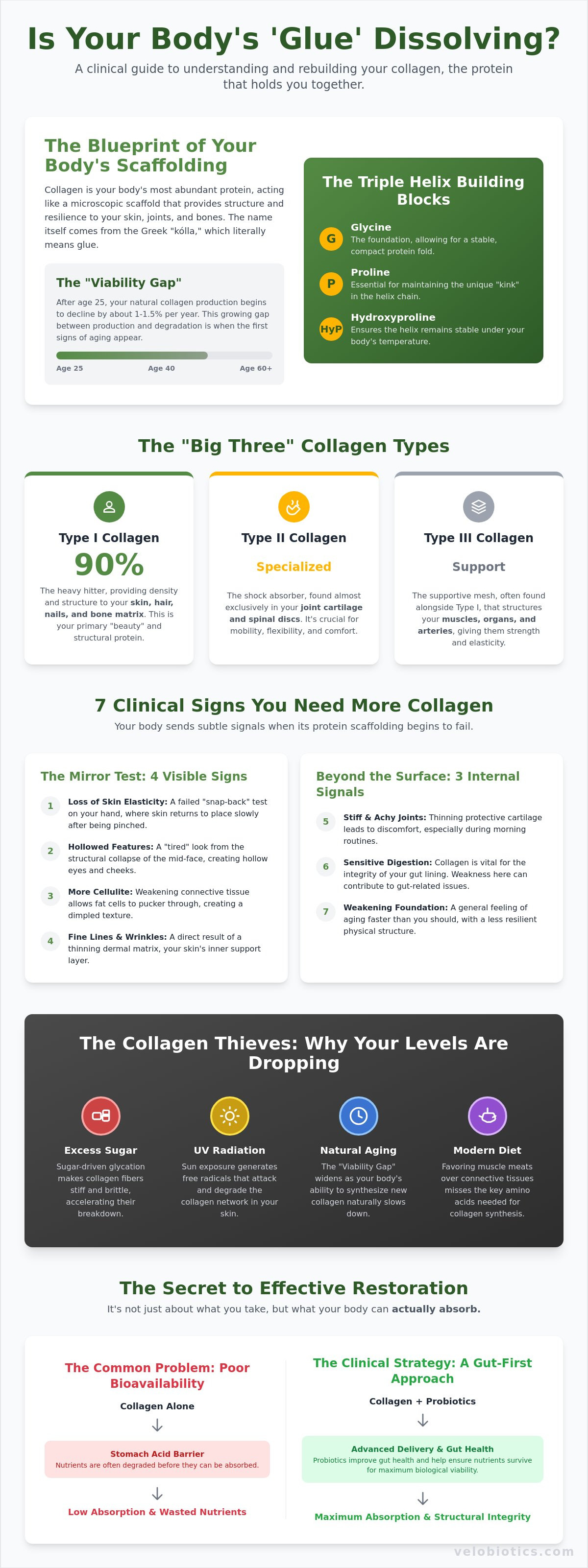
Unfortunately, our bodies don't maintain peak production forever. After the age of 25, your natural synthesis begins to decline, a phenomenon I call the "Viability Gap." This is when you might start noticing the physical signs you need more collagen in your diet, as your internal "glue" starts to wear thin. While there are at least 16 different types of collagen in the human body, we focus primarily on the "Big Three" because they account for the vast majority of our structural integrity.
Watching the clinical progression of deficiency helps clarify why intervention is necessary:
The Triple Helix: A Masterpiece of Bio-Engineering
Think of collagen as a high-performance rope. It's built from three specific amino acids that weave together into a tight, sturdy triple helix:
- Glycine: The foundation that allows for a stable, compact fold.
- Proline: Essential for maintaining the specific "kink" in the protein chain.
- Hydroxyproline: A modified version of proline that ensures the helix remains stable under body heat.
These specific building blocks are rare in a modern diet that favors "muscle-meats" like chicken breast or steak, which lack the connective tissue found in traditional bone broths. Think of collagen as the biological rebar that keeps your skin from sagging and your joints from grinding. When these amino acids are missing, the rebar rusts, and the entire structure begins to sag.
Type I vs. Type II: Knowing the Difference for Your Goals
Not all collagen is created equal. Type I is the heavy hitter, making up about 90% of your body's supply and providing density to your skin, hair, and bone matrix. Type II is the specialized shock absorber, found specifically in your cartilage and spinal discs. Type III typically supports the structure of your muscles, organs, and arteries. Recognizing the signs you need more collagen in your diet often means looking at both your skin's texture and your joint comfort simultaneously. A multi-type approach is far superior because it ensures you're supporting both your external appearance and your internal mechanical function.
The Mirror Test: 4 Visible Signs Your Collagen Reserves Are Low
Your reflection often acts as a real-time diagnostic tool for your internal protein status. While we think of wrinkles as a natural part of the aging timeline, they're often a physical manifestation of a thinning dermal matrix. One of the most clinical signs you need more collagen in your diet is a failed 'Snap-Back' test. To perform this, simply pinch the skin on the back of your hand for five seconds and release. In a collagen-rich environment, the skin returns to its original position instantly. If it lingers or flattens slowly, your structural scaffolding is losing its resilience and elasticity.
Beyond elasticity, look at the topography of your face. As we age, the loss of facial fat pads and the underlying collagen network creates hollowed eyes and cheeks. This "tired" look isn't just about sleep; it’s about the structural collapse of the mid-face. Similarly, the appearance of cellulite often signals a weakening of the fibrous connective tissue that keeps fat cells in place. When this mesh becomes brittle, fat puckers through, creating that characteristic dimpled texture. Understanding Why Your Levels Are Dropping is the first step toward reclaiming this surface-level integrity.
Fine Lines vs. Deep Furrows: Tracking the Decline
Surface-level moisturizers often fail because they don't penetrate the dermis, where collagen actually resides. When your collagen levels drop, your skin loses its ability to retain moisture, leading to a "crepey" texture on the neck and hands. This isn't just dryness; it's a lack of the internal sponge-like matrix that holds hydration. Deep furrows indicate a more advanced breakdown of the triple helix structure. To support this internal rebuilding process, you might consider how a high-viability delivery system can help your body actually utilize the proteins you consume.
Hair and Nails: The Outer Indicators of Inner Health
The human body is a master of biological triage. When protein resources are low, your system diverts amino acids away from "aesthetic" structures like hair and nails to protect vital organs. This results in brittle nails with vertical ridges and dull, thinning hair. Collagen provides the structural integrity for the hair follicle itself. If you notice your nails are growing slower than the average 3.5 millimeters per month, it’s a strong metric that your protein synthesis is lagging. Tracking this growth speed is a simple, practical way to monitor the signs you need more collagen in your diet without needing a lab test.
Beyond the Surface: Internal Signals and the Gut Connection
While the mirror provides immediate feedback, your internal systems offer a more profound narrative about your structural protein status. If you've transitioned from fluid motion to feeling like you have "creaky hinges," you are experiencing one of the most common internal signs of collagen loss. This isn't just a byproduct of time; it's a direct result of the thinning cartilage that cushions your bones. You might notice a pervasive ligament stiffness when you first get out of bed, or find that it takes significantly longer to bounce back from a standard workout than it did five years ago. These are clear signs you need more collagen in your diet to support the rapid repair of your connective tissues and muscle fibers.
The relationship between your joints and your diet is governed by a cause-and-effect mechanism. When collagen levels drop, the structural integrity of your ligaments weakens, leading to increased friction and discomfort. It's a biological signal that your body is prioritizing vital organ function over the "luxury" of smooth joint movement. Addressing these internal signals early can prevent the progression from simple stiffness to chronic structural degradation.
The Gut-Skin Axis: Why Your Digestion Dictates Your Glow
Most patients don't realize that their skin's glow actually starts in their small intestine. If your gut lining is compromised, a condition often referred to as "leaky gut," your body struggles to absorb the very collagen peptides you're consuming. This creates a frustrating efficacy gap where supplements pass through your system without being utilized. Glycine, a primary amino acid in collagen, is essential for repairing the mucosal lining of your digestive tract. Restoring your gut microbiome is a clinical prerequisite for collagen absorption. Without a healthy barrier, those expensive peptides never reach your bloodstream to support your dermal matrix or joint cartilage.
Joint Health: More Than Just 'Wear and Tear'
Type II collagen is specifically concentrated in your cartilage and spinal discs. It doesn't just provide structure; it acts as a signaling molecule that tells your body to initiate joint repair. There's a vital difference between temporary inflammation from a long hike and the structural degradation caused by a collagen deficit. To combat this, I recommend low-impact movement like swimming or cycling. These activities help "pump" nutrients into collagenous tissues that lack their own blood supply. This mechanical loading is a practical way to ensure your body uses its available protein resources effectively, especially when you notice the first signs you need more collagen in your diet.
The Collagen Thieves: Why Your Levels Are Dropping Faster Than They Should
When you start noticing the clinical signs you need more collagen in your diet, it's often because external "thieves" are outpacing your body's repair mechanisms. One of the most destructive processes is glycation. This occurs when excess glucose in your bloodstream bonds to collagen fibers, creating Advanced Glycation End-products (AGEs). These molecules act like a "crust" on your internal scaffolding, making once-flexible protein strands brittle and prone to snapping. This chemical hardening is a primary driver of premature wrinkles and loss of joint mobility, especially for those in the 35 to 54 age demographic who are most susceptible to cumulative metabolic stress.
Environmental factors also play a ruthless role. Photo-aging from UV rays is the leading external destroyer of the dermal matrix, physically unraveling the triple helix structure. Smoking compounds this damage through vasoconstriction, which starves your skin of the oxygen and nutrients required for protein synthesis. Even chronic stress contributes to the decline; high cortisol levels trigger a "fight or flight" response that breaks down structural proteins to provide quick glucose for energy. It's a biological trade-off that leaves your connective tissues weakened and depleted.
Defending Your Reserves: A Practical Protection Plan
Protecting your existing collagen is just as vital as replacing it. I recommend an "anti-glycation" diet that swaps refined carbohydrates for antioxidant-rich berries, which help neutralize AGEs. Vitamin C is a non-negotiable co-factor here. Your body cannot physically assemble collagen fibers without it. Additionally, prioritize sleep as your body's primary repair shop. Most collagen synthesis occurs during deep sleep cycles, making rest a fundamental pillar of structural health. If you're struggling with absorption despite a clean diet, utilizing an advanced probiotic delivery system can ensure your system actually utilizes the nutrients you consume.
Collagen-Boosting Foods vs. Direct Supplementation
Many patients ask if bone broth is enough to move the needle. While it contains beneficial minerals, the amino acid profile in homemade broths is highly variable and often lacks the concentration required for clinical results. To effectively support your body's "weaving" process, you need specific partners:
- Vitamin C: Found in citrus, bell peppers, and broccoli; it stabilizes the collagen helix.
- Zinc and Copper: These minerals act as the biological loom, weaving individual protein strands into a functional matrix.
- Sulfur-Rich Foods: Garlic and onions provide the sulfur necessary for collagen cross-linking.
To truly address the signs you need more collagen in your diet, you must bridge the gap between simple food intake and biological viability. You can start restoring your structural integrity today by choosing a science-backed collagen formulation that survives the harsh environment of your digestive tract.
Maximizing Bioavailability: The Probiotic-Collagen Synergy
The most significant hurdle in clinical nutrition isn't just getting nutrients into your mouth; it's getting them into your bloodstream. Many patients diligently track the signs you need more collagen in your diet and respond by purchasing the first supplement they find. However, most standard collagen products face a "hostile environment" in the stomach. Gastric acid is designed to break down proteins indiscriminately, often destroying the delicate peptide bonds before they reach the small intestine for absorption. This is why you might continue to see the physical signs of deficiency even after months of supplementation.
Probiotics serve as the biological "key" to this delivery problem. Specific bacterial strains act like molecular scissors, further breaking down collagen's triple helix into smaller, highly bioavailable di-peptides and tri-peptides. This synergy ensures that the structural proteins you ingest are actually utilized to repair your dermal matrix and joint cartilage. By optimizing your internal environment, you bridge the gap between ingestion and actual physiological repair.
Why 16 Strains Matter for Nutrient Delivery
A diverse microbiome is essential for complex protein metabolism. Using a broad-spectrum approach with 16 distinct probiotic strains ensures that multiple metabolic pathways are supported simultaneously. Our proprietary micro-encapsulation technology plays a critical role here, protecting the probiotics from stomach acid so they arrive alive in the gut. This balanced environment also reduces systemic inflammation, which is a primary "collagen thief" that degrades your structural integrity. Establishing a healthy gut with Velo16 Probiotic Digestive Capsules is a foundational step in ensuring your body can process and distribute collagen effectively.
Actionable Advice: Your Daily Collagen Protocol
To see measurable changes in your skin elasticity and joint comfort, you need a disciplined, science-backed routine. I recommend a "viability-first" approach to your 2026 wellness strategy:
- The Morning Synergy: Take your collagen peptides alongside a whole-food Vitamin C source, like a squeeze of fresh lemon or a handful of berries. Vitamin C is the mandatory co-factor that allows your cells to actually "stitch" those new amino acids into your existing tissues.
- The Consistency Rule: Biological remodeling takes time. While some notice improved gut comfort within days, it typically takes 8 to 12 weeks of consistent intake to see visible structural changes in the skin and joints.
- Hydration Focus: Collagen requires water to maintain its "plumping" effect in the dermis. Ensure you're drinking at least two liters of filtered water daily to support the new protein matrix.
Identifying the signs you need more collagen in your diet is only the first half of the equation. The real transformation happens when you focus on the delivery system. Always remember: you are not what you eat; you are what you successfully absorb.
Reclaiming Your Structural Integrity in 2026
Identifying the clinical signs you need more collagen in your diet is the essential first step toward reversing the biological "Viability Gap." We've explored how your body's internal scaffolding depends on more than just high protein intake; it requires a healthy gut-skin axis and a delivery system that survives the harsh environment of the stomach. By addressing the "thieves" of collagen like glycation and UV damage while prioritizing Type I and Type II support, you can transition from "creaky hinges" to a state of resilient wellness.
To truly bridge the gap between professional medical knowledge and your daily routine, you need a solution designed for biological success. Our doctor-formulated approach uses proprietary micro-encapsulation technology that ensures probiotics survive with 1000x better viability than standard offerings. This provides the essential gut-skin synergy your body needs to absorb and utilize every peptide. Discover the science of viable wellness with Velobiotics Collagen Peptides and start restoring your foundation today.
Your body's ability to repair itself is a masterpiece of bio-engineering. With the right tools and a focus on absorption, you can maintain your strength and glow for years to come.
Frequently Asked Questions
How long does it take for collagen supplements to work for skin and joints?
You should expect to see measurable results in skin elasticity and joint comfort within 8 to 12 weeks of consistent daily use. While some patients report improved gut comfort much sooner, structural remodeling is a slow physiological process that cannot be rushed. Your body needs this window to synthesize new fibers and integrate them into the existing dermal matrix or cartilage for lasting structural support.
Can I get enough collagen from a vegan or vegetarian diet?
True collagen is exclusively found in animal tissues, so a strictly vegan diet cannot provide it directly. However, you can support your body's natural production by consuming high doses of Vitamin C, zinc, and copper found in legumes, seeds, and leafy greens. If you are experiencing the signs you need more collagen in your diet, you may need to supplement with specific amino acids like glycine and proline to bridge the gap.
Is it better to take collagen on an empty stomach or with food?
You can take collagen at any time, but taking it with a Vitamin C source often enhances the synthesis process. Some prefer an empty stomach to avoid competition with other proteins for absorption. The most critical factor isn't the timing, but the health of your microbiome. Ensuring your gut can actually process the peptides is far more important than whether you've just eaten a meal.
What is the difference between collagen peptides and hydrolyzed collagen?
There is no functional difference; both terms refer to collagen that has been broken down into smaller chains through a process called hydrolysis. These smaller "peptides" are much easier for your digestive system to absorb than the long, complex protein chains found in food. This increased bioavailability is what makes supplementation more effective than simply eating more muscle meat, which lacks the necessary connective tissue profile.
Can collagen help with weight loss or metabolic health?
Collagen can support metabolic health by promoting satiety and preserving lean muscle mass. As a high-protein source, it helps you feel full longer, which can reduce overall caloric intake throughout the day. Additionally, the amino acid glycine plays a role in regulating blood sugar levels. While it isn't a "magic" fat burner, it is a valuable tool for maintaining a healthy body composition as your metabolism shifts with age.
Are there any side effects to taking high doses of collagen daily?
Most individuals tolerate collagen very well, though some may experience mild bloating or a feeling of heaviness if they start with a high dose too quickly. It's best to begin with a standard serving and allow your digestive tract to adjust. If you have pre-existing kidney concerns, always consult your physician before significantly increasing your daily protein intake to ensure your system can safely process the extra nitrogen.
Do probiotics really help with collagen absorption?
Probiotics are essential for maximizing the biological viability of the proteins you consume. Specific strains act like microscopic tools that further refine collagen peptides into the di-peptides and tri-peptides your bloodstream can actually use. Without a balanced microbiome, much of your supplement may simply pass through your system. This synergy is why a "gut-first" approach is the most efficient way to address the signs you need more collagen in your diet.
Does sugar actually cause wrinkles through collagen damage?
Sugar is one of the primary external "thieves" of skin youthfulness due to a process called glycation. When your blood sugar is high, glucose molecules attach to collagen fibers, creating "cross-links" that make the fibers stiff and brittle. This prevents your skin from snapping back into place and leads to deep, permanent furrows. Reducing refined sugar is perhaps the most effective way to protect your existing structural proteins from premature decay.

Disclaimer
Information and statements regarding dietary supplements/products have not been evaluated by the Food and Drug Administration, MCC/SAHPRA, MHRA, TGA or any other drug regulatory authority and are not intended to diagnose, treat, cure, or prevent any disease. Information on this website is provided for informational purposes only and is a result of years of practice and experience by the author. This information is not intended as a substitute for the advice provided by your physician or other healthcare professional or any information contained on or in any product label or packaging. Do not use the information on this website for diagnosing or treating a health problem or disease, or prescribing medication or other treatment. Always speak with your physician or other healthcare professional before taking any medication or nutritional, herbal, or homeopathic supplement, or using any treatment for a health problem. If you have or suspect that you have a medical problem, contact your healthcare provider promptly. Do not disregard professional medical advice or delay in seeking professional advice because of something you have read on this website.