

Best Probiotic for Vaginal Health: A Doctor’s Guide to Lasting Balance (2026)
What if the supplement you're taking is dying before it even reaches its destination? It's a hard truth, but many women spend a fortune searching for the best probiotic for vaginal health only to ingest bacteria that can't survive the harsh environment of the digestive tract. If you've struggled with recurrent infections despite rounds of antibiotics or felt the embarrassment of persistent odor, you aren't alone. It's exhausting to feel like you're constantly managing symptoms rather than solving the root cause.
I understand that frustration. You deserve a solution that moves beyond vague wellness promises and relies on hard clinical data, especially since the FDA doesn't regulate these supplements for efficacy. In this guide, I'll show you how to identify specific strains like Lactobacillus rhamnosus and L. reuteri that actually colonize effectively. We'll explore the advanced delivery science that protects these delicate microbes, ensuring they survive to reseed your microbiome. By the end, you'll know exactly how to bypass the marketing hype and choose a formula that provides the lasting balance you've been looking for.
Key Takeaways
- Understand the biological mechanism of the "Acid Shield" and why maintaining a pH of 3.8–4.5 is your first line of defense against recurring imbalance.
- Identify the specific clinical strains that constitute the best probiotic for vaginal health, focusing on the microbes that naturally dominate a healthy ecosystem.
- Compare the efficacy of oral capsules versus suppositories to determine which delivery method provides the most effective "reseeding" for your body.
- Learn the "Clear and Reseed" method for tackling stubborn issues by using boric acid to remove biofilms before introducing protective probiotics.
- Get a practical checklist to verify the viability and technological seals of any supplement, ensuring the active ingredients are actually utilized by your body.
The Science of Your Vaginal Microbiome: Why Balance is Everything
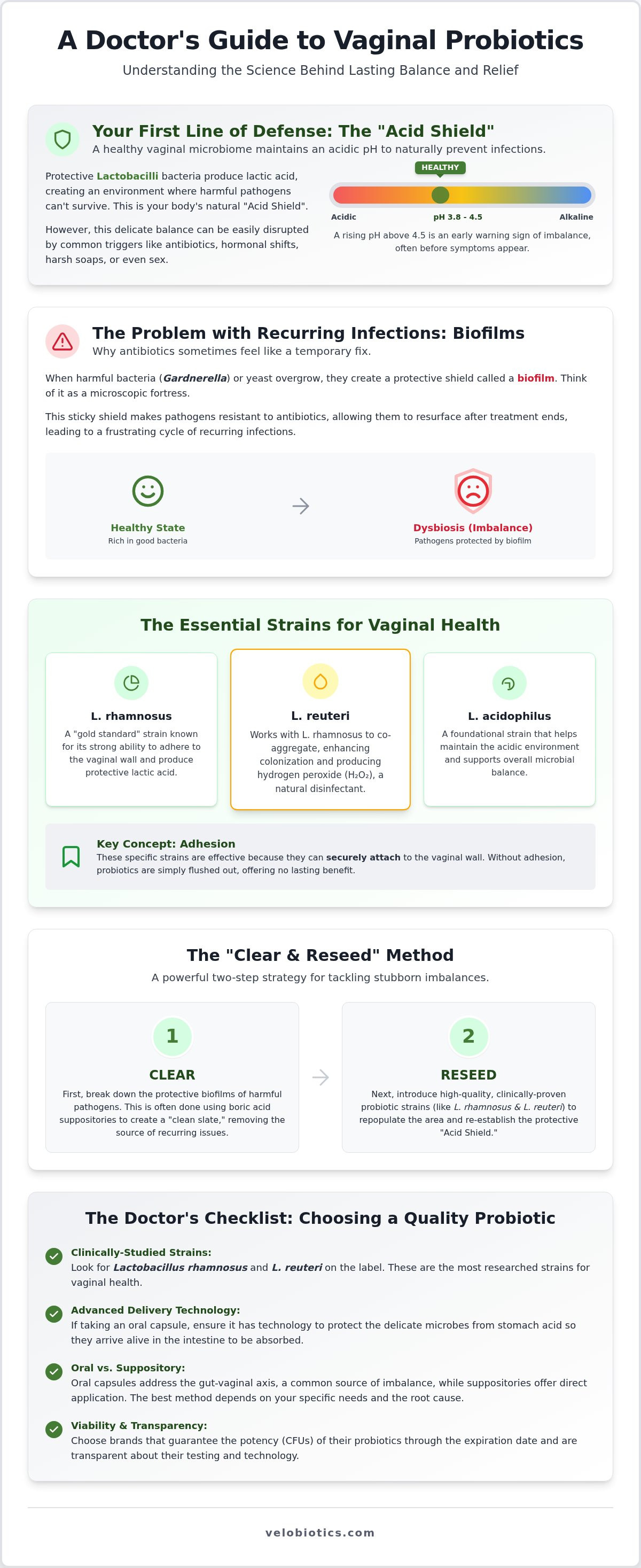
Think of your body as a high-end club. The vaginal microbiome is the exclusive VIP lounge. It's a delicate ecosystem where "good" bacteria, primarily Lactobacilli, keep the peace. When patients ask me for the best probiotic for vaginal health, they're really looking for a way to restock the security team at the door. These Lactobacilli act like elite bouncers. They produce lactic acid, creating an "Acid Shield" with a healthy pH typically between 3.8 and 4.5. This acidic environment is hostile to unwanted guests like Gardnerella vaginalis or yeast.
If the bouncers take a break, these pathogens don't just walk in; they set up camp. They build "biofilms," which are sticky, protective shields that act like a microscopic fortress. This is why standard antibiotics often feel like a temporary fix. They might kill the active bacteria, but they struggle to penetrate the biofilm. Once the medication stops, the pathogens resurface from behind their shield, and the cycle of infection starts all over again.
To better understand this concept, watch this helpful video:
What Happens When Balance Shifts? (Dysbiosis)
When your protective bacteria are outnumbered, you enter a state called dysbiosis. This is the biological transition from a healthy state to symptomatic BV or yeast infections. Triggers are everywhere: antibiotics that wipe out your natural flora, hormonal shifts during your cycle, or even alkaline semen after sex. Harsh soaps are another major culprit. Simply "killing" the bad bacteria with a prescription isn't enough. If you don't actively replace the good strains, your internal environment remains an empty house waiting for the next pathogen to move in.
pH Balance: The Ultimate Health Metric
Lactic acid production is your primary mechanism of protection. It is the fuel for your Acid Shield. A rising pH level is often the very first warning sign that an infection is brewing, sometimes days before you notice an odor or discharge. You can actually be proactive here. I recommend keeping a pack of vaginal pH strips in your medicine cabinet. If you see your levels climbing above 4.5 after your period or intimacy, it's a signal to support your microbiome with the best probiotic for vaginal health before symptoms become disruptive.
Essential Strains: Which Microbes Actually Protect Vaginal Health?
Many women reach for the first bottle of "probiotic" yogurt they see in the grocery aisle when they feel an imbalance coming on. While yogurt is great for your breakfast, it's rarely the solution for your intimate health. The best probiotic for vaginal health requires a very specific set of biological skills that generic gut strains simply don't possess. We are looking for specialized microbes that can survive the digestive journey and then successfully colonize the vaginal tract.
The "Big Three" you should look for on any label are Lactobacillus rhamnosus, Lactobacillus reuteri, and Lactobacillus acidophilus. These aren't just random names; they are the heavy hitters of the microbiome. Their primary job is to produce lactic acid and hydrogen peroxide (H2O2). This production of H2O2 is critical because it acts as a natural disinfectant, keeping the environment sterile and preventing pathogens from gaining a foothold. Without these specific strains, the vaginal ecosystem becomes vulnerable to overgrowth and infection.
Success also depends on a concept called adhesion. Adhesion is the ability of a specific bacterial strain to securely attach itself to the vaginal wall to prevent being washed away by natural physiological fluids. If a strain cannot "stick," it cannot protect you. This is why many generic supplements fail; they contain bacteria that might be alive in the capsule but are incapable of setting up a permanent residence where you need them most.
L. rhamnosus and L. reuteri: The Gold Standard
Clinical trials have repeatedly demonstrated that the combination of L. rhamnosus and L. reuteri significantly reduces the recurrence of Bacterial Vaginosis (BV). These strains are unique because of their documented ability to migrate from the gut to the vaginal tract after oral ingestion. However, they can only make this trek if they survive the "viability gap," which is the harsh transit through stomach acid and bile. Using targeted oral capsules designed for survival ensures these microbes arrive at their destination ready to work.
Why Diversity Matters (But Only the Right Kind)
Don't fall for the marketing trap that "more strains equals better results." A supplement with 15 different gut-focused strains is a shotgun approach that often lacks the concentration of the specific bacteria your vagina actually needs. In the world of microbiology, we call this strain specificity. You wouldn't hire a plumber to fix your electrical wiring just because they are both "contractors." Similarly, you need a sniper-like focus on the Lactobacilli that naturally dominate a healthy vaginal environment. For a deeper look at how these microbes combat specific imbalances, you can explore this Pillar: Probiotics for BV.
Oral Capsules vs. Suppositories: Comparing Delivery Methods for Efficacy
When you're standing in the supplement aisle searching for the best probiotic for vaginal health, you'll likely face a choice between a bottle of capsules and a box of suppositories. It's a common point of confusion. To choose correctly, you have to understand the biological gauntlet these microbes face. Your stomach is a vat of hydrochloric acid with a pH as low as 1.5. Its primary job is to destroy bacteria. For an oral probiotic to work, it must survive this acid, withstand bile salts in the small intestine, and then successfully migrate to the vaginal tract. This is the "Journey Problem."
Without advanced delivery technology, most oral probiotics are biologically dead before they even reach your intestines. This viability gap is the reason many women feel like their supplements aren't doing anything. In contrast, the direct approach of a suppository bypasses the digestive system entirely. It delivers the "good" bacteria exactly where they are needed, providing immediate reseeding to the affected area. Choosing between them isn't about which is better overall, but which is better for your current physiological needs.
Oral Probiotics: The Long-Term Maintenance Strategy
Oral supplements are your best bet for daily prevention and overall immune support. They work systemically to keep your microbiome populated over time. However, survival is the only metric that matters here. If the label doesn't mention micro-encapsulation or acid-resistant technology, those billions of CFUs might never make it to your "VIP lounge." For patients who want to support both their urinary and intimate health, I suggest Femina Probiotic Capsules with Cranberry. The micro-encapsulation ensures the strains stay viable through the stomach so they can actually do their job.
Vaginal Suppositories: The 'Emergency' Reset
If you are currently dealing with active odor, unusual discharge, or have just finished a course of antibiotics, you need a local intervention. Suppositories act as an "emergency reset" by providing 100% delivery of the active strains directly to the vaginal wall. This method is incredibly efficient for restoring balance quickly when your system has been compromised. It's a targeted strike against dysbiosis. A critical safety reminder: never ingest suppositories orally. They are designed for local absorption only, and you should always follow the specific packaging instructions for the best results.
The Doctor’s Checklist: How to Identify a High-Quality Vaginal Probiotic
When patients ask me how to spot the best probiotic for vaginal health, I tell them to ignore the flashy front-of-box marketing. You have to look at the "fine print" on the back. A truly effective supplement isn't just a collection of bacteria; it's a piece of biological engineering. Use this checklist to separate high-tech solutions from generic placebos that won't survive the journey to your microbiome.
- Verify the Strains: Ensure the label lists L. rhamnosus or L. reuteri. These are the most clinically validated strains for intimate balance. Generic "Lactobacillus" isn't enough; you need the specific strains that have been studied for vaginal adhesion.
- Demand Delivery Technology: Look for mentions of micro-encapsulation or acid-resistance. Without a protective shield, your stomach acid will destroy the active ingredients before they reach your intestines.
- Check the Expiry Guarantee: CFU counts should be guaranteed at the time of expiration, not just at the time of manufacture. Bacteria naturally die off over time, so you need to know what's still alive when you actually swallow the capsule.
- Look for Synergistic Ingredients: Ingredients like cranberry extract provide a dual-action approach. While probiotics reseed the flora, cranberry helps prevent pathogens from sticking to the urinary tract walls.
- Assess the Packaging: Moisture is the enemy of shelf-stable bacteria. Probiotics should be in moisture-controlled bottles or individual blister packs to prevent them from "activating" and dying in the bottle.
The CFU Myth: Why More Isn't Always Better
Don't be fooled by labels boasting 50 or 100 billion CFUs. If those bacteria are dead by the time they reach your gut, the number is meaningless. 50 billion dead bacteria are far less useful than 1 billion live ones that actually colonize. I prefer to focus on Bio-viability, which is the actual number of bacteria that reach the target site alive and ready to function. You can read more about the Probiotics That Survive Stomach Acid to understand the engineering required for true efficacy. High-quality supplements prioritize survival over inflated numbers.
Shelf Stability and Storage
If a probiotic requires constant refrigeration, it's often a sign of fragile technology. While some strains are naturally heat-sensitive, high-quality micro-encapsulated formulas are designed to be shelf-stable. This is a practical necessity for busy lifestyles. Unprotected probiotics can easily be killed by heat and humidity during shipping or while sitting in a warm mailbox. Choosing a stable formula ensures that the potency you paid for is the potency you actually receive. For a solution that meets all these clinical standards, you can shop the Femina™ Probiotic Capsules with Cranberry Extract to start your journey toward lasting balance.
Ready to upgrade your intimate health routine? Explore our full range of doctor-founded probiotics designed for maximum biological viability.
The Velobiotics Solution: Advanced Delivery for Vaginal Viability
While some academic reports suggest that effective microbial therapeutics are still on the horizon, we have focused on solving the viability gap right now. The best probiotic for vaginal health isn't defined by a long list of ingredients; it's defined by the delivery system that protects those ingredients. Our proprietary micro-encapsulation technology is the "secret sauce" that distinguishes our approach. This technology provides up to 1000x better survival rates for probiotics compared to standard, unprotected formulas. By shielding the delicate Lactobacilli from environmental stressors, we ensure that the bacteria are actually utilized by your body rather than dying in the package or during transit.
We've moved beyond the "one-size-fits-all" supplement model to address the reality of stubborn, recurrent imbalances. This led to the development of the "Clear and Reseed" method. This dual-action approach acknowledges that you cannot effectively plant a garden in a field full of weeds. You must first clear the path before the good bacteria can successfully colonize and protect your internal environment.
The 'Clear and Reseed' Strategy
Many women turn to boric acid as a standalone solution for odor or discharge. While boric acid is excellent at breaking down biofilms, using it alone is only half the battle. It leaves a microbial vacuum. If you don't immediately introduce protective probiotics into that empty space, the pathogens will simply return and rebuild their fortresses. By using Femina Probiotic COOKIE FRESH Suppositories with Boric Acid, you address both needs at once. The boric acid clears the biofilm, while the micro-encapsulated probiotics reseed the flora to prevent bad bacteria from gaining a foothold. For those dealing with persistent issues, a consistent 7 to 14-day timeline is the gold standard for restoring a lasting Acid Shield.
A Founder’s Promise: Science You Can Feel
I founded this brand because I was tired of seeing patients frustrated by temporary "quick fixes" that failed to address the underlying biological challenges. The Velobiotics Story is built on a commitment to empirical evidence and functional superiority. We believe that vaginal health is a continuous journey of balance, not a single destination. Our goal is to bridge the gap between complex laboratory breakthroughs and your daily routine. It's time to move away from vague wellness promises and embrace a clinical solution that actually works. Join the thousands of women who have found their "Cookie Fresh" confidence by choosing a system designed for maximum biological viability.
Empower Your Microbiome with Clinical Precision
Achieving lasting intimate balance isn't a matter of luck; it's a result of targeted biological support. You now know that the best probiotic for vaginal health must offer more than just a high CFU count. It requires clinically validated strains like L. rhamnosus and a delivery system that ensures those microbes actually survive the journey to their destination. By adopting a "Clear and Reseed" strategy, you can break down stubborn biofilms and restore your natural Acid Shield for long-term protection.
As a doctor-founded brand, we've engineered our formulas to solve the viability gap that causes so many other supplements to fail. Our proprietary micro-encapsulation technology provides 1000x better survival rates, while our dual-action suppositories combine boric acid with probiotics for a comprehensive reset. Don't settle for temporary fixes when you can support your body with science-backed solutions. Shop the Femina Cookie Fresh Collection for Lasting Vaginal Balance and take the first step toward a more confident, balanced life. You deserve to feel your best every single day.
Frequently Asked Questions
How long does it take for vaginal probiotics to work?
You can expect different timelines based on your chosen delivery method. Vaginal suppositories typically offer symptom relief within 24 to 72 hours because they provide immediate local reseeding. Oral capsules usually require more patience, often taking 14 to 28 days to establish a stable colony. For the most effective results, consistency is vital. You're trying to shift an entire ecosystem, so daily dosing helps ensure the new "good" bacteria can successfully compete for space.
Can I take oral probiotics and use vaginal suppositories at the same time?
Combining both formats is often the most comprehensive way to manage your microbiome. I frequently recommend using a suppository for an immediate "emergency reset" while taking oral capsules for long-term systemic maintenance. This dual-action approach ensures you are clearing pathogens locally while building up a defensive reserve internally. Just ensure your oral supplement uses micro-encapsulation technology so the bacteria actually survive the journey through your stomach acid to reach the vaginal tract.
Which probiotic strain is best for eliminating vaginal odour?
To eliminate persistent odor, look for Lactobacillus rhamnosus and Lactobacillus reuteri. These specific strains are the heavy hitters for producing lactic acid and hydrogen peroxide. This creates a sterile environment that prevents odor-causing pathogens like Gardnerella from flourishing. When you choose the best probiotic for vaginal health, these gold-standard strains are non-negotiable. They act as the elite security team that maintains your "Acid Shield" and keeps your internal environment fresh and balanced.
Do probiotics help with recurrent yeast infections?
Probiotics are a powerful tool for preventing yeast overgrowth by maintaining a strictly acidic environment. Candida thrives when your pH rises above 4.5, but a healthy population of Lactobacilli keeps your pH between 3.8 and 4.5. By producing natural antifungal substances, these "good" bacteria prevent yeast from setting up camp. If you suffer from recurrent infections, focus on strains that excel at adhesion so they can stay on the vaginal wall and provide long-term protection.
Should I take probiotics while on antibiotics for BV?
You should definitely start probiotics as soon as you begin antibiotics. Antibiotics are like a wildfire that clears out all bacteria, both good and bad. This leaves a biological vacuum that pathogens are eager to fill. By introducing high-quality probiotics during and after your course, you "reseed" the area before the bad guys can return. Just remember to space your oral probiotic dose at least two hours away from your antibiotic to ensure the bacteria survive.
Can probiotics help restore pH balance after my period?
Your period is a major trigger for imbalance because menstrual blood has a pH of about 7.4. This alkaline shift can temporarily deactivate your "Acid Shield," making you vulnerable to infections right after your cycle ends. Using a targeted probiotic or a suppository during this window helps drop your pH back into the safe 3.8 to 4.5 range. It's a practical way to proactively manage your health and prevent that "post-period" irritation from starting.
Is it better to take probiotics in the morning or at night?
Timing depends on the format you choose. For oral probiotics, taking them on an empty stomach, either first thing in the morning or right before bed, helps the bacteria move through the stomach quickly. For vaginal suppositories, I always recommend nighttime application. This allows the product to absorb fully while you are lying down, preventing gravity from causing the active ingredients to leak out before they can reseed the vaginal wall effectively.
Can I use vaginal probiotics while pregnant or breastfeeding?
Probiotics are generally considered safe and beneficial during pregnancy and breastfeeding to help prevent common issues like BV or Group B Strep. Maintaining a healthy microbiome is important for both you and your baby during this time. However, because every pregnancy has its own unique clinical profile, you must consult your OB-GYN before starting any new supplement. They can help you choose the best probiotic for vaginal health that aligns with your specific prenatal care plan.

Disclaimer
Information and statements regarding dietary supplements/products have not been evaluated by the Food and Drug Administration, MCC/SAHPRA, MHRA, TGA or any other drug regulatory authority and are not intended to diagnose, treat, cure, or prevent any disease. Information on this website is provided for informational purposes only and is a result of years of practice and experience by the author. This information is not intended as a substitute for the advice provided by your physician or other healthcare professional or any information contained on or in any product label or packaging. Do not use the information on this website for diagnosing or treating a health problem or disease, or prescribing medication or other treatment. Always speak with your physician or other healthcare professional before taking any medication or nutritional, herbal, or homeopathic supplement, or using any treatment for a health problem. If you have or suspect that you have a medical problem, contact your healthcare provider promptly. Do not disregard professional medical advice or delay in seeking professional advice because of something you have read on this website.