

How Gut Health Impacts Male Testosterone Levels: A Doctor’s Guide to the Gut-Testis Axis
Could the secret to your peak performance and gym recovery be hiding in your colon rather than your lifting routine? Most men I see in my clinic are frustrated by unexplained fatigue and stubborn bloating despite hitting the weights regularly. You've likely tried every "testosterone booster" on the shelf, only to find they don't deliver on their promises. We are going to dive into exactly how gut health impacts male testosterone levels through a complex biological highway known as the gut-testis axis. Recent 2026 research published in the Journal of Ageing and Longevity even suggests that specific probiotic combinations can lead to a 12 percent average increase in testosterone levels.
I understand how confusing it is to sort through conflicting advice while your energy levels continue to dip. This guide will clarify the biological link between your microbiome and male vitality, offering you actionable dietary changes you can start today. You will learn the science of bacterial viability and how to identify supplements that actually reach their destination instead of being destroyed by stomach acid. Let's look at how fixing your internal environment can finally unlock the results you've been working for.
Key Takeaways
- Learn how the gut-testis axis creates a direct communication line between your digestive system and your reproductive health, dictating how much hormone your body actually produces.
- Discover how gut health impacts male testosterone levels by preventing metabolic endotoxemia, a condition where gut toxins leak into your blood and shut down hormone-producing Leydig cells.
- Understand the role of Short-Chain Fatty Acids like butyrate, which act as chemical messengers to tell your brain and pituitary gland to keep testosterone production high.
- Get a practical plan to restore your microbiome through fiber diversity, including why you should aim for 30 different plant types a week to maximize hormonal signaling.
- Identify the specific criteria for a male-focused probiotic, focusing on 16-strain diversity and delivery technology that ensures the bacteria survive the journey through stomach acid.
Understanding the Gut-Testis Axis: Why Your Digestion Dictates Your Hormones
Think of your body like a high-performance engine. If the fuel line is clogged, it doesn't matter how much premium fuel you pump in; the output will still suffer. In my clinical practice, I often see men rushing toward testosterone replacement therapy (TRT) without looking at the "hormonal upstream" factors. Your gut is basically the board of directors for your hormones, and right now, they might be voting for a layoff. The most critical of these factors is the gut-testis axis. This bidirectional communication system means your microbiome isn't just processing lunch; it's actively talking to your reproductive system.
The gut-testis axis is a complex signaling pathway where intestinal bacteria influence the production of gonadotropins, the precursors to testosterone. Since your gut houses 70 to 80 percent of your immune system, any dysfunction there creates a ripple effect that hits your hormone-producing glands. Understanding how gut health impacts male testosterone levels starts with realizing that your testicles don't operate in a vacuum. If your gut is inflamed, your hormones will be suppressed. It's often the missing link for men wondering why their vitality has stalled.
To better understand this concept, watch this helpful video:
The Microbiome: Your Body’s Internal Pharmacy
Your gut is home to trillions of microorganisms that act as a biological pharmacy. These bacteria produce enzymes and vitamins that are essential for steroidogenesis, which is the technical term for making hormones. Understanding the Gut Microbiome is vital because a diverse ecosystem prevents bad bacteria from "hijacking" your hormones. For instance, specific microbes help recycle hormones, ensuring they stay in circulation rather than being wasted. When diversity drops, this recycling process breaks down. This is why I recommend focusing on variety, such as using Velo16, which provides 16 distinct strains to ensure your internal pharmacy stays fully stocked.
Signs Your Gut is Tanking Your Testosterone
You might think your digestion is "fine" because you don't have constant pain, but your microbiome could still be struggling. Common issues like bloating or gas are often red flags for low T. Have you noticed a "post-meal slump" where your energy crashes after eating? That isn't just a food coma; it's a sign of metabolic stress. When your gut is out of balance, it sends distress signals that cause your brain to downregulate testosterone production to save energy. If you're dealing with brain fog and low energy alongside digestive discomfort, your gut-testis axis is likely the culprit. Recognizing how gut health impacts male testosterone levels through these subtle signs is the first step toward reclaiming your edge.
The Inflammation Connection: How Leaky Gut Lowers T-Levels
Chronic inflammation is the silent killer of male vitality. While many men focus on lifting heavier or sleeping more, they often overlook the fire burning in their digestive tract. When your gut lining becomes compromised, a condition often called "leaky gut," it triggers a cascade of systemic issues known as metabolic endotoxemia. This happens when toxins, specifically bacterial fragments, escape the intestines and enter your bloodstream. Once these toxins are loose, your immune system goes into high alert, creating a pro-inflammatory environment that directly targets your hormonal health.
This inflammatory state is a primary reason how gut health impacts male testosterone levels so aggressively. Your body is designed to prioritize survival over reproduction. If your system is fighting a constant internal battle against gut-derived toxins, it shifts resources away from hormone production. This often leads to a spike in cortisol, the body's primary stress hormone. Since testosterone and cortisol are both derived from cholesterol, they share the same biological building blocks. In a state of chronic inflammation, your body "steals" these precursors to make more cortisol, leaving your testosterone levels in the gutter.
Endotoxins and the Leydig Cell Shutdown
The primary culprit in this process is a group of endotoxins called Lipopolysaccharides (LPS). These are components of the cell walls of certain bacteria in your gut. When LPS leaks into your blood, it travels to the testes and interferes with the Leydig cells, which are your body's primary testosterone factories. Research on The Gut Microbiota-Testis Axis shows that inflammation can actually block the Luteinizing Hormone (LH) signal from your brain. This means even if your brain is screaming at your body to produce more testosterone, the message never gets through. Clinical observations suggest that even mild gut permeability can reduce testosterone production by approximately 30 percent.
Nutrient Absorption: The Building Blocks of Testosterone
You can't build a house without bricks, and you can't build testosterone without specific micronutrients. The "Big Three" for male hormonal health are Zinc, Vitamin D, and Magnesium. Your gut is responsible for absorbing these minerals, along with the healthy fats and cholesterol required for steroid hormone production. If your gut lining is inflamed or your microbiome is out of balance, you can eat a perfect organic diet and still remain nutrient-deficient. This is why addressing absorption is just as important as the food you eat. For men looking to bridge this gap, using a targeted multivitamin like His-Biotics ensures that your essential nutrients are delivered alongside probiotics that actually survive the journey to the gut.
If you want to protect your T-levels, you have to protect your gut barrier. Reducing processed seed oils and excessive alcohol is a great start to lowering that internal fire. For those ready to take a professional approach to their hormonal health, consider exploring how a high-viability probiotic can help restore your intestinal integrity and support your natural testosterone production.
Beyond Digestion: Gut Bacteria and Hormone Signaling
Your gut is much more than a processing plant for your Muscle Works protein shakes. It acts like a biological radio station, constantly broadcasting signals to your brain and endocrine system. One of the most fascinating ways how gut health impacts male testosterone levels is through the production of Short-Chain Fatty Acids (SCFAs), specifically butyrate and acetate. When your beneficial bacteria ferment fiber, they create these SCFAs, which act as chemical messengers. These messengers travel through the bloodstream to the pituitary gland, giving it the "green light" to release the precursor hormones needed for testosterone production.
Without a robust population of fiber-munching bacteria, this signaling loop becomes faint. It's like trying to make a phone call with only one bar of service; the message to produce testosterone simply doesn't get through clearly. This is why diversity is non-negotiable. To keep these signals strong, I often suggest a broad-spectrum approach like Velo16, which provides the bacterial variety necessary to maintain high SCFA output. When these bacteria are thriving, they ensure the brain-pituitary-testis signaling loop remains optimized for peak performance.
The Estrobolome: Managing the Male Estrogen Balance
Many men believe estrogen is "the enemy," but the truth is more nuanced. You need a specific, healthy amount of estrogen for bone density and cognitive function. The problem arises when your "estrobolome", a dedicated group of gut bacteria, stops working correctly. These bacteria produce an enzyme called beta-glucuronidase. If your gut is sluggish or imbalanced, this enzyme can unbind estrogen that was supposed to be excreted, causing your body to reabsorb it. This leads to estrogen dominance, which can cause unwanted fat gain and mood swings. A healthy gut ensures you poop out excess hormones instead of recycling them back into your system.
Neurotransmitters: The Gut-Brain-Hormone Connection
We often think of drive and motivation as purely "mental" traits, but they are deeply rooted in your gut. Approximately 95 percent of your body's serotonin is produced in the digestive tract. This neurotransmitter is a key player in the "safety" signals sent via the Vagus nerve to your brain. When your gut is in a state of dysbiosis, it sends a constant stream of "threat" signals, putting your body into a survival mode that prioritizes stress management over reproductive health. By fixing the gut environment, you tell your endocrine system it's safe to prioritize testosterone, effectively flipping the switch from "survive" to "thrive."
5 Steps to Restore Your Gut and Boost Testosterone Naturally
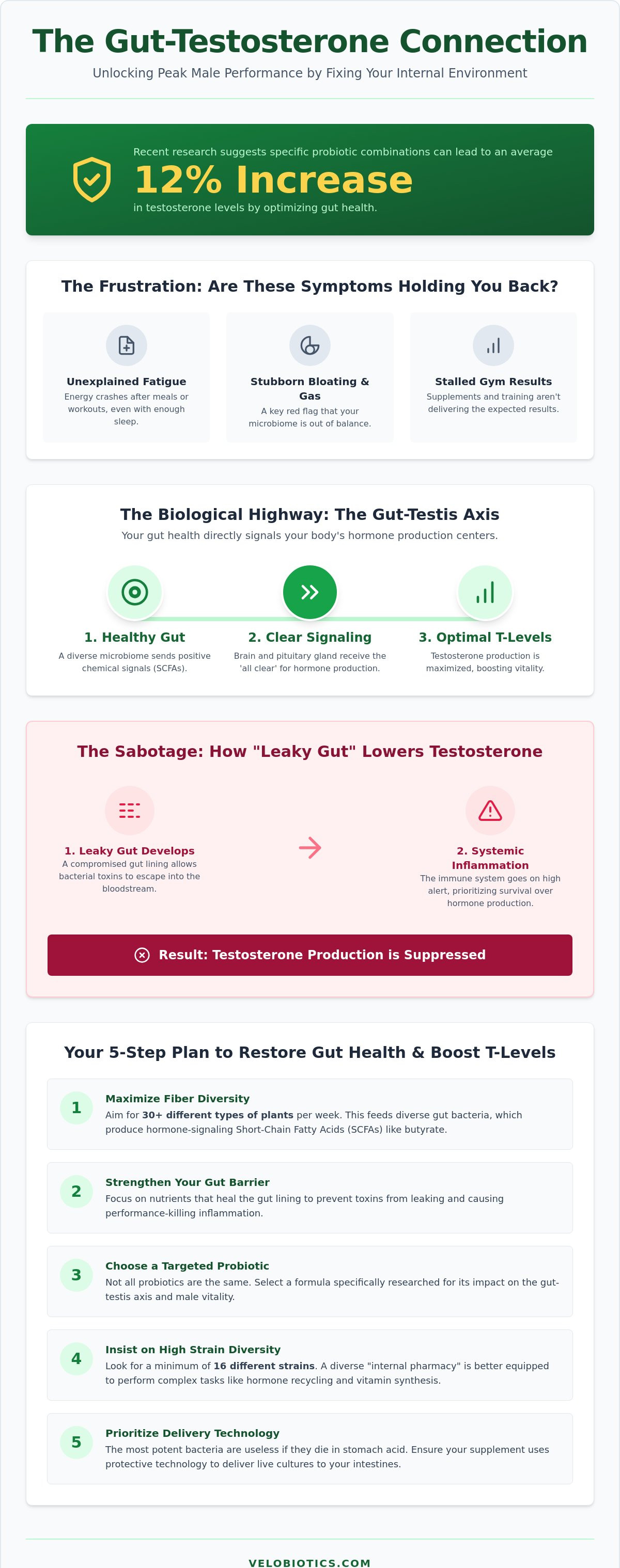
Fixing your hormones shouldn't start with a needle. It should start with your fork and your schedule. To truly optimize how gut health impacts male testosterone levels, you must move beyond generic wellness advice and focus on biological viability. I recommend a five-step protocol designed to seal the gut lining and restore the signaling pathways we discussed earlier. First, prioritize fiber diversity. Aim for 30 different plant types per week. This isn't about volume; it's about variety. Each plant species feeds a different strain of bacteria, ensuring your "internal pharmacy" stays diverse and resilient.
Second, you must eliminate microbiome disruptors. Artificial sweeteners, excessive alcohol, and processed seed oils act like sandpaper on your delicate intestinal lining. These substances trigger the release of LPS toxins, which we know leads to a Leydig cell shutdown. Third, implement strategic fasting. Giving your gut a 12 to 14 hour break allows the Migrating Motor Complex (MMC) to perform its "housekeeping" waves. This mechanical clearing of bad bacteria is essential for preventing overgrowth. Finally, pair these habits with natural sunlight and movement. Vitamin D acts as a pro-hormone that works synergistically with your gut bacteria to maximize steroidogenesis.
The "Viability" Secret: Why Your Probiotic Might Be Failing You
Most men are wasting money on store-bought probiotics that never actually work. The harsh reality is that your stomach acid is a survival gauntlet with a pH between 1 and 3. Most standard capsules are destroyed within 20 minutes of ingestion. If the bacteria don't reach your lower intestine alive, they can't influence your hormone levels. This is why a 50-billion CFU count is a vanity metric if the delivery system is weak. You should specifically look for micro-encapsulated delivery systems, like those found in Velo16, which protect the bacteria until they reach the site of absorption.
Stress Management for the Modern Man
There's a male equivalent to "Rushing Woman’s Syndrome" characterized by a constant sympathetic nervous system overload. When you stay in "fight or flight" mode, your body shuts down non-essential functions like gut repair and testosterone production. You can't heal your gut while your body thinks it's being chased by a predator. Simple box-breathing techniques can "switch on" your parasympathetic mode, allowing for better nutrient absorption. Remember, your highest testosterone peaks occur in the morning, but only if you've achieved deep, restorative sleep. Sleep is when your gut lining undergoes the most intense repair, directly supporting your hormonal baseline.
If you're ready to stop guessing and start supporting your biology with precision, it's time to choose a solution that actually survives the journey. Explore His-Biotics to ensure your body receives the essential nutrients and viable probiotics it needs to thrive.
Optimizing Male Vitality: The Targeted Probiotic Solution
While the market is flooded with general wellness supplements, men have unique physiological requirements that demand a more precise approach. Understanding how gut health impacts male testosterone levels is only half the battle; the other half is ensuring that your interventions are biologically viable. Most generic probiotics are designed for a "standard" human, but they often lack the strain diversity and delivery technology needed to support the male endocrine system under stress. To truly move the needle on your vitality, you need a targeted solution that bridges the gap between clinical research and daily convenience.
The core of this solution lies in two factors: strain diversity and delivery viability. A multi-strain formulation, specifically one containing 16 or more distinct bacterial types, provides the broad-spectrum support required for hormonal signaling. However, even the best strains are useless if they don't survive the stomach's acidic environment. This is where micro-encapsulation technology becomes a game-changer. It acts as a protective shield, ensuring the probiotic "payload" reaches the small intestine intact, where it can actually begin the work of supporting your gut-testis axis.
His-Biotics: Engineered for the Male Microbiome
In my clinic, I've found that the most effective way to support male health is by combining potent probiotics with essential micronutrients. This is the philosophy behind His-Biotics. By pairing 16 probiotic strains with a male-focused multivitamin, we create a synergistic effect that supports both immune resilience and hormone production. This clinical-grade delivery is particularly vital for men with high-stress lifestyles, where elevated cortisol levels often threaten to tank their natural testosterone. Instead of taking multiple separate pills, this approach delivers everything your body needs in a single, protected dose.
The Velo16 Approach to Digestive Harmony
If you've recently finished a course of antibiotics or have spent years on a diet high in processed foods, your microbiome diversity is likely compromised. This "extinction event" in your gut can lead to a sluggish estrobolome, causing the hormone reabsorption issues we discussed earlier. Using a high-diversity formulation like Velo16 helps restore that lost balance. It provides the bacterial variety needed to manage estrogen levels and keep your metabolic pathways clear. By focusing on how gut health impacts male testosterone levels through these specific delivery systems, you can finally stop guessing and start seeing the results in your energy, mood, and recovery.
Ready to take the next step in your health journey? You can Explore His-Biotics Probiotics for Men to see how a doctor-led, micro-encapsulated formula can transform your vitality from the inside out.
Take Command of Your Hormonal Future
We've explored the complex highway of the gut-testis axis and how internal inflammation can silently sabotage your Leydig cells. You now understand that your microbiome is a hormonal control center, not just a digestive organ. By addressing the "hormonal upstream" through fiber diversity and strategic lifestyle shifts, you can effectively clear the path for natural testosterone production. Understanding how gut health impacts male testosterone levels gives you a significant advantage in managing your long-term vitality and recovery.
If you’ve optimized your gut and still feel your hormone levels aren’t where they should be, Helio Peptide offers physician-supervised telehealth programs for TRT and HRT that can help you take complete command of your hormonal health.
While diet and sleep provide the foundation, the right delivery system ensures your efforts aren't wasted. My doctor-founded formula uses advanced micro-encapsulation to provide 10x better survival rates compared to standard capsules; this ensures all 16 clinically studied probiotic strains reach their destination. It's time to stop settling for supplements that don't survive your stomach acid. You can Optimize your gut-testis axis with His-Biotics Probiotics for Men to experience the difference that biological viability makes. You have the tools and the science; now it's time to put them to work for your health. You've got this.
Frequently Asked Questions
Can low testosterone cause digestive problems like bloating or constipation?
Yes, low testosterone can lead to slower gut motility, which often results in constipation and bloating. Testosterone helps maintain the smooth muscle tone of the digestive tract. When levels drop, your digestion slows down, allowing gas to build up. This creates a frustrating cycle where poor digestion further stresses the body, potentially lowering your hormone levels even more. Addressing your T-levels can often resolve these chronic digestive issues.
How long does it take for gut health to improve testosterone levels?
You can generally expect to see measurable changes in your hormonal profile within 4 to 12 weeks of consistent gut optimization. Microbiome shifts happen quickly, but systemic inflammation takes time to subside. A 2026 study found that older men using specific probiotic and plant-derived combinations saw a 12 percent average increase in testosterone. Consistency is key; you're rebuilding an entire ecosystem, so don't expect overnight results after only a few days of use.
Do probiotics actually increase testosterone in men?
Probiotics support the environment needed for your body to produce its own testosterone efficiently. While they aren't hormones themselves, they reduce the inflammatory load that shuts down Leydig cells. This is a major way how gut health impacts male testosterone levels. By clearing out endotoxins and improving nutrient absorption, probiotics remove the "brakes" from your endocrine system. This allows your natural production to reach its biological potential without the interference of chronic internal stress.
What are the best probiotic strains for male hormonal health?
Diversity is more important than any single "magic" strain, but look for a 16-strain blend including Lactobacillus reuteri and Bifidobacterium breve. These have shown promise in supporting the gut-testis axis and reducing systemic inflammation. Because every man's microbiome is unique, using a broad-spectrum formula ensures you cover all the bases for hormonal signaling. Just make sure these strains are delivered via a clinical-grade system that ensures they reach the lower gut alive and functional.
Can a "leaky gut" really lead to low libido and fatigue?
Absolutely, because leaky gut triggers metabolic endotoxemia, which forces your body into a constant survival mode. When toxins leak into your blood, your immune system demands massive amounts of energy, leaving little left for libido or physical drive. Your body also prioritizes making cortisol to fight this internal stress, which directly cannibalizes the building blocks needed for testosterone. Fixing your gut barrier is often the fastest way to reclaim your sexual edge.
Is it better to get probiotics from food or supplements for testosterone?
Fermented foods are great for maintenance, but targeted supplements are better for correcting a hormonal deficit. Food sources like sauerkraut often lack the specific strain counts and delivery protection required to survive harsh stomach acid. For a clinical impact on how gut health impacts male testosterone levels, you need the precision of a multi-strain supplement. This allows you to deliver a concentrated payload of beneficial bacteria directly to the site of absorption where they are needed most.
What is the "Gut-Testis Axis" and why is it important?
The Gut-Testis Axis is the bidirectional communication highway between your intestinal microbiome and your reproductive system. It's important because it controls the signaling loop between your brain and your testes. If the signals from your gut are pro-inflammatory, your brain tells your body to downregulate hormone production to save resources. Mastering this axis means you're addressing the root cause of hormonal decline rather than just treating the symptoms with expensive, temporary patches.
How does stomach acid affect the efficacy of my probiotic supplement?
Stomach acid is a highly effective biological barrier that unfortunately kills up to 99 percent of standard probiotic bacteria. With a pH level as low as 1.0, your stomach is designed to destroy microorganisms before they reach your intestines. This is why a high "CFU count" is often a misleading marketing metric. Without advanced micro-encapsulation technology to shield the bacteria, your supplement is essentially neutralized before it can provide any hormonal benefit.

Disclaimer
Information and statements regarding dietary supplements/products have not been evaluated by the Food and Drug Administration, MCC/SAHPRA, MHRA, TGA or any other drug regulatory authority and are not intended to diagnose, treat, cure, or prevent any disease. Information on this website is provided for informational purposes only and is a result of years of practice and experience by the author. This information is not intended as a substitute for the advice provided by your physician or other healthcare professional or any information contained on or in any product label or packaging. Do not use the information on this website for diagnosing or treating a health problem or disease, or prescribing medication or other treatment. Always speak with your physician or other healthcare professional before taking any medication or nutritional, herbal, or homeopathic supplement, or using any treatment for a health problem. If you have or suspect that you have a medical problem, contact your healthcare provider promptly. Do not disregard professional medical advice or delay in seeking professional advice because of something you have read on this website.