

How to Know if Boric Acid is Working: A Doctor’s Guide to Success Indicators
That thin, watery discharge you're seeing isn't a sign of failure; it's actually a clinical indicator that your body is flushing out pathogens and resetting its internal chemistry. When patients ask me how to know if boric acid is working, they're often surprised to learn that success isn't just the absence of symptoms. It's the measurable return of a low-pH physiological environment. You've likely spent days worrying about whether your treatment is actually effective or if the infection is just waiting to strike again. Clinical data from 2025 shows that nearly 89% of women with recurrent bacterial vaginosis achieve normal vaginal flora using this method, proving that the right delivery of active ingredients creates a hostile environment for bad bacteria.
I understand the anxiety of feeling like your body is a constant science project. In this guide, I'll help you decode the specific sensory and physiological signs that prove your treatment is restoring your delicate biological balance. We'll explore the healing timeline, explain why certain messy side effects are actually positive milestones, and identify the exact moment you should switch to probiotics to protect your results.
Key Takeaways
- Identify why the "melting phase," characterized by significant watery discharge, is actually a positive indicator that your treatment is resetting your vaginal pH.
- Use our sensory checklist to track your progress, including the "odor fade" and texture transitions that signal a return to biological balance.
- Master the healing timeline to understand how to know if boric acid is working by looking for a 70% reduction in irritation within the first 48 to 72 hours.
- Learn to differentiate between a normal, mild "boric acid burn" and actual red flags like spotting or allergic reactions that indicate a sensitive cervix.
- Transition effectively from treatment to maintenance by understanding why probiotics are the "security guards" needed to protect your newly restored environment.
The Immediate Response: What Happens in the First 24 Hours?
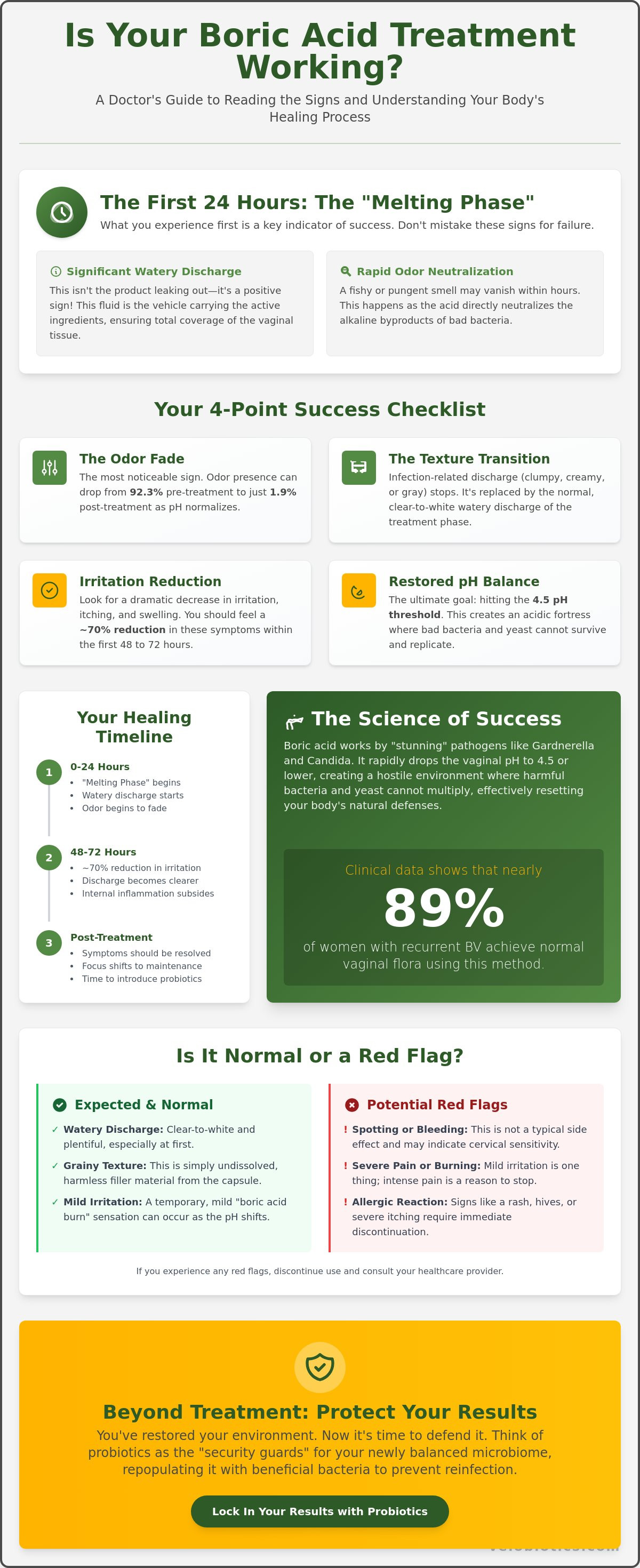
Within the first 24 hours of treatment, your body undergoes a rapid chemical shift. Once you insert a capsule, the moisture in the vaginal canal begins to break down the outer shell. Boric acid is highly soluble in this environment, meaning it starts to disperse across the mucosal lining almost immediately. This is what I call the "melting phase." You should expect a significant amount of watery discharge during this initial window. Many patients worry this means the product is leaking out without doing its job, but the opposite is true. This fluid is the vehicle that carries the active ingredients to every fold of the vaginal tissue to ensure total coverage.
This initial flush also triggers a quick neutralization of odors. If you've been dealing with a fishy or pungent smell, you might notice it vanish within just a few hours. This isn't just masking the scent; it's a result of the acid reacting with the alkaline byproducts of bad bacteria. Understanding this rapid timeline is the first step in learning how to know if boric acid is working effectively. The "leakage" you feel overnight is actually a sign of the capsule's successful distribution throughout the canal.
To better understand this concept and what you should expect during the first day, watch this helpful video:
Normal vs. Abnormal Leakage
The discharge resulting from a working suppository should have a clear-to-white, watery consistency. Sometimes you might notice a grainy or sandy texture in your liner. Don't panic; this isn't a failure of the treatment. It is simply the undissolved filler material from the capsule itself. For the best experience, using a panty liner during the first 48 hours is non-negotiable. If you are using a precision-formulated option like Femina COOKIE FRESH, the discharge is a sign that the delivery system is functioning as intended.
The Science of the pH Drop
The primary goal of this treatment is to hit the 4.5 pH threshold. Pathogens like Gardnerella and Candida cells are highly sensitive to their environment. When the pH drops, it effectively "stuns" these cells, stopping them from replicating. Your vaginal pH balance acts as the immune system of the vagina. By restoring this acidity, you're creating a fortress that bad bacteria cannot survive in. This rapid acidification is exactly how to know if boric acid is working on a cellular level, even before your physical symptoms have completely vanished.
Your Success Checklist: 4 Signs Your Boric Acid is Doing Its Job
Monitoring your progress requires more than just waiting for the treatment course to end. As a clinician, I advise patients to look for four specific physiological markers that indicate the active ingredients are successfully altering the vaginal microbiome. The first and most noticeable sign is the "Odor Fade." When using boric acid for yeast infection or bacterial vaginosis, the rapid acidification neutralizes the alkaline compounds that bad bacteria produce. In clinical studies, odor presence has been shown to drop from 92.3% to just 1.9% of participants following treatment. You'll notice the scent shifts from a sharp, pungent aroma to something neutral within the first 48 hours. This shift is a primary indicator of how to know if boric acid is working effectively.
The second sign is the "Texture Transition." A successful treatment stops the production of "infection discharge," which is often clumpy, creamy, or gray. Third, look for a visible reduction in internal inflammation. Many women describe a "heavy" or "swollen" sensation during an active flare-up; as the acid stabilizes the environment, this pressure dissipates. Finally, the persistent itch should subside. The cooling effect of a restored pH balance interrupts the inflammatory cycle that triggers the urge to scratch, allowing the mucosal lining to begin its repair process.
Analyzing Your Discharge Texture
It's vital to distinguish between "Infection Discharge" and "Treatment Discharge." While your infection might have looked chunky, yellow, or gray, the fluid you see now should be clear or milky and very thin. This temporary increase in volume is actually your body flushing out cellular debris and dead pathogens. As the treatment concludes, you can expect the return of normal, "egg-white" cervical mucus. This signals that your biological rhythm is back on track. For those seeking a focused approach to this reset, Femina COOKIE FRESH offers a streamlined delivery system to facilitate this flush.
The Sensory Test: Comfort and Confidence
The ultimate success metric is often psychological: the moment you stop "feeling" your vagina throughout the day. During an infection, every movement is a reminder of the discomfort. If you experience a mild tingling during treatment, it's usually the acid interacting with already irritated tissue, which is quite different from the deep, throbbing itch of the infection itself. I recommend keeping a simple 3-day symptom diary to track these changes. Recording the intensity of your symptoms each morning provides empirical proof of your recovery, giving you the confidence that your internal environment is finally stabilized.
The Healing Timeline: How Long Should You Wait for Results?
Healing isn't an overnight switch; it's a physiological sequence that begins the moment the boric acid vaginal suppository dissolves. On Day 1, you'll experience "The Flush." While the fishy odor often vanishes within hours, your discharge will increase significantly as your body ejects cellular debris. By Days 2 and 3, you should reach a turning point where itching and burning are roughly 70% resolved. This specific window of relief is how to know if boric acid is working on the underlying cause rather than just providing a temporary scent fix. Between Days 4 and 7, your internal environment reaches stabilization, and your discharge should transition back to a normal, healthy consistency.
For chronic or resistant cases, the timeline extends. Clinical research indicates that 85% of women with standard antifungal-resistant yeast infections cleared the infection after a 14-day course. If you've been dealing with symptoms for months, a short 3-day treatment likely won't provide the deep-seated reset your microbiome requires. Understanding this progression prevents the anxiety that often comes when symptoms don't vanish instantly after the first dose.
Acute vs. Recurrent Timeline
A single night of treatment might resolve a mild odor, but it rarely clears a deep-seated infection. If you struggle with recurrent issues, you're likely fighting "biofilms." These are protective, sticky layers that bacteria like Gardnerella build to shield themselves from your immune system. Clinical data suggests that while acute cases resolve quickly, chronic infections often require a 14-day protocol to fully dismantle these biofilms. Don't make the mistake of stopping the moment you feel better; finishing the course ensures the pathogens don't just go into hiding.
When Boric Acid Isn't Enough
I always recommend the 7-day rule: if your symptoms haven't shifted by the end of a week, it's time for a clinical swab. Boric acid is a powerful pH balancer, but it isn't a cure-all for every type of vaginal distress. It can occasionally mask the symptoms of aerobic vaginitis or certain STIs that require targeted medical intervention. Understanding What Is Bacterial Vaginosis (BV)? Causes & Symptoms is essential for identifying whether your condition is a simple microbial imbalance or something more complex. If you see no improvement, don't keep self-treating; seek a professional diagnosis to ensure you aren't ignoring a different biological challenge.
Troubleshooting: Is It Working or Are These Red Flags?
Even when a treatment is highly effective, the process of resetting your internal environment can feel a bit turbulent. One of the most common questions I hear in my clinic is whether a slight "burn" is a sign of success or a reason to stop. If you experience a mild, fleeting tingling during the first few nights, it's usually just the acid interacting with tissue that's already raw from infection. This is part of the stabilization process. However, how to know if boric acid is working versus causing an adverse reaction often comes down to intensity. A mild sensation is normal; a deep, persistent throb or the appearance of hives is a clear signal to discontinue use.
You might also notice light spotting or pink-tinged discharge. This often happens because the acid can temporarily irritate a sensitive cervix, especially if the capsule is placed too shallow. This isn't usually a treatment failure, but it is a sign to adjust your technique. On the other hand, if your "Liner Test" reveals green, frothy, or heavily bloody discharge, the boric acid isn't the culprit; you likely have a primary infection like Trichomoniasis or an STI that requires prescription antibiotics. Finally, please put the douche away. Douching while using suppositories is a recipe for treatment failure because it washes away the active ingredients before they can stymie pathogen growth.
Managing Sensitivity
If you have particularly sensitive tissues, you don't have to suffer through the "melting phase" discomfort. A simple pro-tip is to apply a tiny amount of coconut oil or water-based lubricant to the tip of the capsule before insertion. This reduces friction and helps the capsule reach the proper depth, which should be about the length of your middle finger. If you find that the pure acid is too much for your system, it might be time to switch from Femina Boric Acid Only to a more supportive, probiotic-infused version that helps rebuild the mucosal barrier while it cleanses.
Identifying 'Treatment Failure'
True treatment failure is rare but identifiable. If you experience hives, intense swelling, or any difficulty breathing, you are likely having an allergic reaction and should seek medical help immediately. Remember that boric acid is a targeted tool for pH-related issues; it won't resolve viral infections or STIs. If your symptoms clear up but return immediately after intimacy, you might be experiencing a "rebound" effect. This happens when a partner's own unbalanced flora or higher-pH seminal fluid re-triggers your system. In these cases, you're better off exploring our comprehensive probiotic and boric acid solutions to ensure your defenses are strong enough to withstand external triggers.
Beyond the Suppository: How to Maintain Results Long-Term
Think of boric acid as a biological "reset button." While it is incredibly effective at clearing out the pathogens causing your discomfort, it doesn't stay behind to defend the territory. This is the foundation of the "Clean Slate" theory: boric acid clears the path, but probiotics build the house. Once you have confirmed how to know if boric acid is working by the reduction in odor and the stabilization of discharge we discussed earlier, your focus must shift from elimination to colonization. You've cleared the weeds; now you must plant the grass.
Lactobacillus is the essential "security guard" of your vaginal health. These beneficial bacteria produce the lactic acid necessary to maintain a protective acidic barrier. Without them, the vacancy left by the infection is an open invitation for a rebound. I typically recommend starting oral or vaginal probiotics within 24 hours of finishing your acid course to ensure these "good" bacteria take up residence before bad actors can re-establish a biofilm. Practicality is key here. Beyond supplements, your daily routine should support this new equilibrium. Wear 100% cotton underwear to prevent moisture buildup and strictly use scent-free soaps only on the external vulva. These "Cookie Fresh" habits are the unsung heroes of long-term stability.
The Probiotic Hand-off
Using Femina Probiotic Cookie Fresh simplifies this process significantly because it combines the antiseptic effect of boric acid with the immediate re-colonization of probiotics. This dual-action approach ensures that as the acid creates a "clean slate," the beneficial strains are already present to occupy the space. The science of re-colonization is delicate; the goal is to establish a dominant population of healthy flora that can naturally suppress future overgrowth. To understand more about this biological transition, read our Probiotics for BV: A Doctor’s Guide.
Creating a Maintenance Routine
You don't always need a full 7-day course for maintenance. Many of my patients find success using boric acid reactively, such as a single dose after intimacy or during the final day of a period when vaginal pH naturally spikes and becomes more alkaline. For systemic wellness, incorporating Femina Probiotic Capsules with Cranberry helps support the entire urogenital tract. My final word of advice: listen to your body. It is the best diagnostic tool you have. If you've mastered how to know if boric acid is working by paying attention to your sensory signals, you'll be able to catch minor imbalances before they turn into full-blown infections.
Take Control of Your Vaginal Microbiome Today
Understanding the physiological shifts in your body is the first step toward lasting relief. We've explored how the initial "melting phase" and the "odor fade" serve as reliable markers of success. However, clearing pathogens is only half the battle. To prevent the frustrating cycle of recurrence, you must transition from elimination to re-colonization. This is where clinical-strength pH support meets advanced science. My doctor-founded and formulated solutions utilize proprietary micro-encapsulation technology to ensure probiotic survival where it matters most. Stop guessing how to know if boric acid is working and start building a resilient internal environment that protects itself. You have the tools to decode your body's signals and the technology to maintain that delicate balance. Restore your balance with Femina Probiotic Cookie Fresh, the Doctor-formulated duo of Boric Acid + Probiotics. You deserve to feel confident, balanced, and comfortable in your own skin every single day.
Frequently Asked Questions
How long does it take for a boric acid suppository to dissolve completely?
It typically takes between 4 and 12 hours for a suppository to dissolve completely. The exact timing depends on your internal moisture levels and the specific composition of the capsule shell. I recommend inserting the capsule right before bed so it has plenty of horizontal time to break down and coat the vaginal walls while you sleep. This ensures the active ingredients stay in contact with the tissue for the maximum duration.
Is it normal to have watery discharge after using boric acid?
Watery discharge is a completely normal and expected part of the treatment process. This fluid is actually a clinical sign of how to know if boric acid is working to distribute the active ingredients throughout the vaginal canal. It is simply the carrier for the acid as it resets your pH, so keep those panty liners handy for the first few days to manage the increased volume.
Can I have sex while using boric acid suppositories?
You should avoid sexual activity until at least 24 hours after your final dose has been administered. Boric acid is toxic if ingested orally, which poses a significant risk to your partner during intimacy. Additionally, your vaginal tissues are currently inflamed and healing; the friction from sex can cause further irritation, increase discomfort, and potentially delay your overall recovery timeline.
What should I do if I feel a burning sensation after insertion?
If you feel an intense or persistent burning sensation, you should wash the external area with lukewarm water and discontinue use immediately. While a mild, fleeting tingle is common when the acid touches raw or irritated tissue, sharp pain might indicate an allergic reaction or a sensitive cervix. Try using a water-based lubricant on the capsule tip for a more comfortable insertion during your next attempt.
How do I know if my infection is BV or a yeast infection before starting?
You can usually distinguish between the two by observing the texture and scent of your discharge. Yeast infections typically produce thick, white, "cottage cheese" discharge with intense itching but no smell. Bacterial vaginosis (BV) usually presents as thin, grayish fluid with a distinct fishy odor. Boric acid is an excellent tool for both because it resets the acidic environment that these different pathogens hate.
Can I use boric acid during my period, and does it still work?
You can certainly use boric acid during your period, and it is often the most effective time to do so. Menstrual blood has a pH of about 7.4, which is quite alkaline compared to the healthy vaginal range. This shift can trigger infections or odor, so using a suppository during your flow helps maintain the necessary acidity to keep bad bacteria from taking over your system.
Why does the odor come back after I stop using boric acid?
Odor often returns because the "clean slate" left by the acid hasn't been re-colonized with protective probiotics. This is a key part of how to know if boric acid is working on the immediate infection but failing to provide a long-term cure. You must introduce beneficial Lactobacillus to act as your internal security guards. Without these bacteria, your pH will eventually rise again, inviting the pathogens back.
Is it safe to use boric acid every day for a month?
Daily use for an entire month is generally not recommended unless a healthcare provider specifically prescribes it for a resistant biofilm or chronic case. For most acute issues, a 7 to 14-day course is the clinical standard for success. Overusing the treatment can prevent your natural, healthy flora from returning, which leaves your vaginal environment vulnerable once you finally stop the daily applications.

Disclaimer
Information and statements regarding dietary supplements/products have not been evaluated by the Food and Drug Administration, MCC/SAHPRA, MHRA, TGA or any other drug regulatory authority and are not intended to diagnose, treat, cure, or prevent any disease. Information on this website is provided for informational purposes only and is a result of years of practice and experience by the author. This information is not intended as a substitute for the advice provided by your physician or other healthcare professional or any information contained on or in any product label or packaging. Do not use the information on this website for diagnosing or treating a health problem or disease, or prescribing medication or other treatment. Always speak with your physician or other healthcare professional before taking any medication or nutritional, herbal, or homeopathic supplement, or using any treatment for a health problem. If you have or suspect that you have a medical problem, contact your healthcare provider promptly. Do not disregard professional medical advice or delay in seeking professional advice because of something you have read on this website.