

Medication for BV: A Doctor’s Guide to Antibiotics, OTC Fixes, and Lasting Balance
Did you know that up to 58% of women who receive standard treatment for bacterial vaginosis will see their symptoms return within just 12 months? If you've spent years stuck in a cycle of "revolving door" infections, you know exactly how exhausting it is. You've likely dealt with the lingering metallic taste of metronidazole or the nausea that comes with finding the right medication for bv, only to have that familiar, embarrassing odor return through your clothes weeks later. It's frustrating to feel like you're constantly chasing a temporary fix rather than a permanent cure.
I understand your struggle because I've spent my career as a physician studying the delicate balance of the vaginal microbiome. I'm going to help you identify the most effective treatments while explaining why your previous attempts likely failed to keep you clear. You'll learn the doctor-approved protocol to stop the recurrence for good, ensuring your beneficial bacteria actually survive and flourish. This guide breaks down the science of antibiotics, the truth about OTC options, and the exact steps to reclaim your confidence and lasting comfort.
Key Takeaways
- Understand how the right medication for bv targets harmful bacteria to restore your vaginal pH to its protective 4.5 threshold.
- Compare "Gold Standard" antibiotics like Metronidazole and Tinidazole to decide whether oral pills or vaginal gels are the most practical choice for your lifestyle.
- Discover why 50% of infections return and how to prevent the "forest fire" effect that leaves your microbiome bare and vulnerable.
- Learn how to integrate boric acid and probiotics as supportive therapies to effectively "re-seed" your vaginal forest after treatment.
- Follow my clinical, two-step protocol to clear the infection and reset your internal balance to stop the cycle of recurrence for good.
Decoding BV Medications: Why Your Vaginal Microbiome is Out of Sync
Let's get one thing straight: having BV doesn't mean you're "unclean" or that you've contracted an STI. As a doctor, I see the emotional toll this condition takes on women every day; it's exhausting to deal with the recurring odor and the constant worry about what others might notice. Scientifically, Bacterial vaginosis is actually a state of dysbiosis, which is simply the disruption of the "good cop" bacteria that keep your internal ecosystem in check. When your vaginal pH climbs above the 4.5 threshold, it creates a playground for anaerobic bacteria like Gardnerella vaginalis to multiply. Choosing the right medication for bv isn't just about killing germs; it's about restoring a very specific acidic environment.
To better understand why your current approach might be failing, watch this helpful breakdown:
Prescription vs. Over-the-Counter: The First Big Choice
If you're experiencing symptoms for the first time, a doctor's visit is mandatory to confirm the diagnosis. This is especially critical if you're pregnant, as untreated BV is linked to a 40% higher risk of preterm birth in some clinical observations. You also need professional help if you develop a fever or pelvic pain. Many women reach for over-the-counter itch creams, but these are usually anti-fungals designed for yeast infections. They won't touch the bacteria causing BV. While you can find supportive therapies like Femina Probiotic Capsules to help maintain balance, the primary medication for bv often requires a targeted prescription to lower the anaerobic load.
Why "Just Any Medicine" Doesn't Work for BV
Treating BV with a random "down there" medicine is like trying to fix a software bug with a hammer. Anti-fungals like Monistat fail because they target yeast cell walls, not the cell membranes of bacteria. If you use the wrong treatment, you're just wasting time while the bad bacteria build a stubborn biofilm. Avoid DIY "cleanses" like douching at all costs. Douching is a biological disaster that flushes out the protective Lactobacillus and spikes your pH, making the infection much worse. Dysbiosis is the disruption of the "good cop" bacteria that keep your internal ecosystem in check. Effective treatment must focus on high-potency recovery that allows your natural flora to flourish again.
- pH 4.5: The critical acidity level your vagina needs to stay healthy.
- Anaerobes: The "bad guys" that thrive when oxygen and acid levels drop.
- Biofilm: A sticky shield bacteria build to hide from medicine.
The Antibiotic Arsenal: Comparing Metronidazole, Clindamycin, and Tinidazole
Let's get clinical for a moment. When we talk about clearing an infection, we aren't just guessing. We use a specific antibiotic arsenal designed to wipe out the overgrowth of anaerobic bacteria. Choosing the right medication for bv is a science, and it usually starts with a 500mg dose of a very specific drug. In my years of clinical practice, I've seen that the Diagnosis and treatment of BV often requires a heavy-handed approach to break down the bacterial biofilms that protect these stubborn pathogens.
Metronidazole (Flagyl): The Heavy Hitter
Metronidazole remains the gold standard in the medical community. It works by disrupting the DNA of anaerobic bacteria, effectively stopping them from replicating. It's remarkably precise. It doesn't usually bother your friendly Lactobacilli as much as a broad-spectrum antibiotic would. However, you must respect the 7-day rule. If you stop on day four because the odor has vanished, you're just training the remaining bacteria to be resistant. This leads to chronic recurrence, which affects up to 30% of women within three months of treatment.
You should also take it with a full meal to avoid the common stomach flip. Many patients report a strange metallic taste in their mouth, but that's a small price for clarity. Please, skip the cocktails. Mixing this medication for bv with alcohol leads to a disulfiram-like reaction. This can cause severe vomiting, flushing, and heart palpitations that can last for 24 hours after your last drink.
Clindamycin and Tinidazole: When to Switch
Sometimes Metronidazole isn't the right fit. Maybe you're allergic, or perhaps it didn't work during your last bout. That's when we pivot. Clindamycin 2% cream is a fantastic alternative for those who prefer a localized treatment over oral pills. It's highly effective, but it comes with a warning: the oil in the cream can degrade latex condoms. You'll need to use backup birth control for at least 72 hours after your final dose to stay protected.
- Tinidazole: This is a newer cousin to Metronidazole. It's often favored for its shorter 2-day or 5-day regimen, making it easier for busy lifestyles.
- Clue Cell Testing: Before I switch your prescription, I always check for "clue cells" under the microscope. These are vaginal skin cells covered in a "shag carpet" of bacteria. Seeing them helps me confirm we are still fighting BV and not a yeast infection.
While these antibiotics are excellent at clearing out the "bad guys," they don't always help the "good guys" return to power. I often suggest my patients use Femina Probiotic Capsules alongside their recovery to ensure the vaginal microbiome is actually being rebuilt, not just emptied out. Clearing the path with medicine is only half the victory; you have to repopulate the territory to stay healthy.
The "Revolving Door" Problem: Why Medication Often Fails to Stop Recurrence
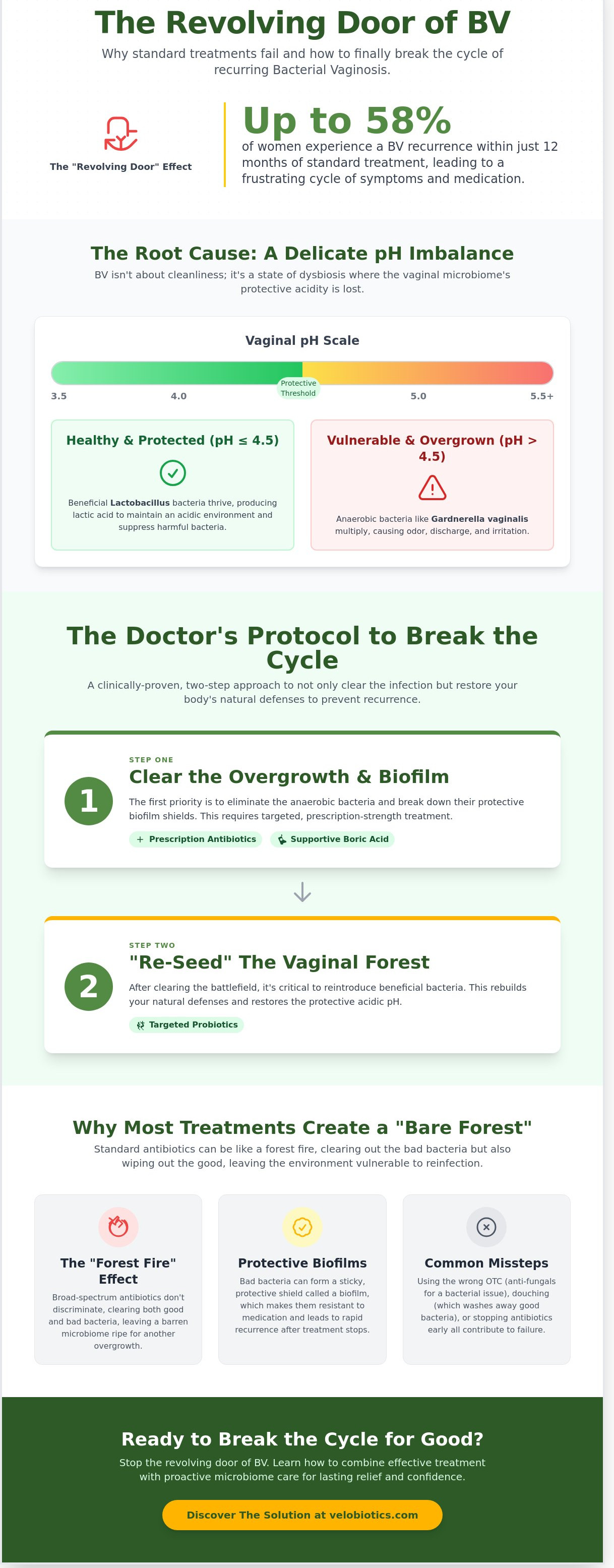
Most patients come to my clinic feeling defeated by a cycle they can't seem to break. You take your prescription, the symptoms vanish for a few weeks, and then, without warning, the familiar itch and odor return. This isn't just bad luck. Clinical data shows that 50% of women experience a BV recurrence within just six months of completing antibiotic treatment. It feels like a revolving door because the standard approach often treats the symptoms without fixing the underlying biological environment.
Think of your vaginal microbiome as a lush forest. When an infection takes over, it's like a patch of invasive weeds has moved in. Antibiotics act like a forest fire. They clear the weeds, but they also incinerate the trees and the grass, leaving the ground bare. In nature, bare ground is an invitation for weeds to grow back even faster. While the CDC treatment guidelines offer clear protocols for clearing the immediate infection, they don't always provide a plan for replanting the "good" forest. Without those protective "good" bacteria, the bad ones have a vacant lot to move back into.
We also have to consider external factors. Your partner's skin microbiome can act as a reservoir for bacteria. If you clear your infection but your partner is unknowingly re-introducing those same bacteria during intimacy, you're essentially fighting a losing battle. It's a complex ecosystem that requires more than just a quick kill-all solution.
Antibiotics Leave a "Probiotic Gap"
Antibiotics are non-discriminatory. They don't just target the bad guys; they wipe out your Lactobacillus, the "Good Cops" of your vaginal health. These bacteria produce lactic acid to keep your pH balanced. A lack of Lactobacillus is the single most accurate predictor of a BV relapse. If your internal "police force" is gone, the bad bacteria face no resistance. This specific challenge is the reason behind the Velobiotics Story. I realized that simply taking probiotics isn't enough; we had to find a way to ensure those good bacteria actually survive and thrive to bridge this gap.
Biofilms: The Invisible Shield
One of the biggest hurdles in modern medicine is the biofilm. Bacteria like Gardnerella build a sticky, protein-based "shield" over themselves. It's like a protective raincoat that prevents medicine from reaching the bacteria underneath. Standard medication for bv often bounces right off this shield, leaving a small colony of bacteria alive and well. This is why many doctors now recommend a "biofilm buster" like boric acid. It helps strip away that protective layer so the medication for bv can actually do its job instead of just scratching the surface.
Beyond Antibiotics: Boric Acid and Probiotics as Supportive Therapy
Antibiotics are often the first line of defense when you're dealing with Bacterial Vaginosis. However, relying solely on standard medication for bv can feel like trying to fix a garden by only pulling weeds without ever planting new seeds or checking the soil quality. While pharmaceutical medication for bv clears the immediate overgrowth, it doesn't always address the underlying environment. To truly break the cycle of recurrence, I recommend a "Triple Threat" approach: clearing the infection, resetting the pH balance, and re-seeding the microbiome with beneficial bacteria.
Boric Acid: The pH Reset Button
Boric acid isn't a pharmaceutical drug in the traditional sense; it's a mineral that serves as a powerful physical tool for your vaginal health. Its primary job is to lower the vaginal pH back to its ideal acidic state, usually between 3.8 and 4.5. More importantly, it physically disrupts the "biofilm." This is a sticky, protective layer that bad bacteria build to hide from your immune system and your medication. By melting this shield, boric acid makes it much harder for infections to return or hide. Safety is paramount here: you must never swallow boric acid. It's toxic if ingested and is strictly intended for vaginal suppository use only. For women who need a clean, focused reset without extra additives, I suggest using Femina Cookie Fresh Boric Acid Only.
Probiotics: The "Good Cops" Your Vagina Needs
Once the pH is balanced, we have to bring back the "good cops." The most critical strains for vaginal health are Lactobacillus acidophilus and Lactobacillus rhamnosus. These bacteria produce lactic acid and hydrogen peroxide, which naturally keep pathogens at bay. The problem with most oral probiotics is that they're fragile. Up to 99% of standard probiotic bacteria die in the harsh environment of your stomach acid before they ever reach their destination. This creates a massive "probiotic gap" between what you see on the label and what actually survives.
Our patented Velobiotics technology solves this by micro-encapsulating the bacteria. This provides 1000x more delivery compared to non-encapsulated brands, ensuring the "good guys" reach your system alive and ready to work. If you want to dive deeper into the clinical side of this process, read our Probiotics for BV: A Doctor’s Guide. Using this technology allows you to re-seed the vaginal forest effectively, creating a sustainable environment where health can flourish.
The Doctor’s Protocol: How to Break the BV Cycle for Good in 2026
I've spent years in both the clinic and the lab watching women struggle through the "antibiotic carousel." You treat the infection, feel better for a week, and then the symptoms return. Breaking this cycle in 2026 requires a tactical, four-step approach that respects your biology. It isn't just about killing bad bacteria; it's about rebuilding a defensive fortress. If you're tired of temporary fixes, follow this clinical sequence to reclaim your vaginal health.
- Step 1: Clear the infection. You can't build a house on a burning foundation. Consult your physician for a diagnostic swab. If they prescribe a targeted medication for bv, such as Metronidazole or Clindamycin, complete the entire course. Don't stop just because the odor vanishes on day three.
- Step 2: Reset the pH. Antibiotics are "scorched earth" treatments. They raise vaginal pH, making it easier for pathogens to return. Use medical-grade boric acid suppositories to pull the pH back into the ideal 3.8 to 4.5 acidic range.
- Step 3: Re-seed the microbiome. This is the most critical step. You must introduce high-potency, vaginal-specific probiotic strains like Lactobacillus crispatus. Most shelf-stable probiotics die in your stomach acid before they can help you. You need technology that ensures they reach the target alive.
- Step 4: Maintenance. Small lifestyle shifts prevent future invasions. Stick to 100% cotton underwear, use fragrance-free cleansers, and avoid tight synthetic leggings for long periods.
The Velobiotics Femina Solution
I developed the Femina Probiotic Cookie Fresh with Boric Acid to solve the two biggest hurdles in recovery. This formula combines the pH-resetting power of boric acid with our patented micro-encapsulation technology. While standard probiotics often fail to survive the journey, our strains have a 1000x higher survival rate. You're getting a dual-action solution that balances acidity while simultaneously re-seeding the microbiome with protective bacteria. It's the most efficient way to support your body after using a medication for bv.
Practical Tips for Daily Vaginal Vitality
Stop douching immediately. Your vagina is a self-cleaning oven; warm water on the external vulva is all you need. Internal scrubbing disrupts the delicate biofilm you're trying to protect. I also recommend supporting your "gut-vagina axis" with Velo16 Digestive Capsules. Since 70% of your immune system lives in your gut, a balanced digestive microbiome acts as a secondary shield for your systemic health. Finally, track your "normal." If you notice a change in discharge color or a fishy odor that lasts more than 48 hours, it's time to call your doctor again. Early intervention prevents a minor imbalance from becoming a chronic cycle.
Take Control of Your Vaginal Health Today
I've spent years in the lab and clinic seeing women trapped in the revolving door of infections. While standard medication for bv like Metronidazole effectively clears pathogenic bacteria, it often leaves your vaginal microbiome like a scorched earth. To stop the 50% recurrence rate often seen in clinical studies, you must do more than just kill the bad guys; you have to repopulate the good ones. This is where most traditional treatments fall short.
My protocol for 2026 focuses on a dual-action approach that bridges the gap between clinical intervention and long term balance. We use medical grade Boric Acid to break down stubborn biofilms and then introduce high survival probiotics to restore order. Most probiotics fail because the bacteria don't survive the environment, but our patented micro-encapsulation technology ensures 1000x better delivery of live cultures. It's a scientific solution designed by a doctor who understands the biology of your body. You don't have to settle for temporary fixes anymore.
Break the BV cycle with Femina Cookie Fresh Probiotic Suppositories
You deserve to feel confident and balanced every single day.
Frequently Asked Questions
Can I get BV medication over the counter?
You cannot purchase antibiotic medication for bv over the counter in the United States. While you might find pH balancing gels or yeast infection creams at the local pharmacy, true bacterial vaginosis requires a prescription for drugs like Clindamycin. Currently, 0 FDA-approved OTC antibiotics exist for this condition. If you are noticing a fishy odor or unusual discharge, you'll need to see a clinician for a proper diagnosis and a prescription.
What is the fastest way to get rid of BV?
Prescription antibiotics like Metronidazole or Clindamycin represent the fastest clinical path to clearing a BV infection. Most patients notice a significant reduction in symptoms within 48 to 72 hours of starting their first dose. It's vital to finish the entire 5 or 7 day course even if you feel better. Stopping early allows the bad bacteria to bounce back stronger, which leads to a frustrating cycle of chronic reinfection.
Can I use boric acid while taking Metronidazole?
You can safely use 600mg boric acid suppositories while taking your prescribed Metronidazole. Many doctors recommend this combination because boric acid helps break down the protective biofilm that bacteria build to hide from antibiotics. Think of it as a double punch. The boric acid clears the shield, and the medication for bv finishes the job. This dual approach is often used for stubborn, recurrent cases that won't go away.
Why does my BV keep coming back after I finish my antibiotics?
Recurrence happens because antibiotics are like a scorched earth policy; they kill the infection but also wipe out your protective Lactobacillus. Statistics show that up to 50 percent of women see BV return within 12 months of antibiotic treatment. Without those good bacteria to guard the gate, the bad bacteria simply move back in. This is why replenishing your microbiome after treatment is so critical for long term vaginal health.
Is there a "natural" medication for BV that actually works?
There isn't a natural antibiotic, but clinical evidence supports using specific probiotic strains and boric acid as effective natural alternatives for management. Research published in 2019 shows that certain Lactobacillus strains can reduce recurrence rates by more than 40 percent. Our Velobiotics technology ensures these beneficial bacteria survive the harsh journey through your stomach. It's about giving your body the right tools to maintain its own delicate internal balance naturally.
Do I need to treat my partner for BV as well?
You generally don't need to treat a male partner, though female partners might require a checkup. The 2021 CDC STI Treatment Guidelines state that treating male partners doesn't lower the chance of BV coming back for the woman. However, since BV involves an imbalance of bacteria that can be shared, it's a good idea to practice extra hygiene or use protection during the active treatment phase to keep the peace downstairs.
Can I use probiotics instead of antibiotics for a BV infection?
Probiotics are most effective when used alongside or after antibiotics rather than as a total replacement for an acute infection. While antibiotics clear the overgrowth, probiotics help rebuild the vaginal defense system. Our patented micro-encapsulation technology provides 1000x more delivery of live cultures compared to standard pills. This ensures the good guys actually reach your system alive to do their job, rather than being destroyed by harsh gastric acid.
What happens if I leave BV untreated?
Leaving BV untreated can lead to serious reproductive health issues and increased infection risks. Clinical data indicates that an untreated infection makes you 2 times more likely to contract STIs, including HIV or chlamydia. It also increases the risk of pelvic inflammatory disease and can cause complications during pregnancy, such as preterm birth. It's always better to address the bacterial imbalance early rather than waiting for a much bigger problem to develop.

Disclaimer
Information and statements regarding dietary supplements/products have not been evaluated by the Food and Drug Administration, MCC/SAHPRA, MHRA, TGA or any other drug regulatory authority and are not intended to diagnose, treat, cure, or prevent any disease. Information on this website is provided for informational purposes only and is a result of years of practice and experience by the author. This information is not intended as a substitute for the advice provided by your physician or other healthcare professional or any information contained on or in any product label or packaging. Do not use the information on this website for diagnosing or treating a health problem or disease, or prescribing medication or other treatment. Always speak with your physician or other healthcare professional before taking any medication or nutritional, herbal, or homeopathic supplement, or using any treatment for a health problem. If you have or suspect that you have a medical problem, contact your healthcare provider promptly. Do not disregard professional medical advice or delay in seeking professional advice because of something you have read on this website.