

Using Probiotics After Antibiotics for BV: A Doctor’s Guide to Ending the Cycle
Did you know that up to 80% of women who finish a course of antibiotics for bacterial vaginosis find themselves right back where they started within 12 months? It's a frustrating, exhausting cycle that makes you feel like your body is working against you. If you've ever felt like you're trapped in a revolving door of infections and messy side effects like thrush, you aren't alone. Most of my patients come to me feeling defeated because standard treatments often act like a reset button that clears the land but leaves it wide open for weeds to grow back.
The secret to staying clear isn't just taking any supplement; it's about using probiotics after antibiotics for bv with clinical precision. I'm going to share the exact scientific protocol for re-seeding your vaginal microbiome to prevent recurrence and restore your long-term health. We'll explore why certain Lactobacillus strains are non-negotiable for success and how the timing of your dose determines whether those beneficial bacteria actually reach their target or simply wash away. By the end of this guide, you'll have a clear, actionable plan to rebuild your internal environment and regain your confidence.
Key Takeaways
- Understand why standard antibiotics often fail to stop the recurrence cycle by leaving your vaginal microbiome "sterile" and unprotected.
- Discover the clinical protocol for using probiotics after antibiotics for bv, focusing on the specific timing that ensures these beneficial bacteria can actually colonize.
- Learn why your vaginal health depends on identifying specific "Lacto-guards" rather than relying on generic gut health supplements.
- Find out how to overcome the "Ghost Probiotic" problem to ensure your supplements survive stomach acid and reach the target site alive.
- Get a 3-step guide on using a pH reset to prepare your internal environment for successful microbiome re-seeding.
The Antibiotic Paradox: Why BV Often Returns After Treatment
When you're dealing with the fishy odor and discomfort of bacterial vaginosis, antibiotics like Metronidazole feel like a total lifesaver. They are the standard first-line defense, and they're excellent at what they do. However, these medications are "scorched earth" treatments. They don't distinguish between the bad bacteria making you miserable and the protective "Lacto-guards" your body needs to stay healthy. By the time you swallow your last pill, your vaginal environment is often left completely sterile.
This state of sterility is exactly where the paradox begins. A clean slate sounds good in theory, but in biology, nature abhors a vacuum. To understand what bacterial vaginosis is at its core, you have to see it as a battle for real estate. If you don't actively re-seed the area, the pathogens are usually the first to move back in. This is why we see a staggering recurrence rate, with around 50% of women seeing symptoms return within just six months of treatment. There is a critical "window of opportunity" starting from your very first antibiotic dose and extending immediately after your last one. During this time, using probiotics after antibiotics for bv becomes the difference between long-term relief and another trip to the pharmacy.
To better understand how this cycle works and why restoration is key for your balance, watch this helpful video:
The Role of the Vaginal Microbiome
Your primary defenders are Lactobacillus bacteria. These tiny powerhouses produce lactic acid, which keeps your vaginal pH levels in a safely acidic range, typically below 4.5. This acidity acts like a chemical security fence that keeps harmful bacteria from multiplying. During antibiotic therapy, this fence is effectively torn down. Without those acid-producing guards, your pH levels rise, creating a welcoming, alkaline environment for the bad guys to thrive once again. This shift is why many women develop thrush shortly after finishing their meds; the lack of acidity allows yeast to grow unchecked.
Why 'Killing the Bad' Isn't Enough
Restoring health is vastly different from simply clearing an infection. Many "bad" bacteria are survivors; they create biofilms, which are sticky, microscopic fortresses that shield them from the reach of antibiotics. These biofilms allow pathogens to hibernate through the "scorched earth" phase and strike as soon as the coast is clear. This is where "competitive exclusion" comes into play. By using probiotics after antibiotics for bv, you are physically occupying the space on the vaginal wall.
When the good bacteria take up all the available "parking spots," the pathogens simply have nowhere to land and grow. It's about building a living shield that antibiotics alone can't provide. I often recommend starting a regimen with Femina™ Probiotic Capsules to ensure you're sending in the right reinforcements. If you don't fill the void, the bacteria you just killed will be happy to move back into their old neighborhood and start the cycle all over again.
The Lactobacillus Rebound: Re-seeding the Right Strains
Think of your microbiome like a specialized garden. After antibiotics, your internal soil is bare. However, if you try to plant desert cacti in a rainforest, they simply won't survive. This is the mistake many people make when choosing a supplement; your gut thrives on entirely different bacterial species than your "cookie." To effectively stop the cycle, you need the "Big Three" specialists: Lactobacillus crispatus, Lactobacillus rhamnosus, and Lactobacillus reuteri. Many women feel confused about which products to buy, but using probiotics after antibiotics for bv requires a focus on these exact strains rather than generic "multi-strain" gut formulas.
These specific Lactobacillus strains don't just sit there. They are active defenders that produce hydrogen peroxide, a natural disinfectant that keeps the vaginal environment clean. Research from Harvard indicates that specific strains like L. crispatus can significantly help prevent recurrences of bacterial vaginosis by creating a dominant, protective colony that crowds out pathogens. Without these specific guards, the "bad" bacteria will simply wait for the antibiotic to leave your system before they strike again.
Oral vs. Suppository Probiotics
You might wonder how a pill you swallow can help your vaginal health. It's based on the "migration theory," where beneficial bacteria travel from the rectum to the vaginal opening. While this is a natural pathway, oral probiotics must survive a treacherous journey through stomach acid, which acts like a probiotic graveyard. This is why using probiotics after antibiotics for bv is most effective when the delivery system protects the bacteria from the harsh environment of the digestive tract. Conversely, suppositories offer a direct route, providing an immediate pH reset and localized colonization when you're in the middle of a flare-up. If you want to jumpstart this process, consider using a targeted suppository to deliver these strains exactly where they're needed most.
The Power of Lactic Acid
Your best defense against any vaginal infection is a low pH, ideally below 4.5. Probiotics act as tiny "acid factories" that constantly churn out lactic acid to maintain this hostile environment for pathogens. When your pH is acidic, Gardnerella vaginalis cannot easily form the biofilms it needs to survive. L. rhamnosus specifically inhibits the growth and adhesion of Gardnerella vaginalis, the primary culprit behind BV symptoms. By keeping the environment acidic, you ensure that even if a few bad bacteria return, they won't have the strength to start a full-blown colony.
The Viability Crisis: Why Most Probiotics Fail to Help
I see it every day in my clinic: patients who have spent significant amounts of money on high-CFU supplements but still suffer from recurring infections. This is the "Ghost Probiotic" problem. While a label might boast 50 billion CFUs, the reality is that without advanced protection, up to 90% of those bacteria are dead before they ever reach your system. They die from heat on the shelf, moisture in the air, or the brutal acid bath in your stomach. When you're using probiotics after antibiotics for bv, you aren't just looking for high numbers; you're looking for biological viability.
A 2022 meta-analysis on probiotics for BV confirms that these supplements are a powerful tool when paired with antibiotics. However, the effectiveness of the treatment hinges entirely on the bacteria arriving at the target site alive and ready to colonize. If the strains are already compromised by the time they hit your small intestine, they can't perform the "competitive exclusion" we discussed earlier. It's like sending a team of elite guards to a fortress, but they all perish during the commute.
Survival of the Fittest (Bacteria)
Your stomach acid is a highly effective probiotic graveyard. It's designed to destroy pathogens, but it doesn't distinguish between a harmful invader and a helpful Lactobacillus. This is where technology steps in. We use a proprietary micro-encapsulation process that acts like a high-tech shield around each delicate bacterial cell. This seal protects the "Lacto-guards" from moisture, heat, and gastric acid, ensuring they stay dormant until they reach the alkaline environment of the gut. Many "shelf-stable" products are actually already dead because they lack this structural integrity. If the bacteria aren't shielded, they don't stand a chance against your natural digestive defenses.
Quality Indicators to Look For
When you're shopping for a solution, don't get distracted by flashy marketing. Look for three specific indicators of quality: strain transparency, third-party testing, and moisture-proof packaging. You should know exactly which strains you're putting into your body. Because moisture is the number one enemy of probiotic survival, the way the product is sealed matters as much as what's inside. You can learn more about our commitment to these standards in the Velobiotics Story and our focus on viability. Using probiotics after antibiotics for bv only works if the technology matches the biology. By choosing products that prioritize survival, you're finally giving your microbiome the reinforcements it needs to end the cycle for good.
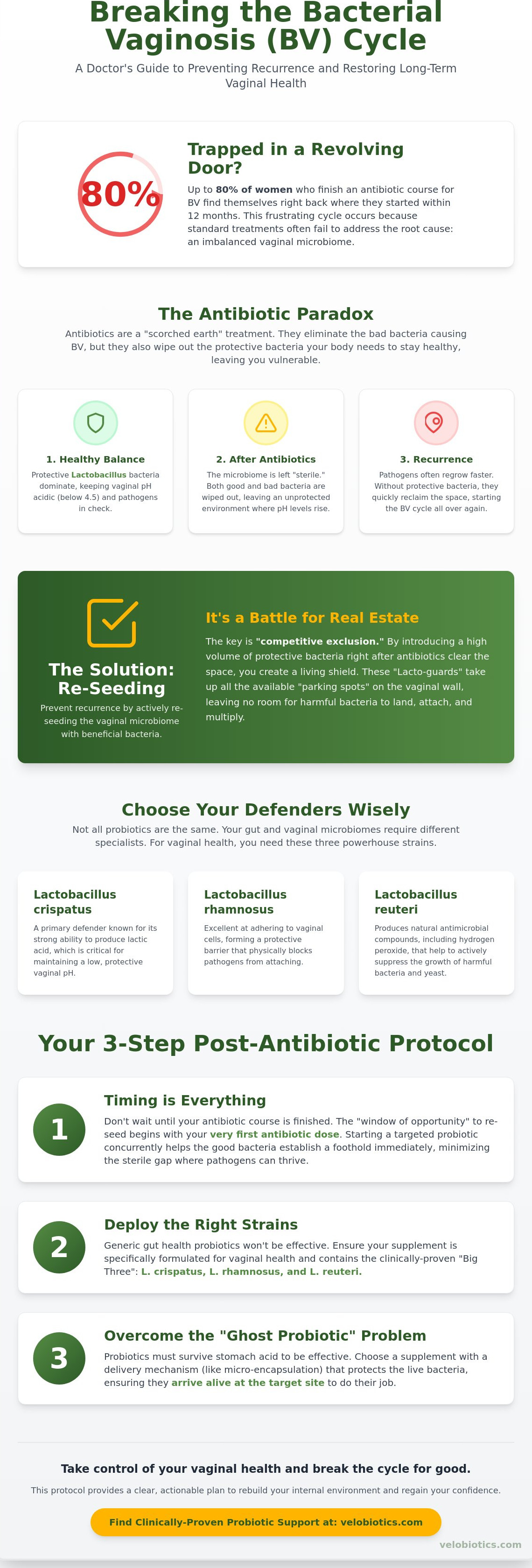
Your Post-Antibiotic Protocol: A Doctor’s 3-Step Guide
Successful recovery depends on a tactical timeline. You don't want to wait until symptoms return to start your defense; you need to act while the "scorched earth" effect of the antibiotics is still in play. Think of this as a strategic window where you can choose exactly which residents move back into your internal neighborhood. By using probiotics after antibiotics for bv with clinical precision, you can finally halt the cycle of recurrence and reclaim your comfort.
Step 1: Resetting the pH
Think of Step 1 as a necessary demolition before a major remodel. Boric Acid isn't a replacement for your medication, but it's a doctor-recommended tool for dissolving the microscopic fortresses that pathogens build to survive. By dropping your pH back into the safe, acidic zone, you create a blank slate that's toxic to bad bacteria but perfect for your new "Lacto-guards." To jumpstart this cleanup phase, you can explore Femina Cookie Fresh with Boric Acid to effectively prepare your internal environment.
Step 2: Massive Re-population
Now that the soil is ready, you need to flood the system. Effective recovery requires a high-potency approach, aiming for at least 10⁸ CFU to ensure the beneficial bacteria can actually take root and dominate the space. Combining oral capsules with targeted vaginal inserts creates a pincer movement against potential recurrence. The migration window is the specific physiological period where beneficial bacteria travel from the digestive tract to the vaginal opening to establish a new colony. Using probiotics after antibiotics for bv during this window ensures your protective bacteria are the first to claim the available real estate.
You can find this level of potency and the required strain protection when you shop our clinically-backed Femina range for your recovery journey.
Step 3: Long-term Defense
Your new bacterial residents need fuel to thrive and multiply. Focus on prebiotic fibers like onions, garlic, and chicory root to feed your microbiome and keep your defenses strong. At the same time, commit to a "clean" lifestyle: douching and scented soaps are officially off the table because they strip away the natural acidity you've worked so hard to rebuild. Support your ongoing resilience with Femina Probiotic Capsules with Cranberry to keep your urinary and vaginal health in peak condition. Consistency is the only way to ensure the cycle of recurrence finally ends for good.
Beyond the Capsule: Comprehensive Support for Your 'Cookie'
Your vaginal health doesn't exist in a vacuum. It's a direct reflection of your body's overall immune status and digestive health. While we've spent a lot of time discussing the localized environment, I always remind my patients that the "cookie" is actually the end of the line for a much larger system. If your gut is in turmoil or your immune system is exhausted from chronic stress, even the best protocol for using probiotics after antibiotics for bv will face an uphill battle. True recovery involves looking at the big picture of your internal biology.
The Gut-Vagina Connection
The "Gut-Vagina Axis" is a very real biological pathway. Your digestive tract acts as the primary reservoir for the Lactobacillus species that eventually migrate to the vaginal tract. This is why a diverse gut microbiome is your best long-term insurance policy. While targeted vaginal strains are crucial, a broad-spectrum approach helps fortify your entire system. Multi-strain probiotics are generally superior because they create a robust, resilient ecosystem that can withstand external shocks. To give your whole body a fighting chance, I often recommend that you check out Velo16 Probiotic Capsules for total body support alongside your targeted recovery plan.
Don't underestimate the power of lifestyle metrics like sleep and stress management. High cortisol levels can actually suppress your immune response and alter the glycogen levels in your vaginal tissue, which the good bacteria need for food. Aim for 7 to 9 hours of quality sleep to give your microbiome the rest it needs to rebuild. When your body is in a state of rest, it can better allocate resources to maintaining those protective "Lacto-guards" we've discussed.
Common Post-Antibiotic Pitfalls
One of the biggest hurdles is the "Yeast Infection Trap." Many women finish their antibiotics and immediately experience new itching or thick discharge. It's easy to assume the BV is back, but it's often actually thrush caused by the "scorched earth" effect of the medication. Before you start using probiotics after antibiotics for bv, you must finish your entire prescribed course of medication. Never stop early just because you feel better; doing so only encourages antibiotic resistance and allows those biofilm-forming pathogens to survive.
Finally, you need to be patient with your body. Rebuilding a complex biological ecosystem takes weeks, not days. If you experience fever, severe pelvic pain, or symptoms that don't improve after following this protocol for 14 days, it's time to see a professional for a clinical review. We've talked about the high recurrence rates, but with the right science and a little bit of time, you really can end the cycle for good.
Reclaim Your Balance and End the Recurrence Cycle
Breaking free from the revolving door of infections requires more than just clearing the bad bacteria; it demands a strategic restoration of your biological defenses. As we've explored, using probiotics after antibiotics for bv is the most effective way to re-seed your microbiome with the protective "Lacto-guards" your body needs to maintain an acidic pH. By following a structured protocol of resetting your environment and re-populating with high-viability strains, you move from temporary relief to long-term wellness.
You shouldn't have to settle for supplements that die before they can help. Our doctor-developed clinical formulations use patented micro-encapsulation for 1000x better survival than standard market offerings. By delivering specifically targeted Lactobacillus strains directly to the target site, we solve the viability crisis that leaves so many women frustrated. You deserve a solution that actually works as hard as you do to stay healthy.
Stop the BV Cycle with the Femina Probiotic Protocol
You now have the scientific roadmap and the practical tools to take control of your intimate health. Stay consistent, be patient with your body's natural healing process, and look forward to a life defined by balance rather than the next flare-up. You've got this!
Frequently Asked Questions
Can I take probiotics at the same time as my BV antibiotics?
You can start taking them immediately alongside your medication. Taking them at the same time helps prevent the "sterile" environment that allows pathogens to return. Just make sure to space your probiotic dose at least two to three hours apart from your antibiotic pill. This gap prevents the antibiotic from accidentally destroying the beneficial bacteria before they can reach your gut and begin their journey to the vaginal tract.
How long should I use probiotics after finishing my BV medication?
I recommend a minimum of 30 to 60 days of consistent use. Rebuilding a complex microbiome isn't an overnight process; it's a biological marathon. While you might feel better within a few days, it takes weeks for the "Lacto-guards" to establish a dominant, self-sustaining colony. For women with chronic recurrence, long-term daily maintenance is often the most effective way to keep the protective acidic barrier intact.
What are the best probiotic strains specifically for preventing BV?
Look for the "Big Three" specialists: Lactobacillus crispatus, Lactobacillus rhamnosus, and Lactobacillus reuteri. These specific strains are the gold standard because they produce hydrogen peroxide and lactic acid. Unlike generic gut bugs, these species are biologically programmed to thrive in the vaginal environment. Using probiotics after antibiotics for bv is only effective if you're using the specific strains that naturally belong in that delicate ecosystem.
Is it better to use oral probiotics or vaginal suppositories for BV?
Both delivery methods serve different purposes in your recovery. Suppositories provide an immediate, localized pH reset and direct colonization of the vaginal wall. Oral capsules support the gut-vagina axis, providing a steady supply of reinforcements over time. For the best clinical outcome, I suggest a dual approach: use suppositories for the first week to reset the environment, then transition to high-viability oral capsules for long-term maintenance.
Can probiotics cause a yeast infection after BV treatment?
Probiotics don't cause yeast infections; they are actually your best defense against them. The thrush many women experience after BV treatment is caused by the antibiotics clearing out your protective bacteria, which allows yeast to grow unchecked. By using probiotics after antibiotics for bv, you are replenishing the Lactobacillus that keep yeast in balance. If you develop a yeast infection, it's a sign your microbiome was too depleted, not a side effect of the supplement.
How do I know if the probiotics are actually working?
You'll notice a significant reduction in the hallmark signs of imbalance, such as fishy odor and unusual discharge. Clinically, the best indicator is a stable vaginal pH below 4.5. You can even use at-home pH strips to monitor this progress. When the environment is acidic, it means your "acid factories" are active. You'll also likely feel more comfortable and see an end to the post-antibiotic irritation often mistaken for infection.
Can I get enough probiotics from yogurt to cure BV?
Yogurt is a great snack, but it's not a clinical treatment for BV. Most commercial yogurts don't contain the specific Lactobacillus strains needed for vaginal health, nor do they provide the high CFU counts (at least 10⁸) required to survive stomach acid. Without advanced delivery technology, most of those bacteria die in your digestive tract. To stop a recurrence cycle, you need concentrated, viable supplements designed to reach the target site alive.
What should I do if my BV symptoms return while taking probiotics?
If symptoms return, you should schedule a clinical review with your healthcare provider immediately. It's possible you're dealing with a stubborn biofilm that requires a longer course of Boric Acid or a different antibiotic entirely. Sometimes, what feels like BV is actually a co-infection or a different type of imbalance. Don't get discouraged; some cases are more resistant than others and require a more aggressive, multi-step approach to fully break the cycle.

Disclaimer
Information and statements regarding dietary supplements/products have not been evaluated by the Food and Drug Administration, MCC/SAHPRA, MHRA, TGA or any other drug regulatory authority and are not intended to diagnose, treat, cure, or prevent any disease. Information on this website is provided for informational purposes only and is a result of years of practice and experience by the author. This information is not intended as a substitute for the advice provided by your physician or other healthcare professional or any information contained on or in any product label or packaging. Do not use the information on this website for diagnosing or treating a health problem or disease, or prescribing medication or other treatment. Always speak with your physician or other healthcare professional before taking any medication or nutritional, herbal, or homeopathic supplement, or using any treatment for a health problem. If you have or suspect that you have a medical problem, contact your healthcare provider promptly. Do not disregard professional medical advice or delay in seeking professional advice because of something you have read on this website.