

What to Avoid When Taking Collagen Supplements: A Doctor’s Guide to Maximizing Bioavailability
You're likely flushing your expensive collagen supplement down the drain before it ever reaches your skin or joints. With the global collagen market projected to hit 4.83 billion dollars in 2026, it's clear we're all searching for that "beauty-from-within" glow, yet most people are inadvertently sabotaging their own progress. It's incredibly frustrating to invest in your health and see zero visible improvement in your skin elasticity or joint comfort. I understand that frustration because, as a doctor, I see patients every day who are confused by conflicting online advice and wasted investments. Knowing what to avoid when taking collagen supplements is the difference between a wasted routine and a transformative one.
The truth is that collagen is a delicate protein, and its success depends entirely on biological viability. In this guide, I'll detail exactly what to avoid when taking collagen supplements to ensure you're not falling victim to common pitfalls like high-sugar diets or poor gut health. You'll learn how to fix your routine, protect your supplements from being destroyed by harsh internal environments, and finally implement a protocol that yields the visible results you've been promised. We'll explore the science of the gut-skin axis and how to ensure your body actually utilizes every gram of protein you ingest.
Key Takeaways
- Identify the hidden fillers and heavy metal contaminants that compromise your supplement's biological viability.
- Learn exactly what to avoid when taking collagen supplements to prevent glycation, a process where sugar molecules sabotage your skin's structural integrity.
- Master the "leaky bucket" protocol to stop collagen degradation and prioritize synthesis through proper nutrient pairing.
- Resolve the debate over hot liquids and meal timing to ensure your peptides survive the journey through your digestive system.
- Discover how the gut-skin axis and advanced probiotic delivery systems turn standard powders into high-potency results.
The Sabotage Factor: Why Your Collagen Supplement Might Not Be Working
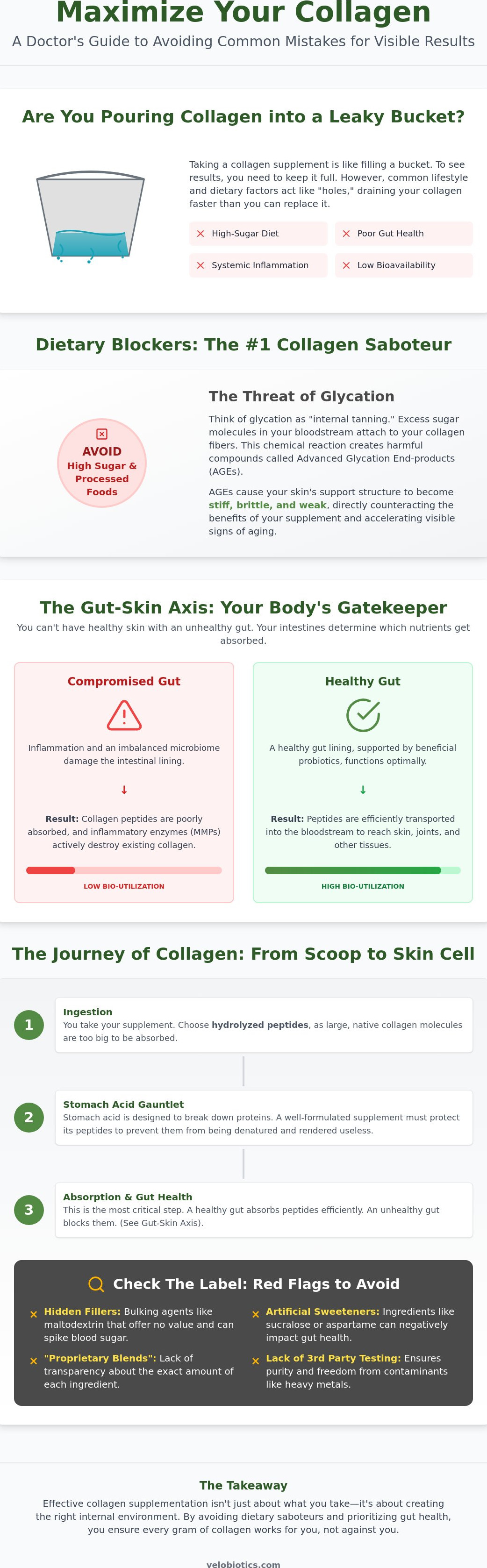
Think of your body's collagen levels as a bucket. To maintain youthful skin and resilient joints, you want that bucket full. Taking a supplement is like pouring water into the bucket, but if you have "holes" in the bottom caused by poor habits or inflammation, you are losing the protein faster than you can replace it. This is the "leaky bucket" analogy of collagen metabolism. When we talk about what to avoid when taking collagen supplements, we are really talking about how to plug those holes. If you don't address the factors causing rapid degradation, you're essentially throwing your money away.
As a doctor and founder, I have spent years analyzing the efficacy gaps in the supplement industry. Many brands focus on high milligram counts while ignoring the biological reality of how our bodies actually process protein. Simply swallowing a pill or a scoop of powder does not guarantee results. What matters is bio-utilization, the specific amount of a nutrient that actually enters your circulation and reaches the target tissues. To understand the foundational science of this protein, it helps to first ask, What is Collagen? It's the most abundant structural protein in the human body, but it requires a very specific internal environment to be synthesized correctly.
To better understand these biological mechanisms, watch this helpful video from a clinical perspective:
The Bioavailability Myth
The biggest misconception in the wellness world is that all collagen is created equal. In its native state, collagen molecules are massive. They're far too large for your intestinal wall to absorb. This is why you must use hydrolyzed peptides. These are "pre-digested" through enzymatic hydrolysis into tiny chains of amino acids. However, even these peptides face a gauntlet. Your stomach acid is designed to break down proteins, and if your supplement isn't formulated to survive this acidic environment, the delicate peptides may be denatured before they ever reach the small intestine for absorption. This is a primary reason why people fail to see visible results.
Your Gut: The Gatekeeper of Beauty
You cannot have glowing skin if you have a "noisy" gut. Your intestinal lining is the gatekeeper for every nutrient you consume. If you are dealing with systemic inflammation or a compromised microbiome, your body's ability to transport collagen peptides into the bloodstream is severely hindered. This is the clinical concept of the gut-skin axis. Chronic inflammation triggers enzymes called matrix metalloproteinases (MMPs), which actively chew up your existing collagen. When you learn what to avoid when taking collagen supplements, you'll see that protecting your gut health is just as important as the supplement itself. Without a healthy gut, your expensive collagen is just expensive waste.
Dietary Blockers: What to Stop Eating for Better Results
Eating the right things is vital, but knowing what to avoid when taking collagen supplements is often more impactful for your long-term results. Even the highest quality peptides can be neutralized by a diet that promotes protein degradation. If your internal environment is flooded with inflammatory molecules, those expensive amino acids will be diverted to basic survival tasks rather than repairing your skin or joints. I often see patients who spend hundreds on supplements while still consuming high amounts of processed sugars, essentially cancelling out their investment.
Glycation: How Sugar 'Tans' Your Internal Collagen
The most significant dietary threat to your collagen is sugar. When glucose levels in your blood spike, a process called glycation occurs. This isn't just a wellness buzzword; it's a chemical reaction where sugar molecules attach themselves to proteins, creating Advanced Glycation End-products (AGEs). I like to explain this as "internal tanning." Just as leather becomes stiff and brittle when over-processed, your collagen fibers lose their elasticity and strength when coated in sugar. They become cross-linked and unable to repair themselves, leading to visible wrinkles and stiff joints. This makes sugar one of the primary things to avoid when taking collagen supplements if you want to maintain structural integrity.
To maximize your biological viability, I recommend implementing the 2-hour rule. Try to avoid consuming high-glycemic foods for at least two hours before and after taking your supplement. This window prevents the "sugar trap" from immediately degrading the new peptides you've just ingested. If you want to see real change, you must stop feeding the chemical process that breaks you down. For more on the clinical perspective of these interactions, Harvard Health on collagen supplements provides excellent context on how these products interact with your overall metabolic health.
The Vitamin C Co-Factor
Think of collagen as a skyscraper and Vitamin C as the lead architect. Without it, the building simply cannot go up. As of 2026, clinical consensus defines Vitamin C as the mandatory enzymatic co-factor for prolyl hydroxylase, the specific enzyme responsible for stabilizing the collagen triple helix structure. Without sufficient ascorbic acid, your body can't "knit" the amino acids into functional tissue. This is why pairing your supplement with Vitamin C-rich foods, like citrus, bell peppers, or strawberries, is a non-negotiable step for efficacy.
Beyond sugar and vitamin gaps, you should also be wary of excessive alcohol and "anti-nutrients" found in highly processed foods. Alcohol dehydrates the skin and interrupts the liver's ability to process proteins efficiently. Similarly, phytic acid in some processed grains can bind to minerals needed for collagen production. If you're looking for a formulation that accounts for these absorption hurdles, our 16 Strains Probiotics Collagen Peptides are designed to support the specific gut environment where these nutrients are processed.
Timing and Temperature: Common Usage Mistakes to Avoid
Your morning routine might be the very thing standing between you and the results you're after. Many of my patients enjoy stirring their powder into a steaming cup of coffee, but this brings us to one of the most debated topics in clinical nutrition: heat degradation. Understanding what to avoid when taking collagen supplements includes analyzing your daily habits, specifically the temperature of your beverages and the timing of your meals. If you're looking for clinical efficacy, you have to treat your supplement with the same precision as a prescription.
Temperature Sensitivity
There's a significant difference between culinary gelatin and medical-grade hydrolyzed peptides. While peptides are generally more heat-stable, exposing them to boiling water can potentially denature the delicate amino acid chains. If the temperature exceeds 300 degrees Fahrenheit, the structural integrity of the protein begins to fail. For practical daily use, I recommend keeping your liquids below 170 degrees. If you can't sip your coffee because it's too hot, it's probably too hot for your collagen. Stirring your peptides into lukewarm or room-temperature water is always the safest bet for maintaining biological viability.
The Protein Competition Factor
Your small intestine uses specific transporters to move amino acids into your bloodstream. These transporters have a limited capacity. If you take your collagen alongside a high-protein meal, like a large steak or a whey protein shake, you're creating "protein competition." The collagen peptides have to fight for space, and they often lose. This is a critical point regarding what to avoid when taking collagen supplements: don't crowd out your peptides. Taking your supplement on an empty stomach, or at least 30 minutes before a meal, ensures the gate is open for maximum absorption.
I often suggest taking collagen before bed. Your body enters a state of repair and synthesis during deep sleep, and having a fresh supply of peptides available can support the natural overnight recovery of your skin and connective tissues. Consistency is the final piece of this puzzle. Clinical results, such as those discussed in the dermatologists' view on collagen supplements, are built on daily, uninterrupted administration. Missing even a few days can reset the biological momentum your body has built up. If you struggle with a complex routine, a streamlined solution like Velo16 Probiotic Digestive Capsules can help maintain that necessary rhythm without the fuss of mixing powders.
Label Red Flags: Fillers and Ingredients to Avoid
Reading a supplement label shouldn't require a medical degree, but the industry often relies on complex terminology to hide low-quality ingredients. When you're determining what to avoid when taking collagen supplements, the ingredient list is your first line of defense. Many "bargain" brands prioritize flavor and shelf-stability over biological viability, filling their powders with additives that can actually trigger the very inflammation you're trying to resolve. As a doctor, I've seen how these hidden culprits can stall progress and lead to unnecessary digestive distress.
The 'Flavor' Trap
The most common offenders in flavored collagen powders are artificial sweeteners and bulking agents like Maltodextrin and Sucralose. Maltodextrin, in particular, has a glycemic index higher than table sugar, which can trigger the glycation process and effectively neutralize the structural benefits of the peptides before they even leave your gut. Additionally, many brands use xanthan gum or guar gum to create a thicker "mouthfeel" in their drinks. While these are common food additives, they often lead to significant bloating and can disrupt the delicate balance of your microbiome. For the best clinical outcomes, unflavored, pure peptides are almost always the superior choice.
You should also be wary of the "collagen creamer" trend. While these products are marketed as a convenient coffee addition, they frequently contain significantly more saturated fats and fillers than actual protein. If the first three ingredients on the label aren't collagen peptides, you're paying for an expensive coffee whitener rather than a therapeutic dose of structural protein. Ensuring your supplement is non-GMO and hormone-free is equally vital, as these factors directly influence the purity of the amino acids being introduced into your system.
Purity and Testing
Sourcing is not just a marketing buzzword; it's a matter of safety. Marine-sourced collagen is often praised for its high bioavailability, but it carries a higher risk of heavy metal contamination, including mercury and lead. This is why third-party lab testing is a non-negotiable requirement for any product I recommend. A reputable brand will provide a Certificate of Analysis (COA) to prove their product is free from these toxins. Similarly, "grass-fed" and "pasture-raised" certifications ensure that the bovine sources haven't been treated with antibiotics or synthetic hormones that could compromise the final product.
A superior collagen label will clearly display a high-potency amino acid profile, specifically highlighting elevated levels of glycine, proline, and hydroxyproline, which are the primary drivers of tissue repair. If a brand hides behind a "proprietary blend" without listing these specifics, it's a major red flag. If you want to skip the guesswork and invest in a formula that prioritizes clinical purity and gut health, explore our doctor-formulated collagen solutions today.
The Probiotic Edge: A New Standard for Collagen Efficacy
While we have discussed dietary blockers and label red flags, the ultimate secret to bioavailability lies in your microbiome. If you want to know what to avoid when taking collagen supplements, the answer often boils down to avoiding a "sterile" or imbalanced gut. Without a diverse array of beneficial bacteria, your body lacks the enzymatic machinery to fully process hydrolyzed peptides. By utilizing 16 specific strains of probiotics, we create a synergistic environment where collagen absorption isn't just possible; it's optimized. This approach shifts the focus from simple ingestion to true biological utilization.
Maximizing Delivery with Velo16 Technology
The journey from your mouth to your bloodstream is perilous for active ingredients. Most standard powders are decimated by gastric juices before they reach the small intestine. We solve this through micro-encapsulation technology, which acts as a protective seal for the ingredients. This is especially critical for probiotics that survive stomach acid, as they must reach the lower GI tract to support the gut-skin axis effectively. By protecting these 16 strains, we ensure they are present to facilitate the transport of Type I and II collagen. Type I is your primary structural support for skin and hair, while Type II focuses on the cartilaginous repair of your joints. To experience this dual-action support, see our 16 Strains Probiotics Collagen Peptides for gut-skin health.
The MD’s Daily Protocol
I am frequently asked about the "perfect" time to take these supplements. While consistency is the most important factor, I personally recommend a nighttime protocol. Your body's natural repair cycles peak during sleep, making it the ideal window for collagen synthesis. Taking your dose on an empty stomach shortly before bed prevents competition with other dietary proteins and ensures the peptides are the primary focus of your metabolic repair teams. By understanding what to avoid when taking collagen supplements, like the usage of low-quality, unprotected powders, you can pivot toward a delivery system that respects your biology.
A successful routine also requires pairing your collagen with probiotics for digestive health to maintain the integrity of the intestinal barrier. When your gut lining is healthy, nutrient uptake is seamless. To help you transition from wasted effort to visible results, I've summarized the "Stop Sabotaging, Start Supporting" checklist below:
- Stop consuming high-sugar foods within two hours of your collagen dose to prevent glycation.
- Stop mixing your peptides into boiling liquids; keep your coffee or tea at a drinkable, lukewarm temperature.
- Stop using products that contain Maltodextrin, Sucralose, or artificial thickeners that cause gut inflammation.
- Start pairing your supplement with a Vitamin C source to act as a biochemical catalyst for tissue knitting.
- Start using a micro-encapsulated formula that protects both the peptides and the probiotic strains from stomach acid.
By following this clinically-driven protocol, you stop treating collagen as a trendy additive and start treating it as the foundational building block it truly is. Your skin, gut, and joints will thank you for the precision.
Master Your Biological Viability Today
We have covered the critical clinical gaps that often render standard supplements ineffective. By eliminating the "sugar trap" of glycation and ensuring your peptides aren't destroyed by extreme heat or crowded out by protein competition, you are already ahead of most consumers. However, the most important shift is recognizing that your gut is the ultimate gatekeeper. Knowing exactly what to avoid when taking collagen supplements, such as inflammatory fillers and unprotected delivery systems, allows you to finally see the visible improvements in your skin and joint health that you deserve.
It's time to stop guessing and start supporting your body with a protocol rooted in empirical evidence. Our 16 Strains Probiotics Collagen Peptides are hydrolyzed for maximum absorption and utilize micro-encapsulation technology for 1,000x better survival compared to standard market offerings. This clinical precision ensures that our 16 studied probiotic strains reach your gut to support the gut-skin axis directly. Shop our Doctor-formulated Probiotic Collagen Peptides to secure your results. You have the scientific knowledge; now it's time to put it into practice for a healthier, more vibrant life.
Frequently Asked Questions
Can I take collagen with my morning coffee?
You can enjoy collagen in your coffee, but you must ensure the beverage isn't boiling. High temperatures above 170 degrees Fahrenheit can denature hydrolyzed peptides, which reduces their biological viability. I recommend letting your coffee cool to a drinkable temperature for a few minutes before stirring in your supplement to protect the delicate protein chains.
What is the best time of day to take collagen for skin results?
Taking collagen shortly before bed is often the most effective strategy for skin rejuvenation. Your body naturally prioritizes tissue synthesis and cellular repair during deep sleep cycles. By providing a fresh supply of amino acids at night, you align with your internal biological clock, allowing your system to focus entirely on structural repair without competing with daily stressors.
Does sugar really stop collagen from working?
Excessive sugar intake directly compromises your results through a chemical process called glycation. When glucose attaches to proteins, it creates Advanced Glycation End-products that turn flexible collagen fibers into brittle, damaged structures. This process is a primary factor in what to avoid when taking collagen supplements if you want to maintain skin elasticity and prevent premature aging.
How long does it take to see results from collagen supplements?
You should expect to see visible improvements in skin hydration and joint comfort within 8 to 12 weeks of consistent use. Clinical studies show that collagen turnover is a gradual process; it takes time for your body to rebuild its internal structural matrix. Patience and daily administration are your best allies when waiting for these biological changes to manifest.
Should I avoid taking collagen with other protein powders?
It's best to avoid mixing collagen with whey or casein protein shakes because of protein competition. Your intestinal transporters have a limited capacity and can become overwhelmed, leading to lower absorption rates for the collagen peptides. For maximum efficacy, take your collagen at least 30 minutes away from other high-protein meals or supplemental shakes.
Can collagen supplements cause bloating or digestive issues?
Digestive issues like bloating are usually caused by low-quality fillers or a compromised gut microbiome rather than the collagen itself. Ingredients like Maltodextrin or certain gums can irritate the intestinal lining. Choosing a formula with micro-encapsulated probiotics helps soothe the gut and ensures the peptides are processed without discomfort, which is a key part of what to avoid when taking collagen supplements.
Is it better to take collagen pills or powder?
Neither form is inherently superior as long as the collagen is hydrolyzed and the dose is therapeutic. Powders offer higher doses per serving, but capsules are often much easier for maintaining the daily consistency required for clinical results. The most important factor is the delivery system and whether the product includes gut support to ensure the protein actually reaches your circulation.
What happens if I take collagen without Vitamin C?
Without Vitamin C, your body simply cannot synthesize new collagen fibers from the amino acids you ingest. Vitamin C acts as the mandatory enzymatic catalyst that knits protein chains together into a stable triple helix. If you are deficient in this co-factor, your supplement efforts will largely go to waste because the "architect" isn't there to start the construction.

Disclaimer
Information and statements regarding dietary supplements/products have not been evaluated by the Food and Drug Administration, MCC/SAHPRA, MHRA, TGA or any other drug regulatory authority and are not intended to diagnose, treat, cure, or prevent any disease. Information on this website is provided for informational purposes only and is a result of years of practice and experience by the author. This information is not intended as a substitute for the advice provided by your physician or other healthcare professional or any information contained on or in any product label or packaging. Do not use the information on this website for diagnosing or treating a health problem or disease, or prescribing medication or other treatment. Always speak with your physician or other healthcare professional before taking any medication or nutritional, herbal, or homeopathic supplement, or using any treatment for a health problem. If you have or suspect that you have a medical problem, contact your healthcare provider promptly. Do not disregard professional medical advice or delay in seeking professional advice because of something you have read on this website.